


Discussion Forum – The new legal landscape: How are justice, privacy, and public security changing?, 22 December 2025
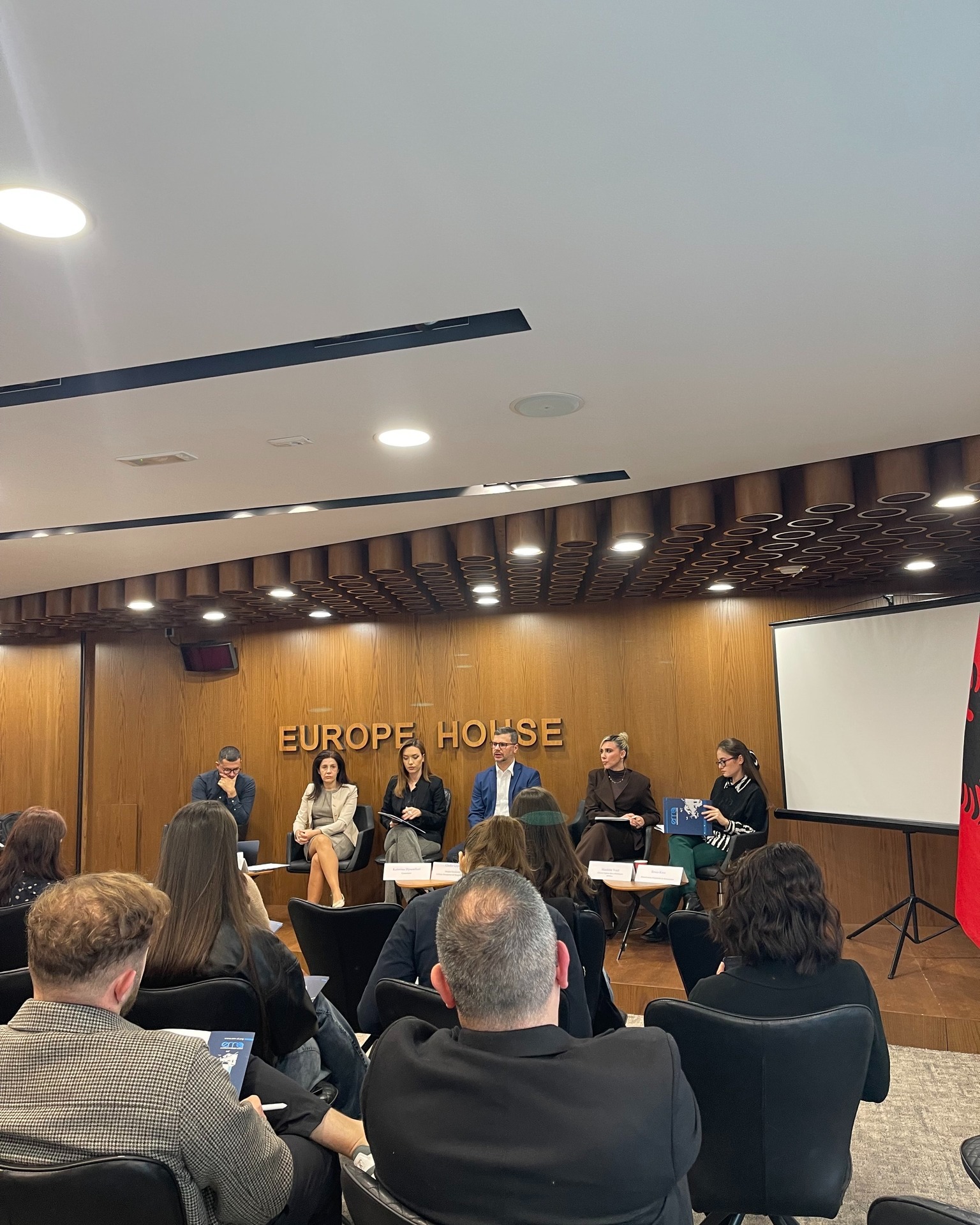 The discussion forum, organised by the European Movement in Albania (EMA) on 22 December 2025, under the moderation of journalist Katerina Hysenllari, focused on topics related to issues under Chapters 23 and 24 of the EU acquis, drawing inspiration from articles published in the Albanian Law Journal (ALJ).
In his introductory remarks, Gledis Gjipali, Executive Director of the European Movement in Albania (EMA), emphasized that such forums bring closer not only the authors of the journal, but also other civil society actors and interest groups, around issues that affect us in our daily lives.
Dr. Irene Dule, Lawyer & Expert at the “Res Publica” Center, author of the article “Strategies – The Repetition Syndrome: Why the HJC’s strategy risks turning into a repetition of planning failure, while increasing judicial effectiveness is today a national emergency?”, addressed the High Judicial Council’s National Strategy for Reducing the Number of Backlogged Cases (2024–2027). She stressed that the strategy is based on unrealistic quantitative projections for productivity increases (50–80%), without a verifiable methodological basis, without an assessment of previous failures, and with generalized statistical indicators that conceal the real burden of old cases. She also noted that the justice reform has produced a deep functional crisis, caused by massive vacancies resulting from the vetting process, the lack of a transitional architecture, and the 2023 judicial map reform, which centralized appeals in Tirana without an impact assessment, creating a “funnel bottleneck” and thousands of pending cases with delays of up to 14.6 years.
Haxhire Vezi, Legal and Policy Officer at PPNEA, author of the article “Alignment with the GDPR and the challenges of implementing the new law on personal data protection in Albania”, stated that the new Law No. 124/2024 “On the Protection of Personal Data,” which entered into force on 1 February 2025, marks a historic turning point for Albania by fully aligning domestic legislation with the EU’s General Data Protection Regulation (GDPR). This law introduces several fundamental innovations, starting with the strengthening of individuals’ rights to control their personal data, in particular the “right to be forgotten,” which gives individuals control over their digital data by allowing the deletion of inaccurate or irrelevant information. However, the success of this reform will depend on strengthening the capacities of the Office of the Commissioner for the Right to Information and the Protection of Personal Data, continuous public education, and close cooperation with the EU in order to transform privacy protection from a formal norm into a sustainable institutional culture.
Vilson Blloshmi, Project Coordinator & Researcher at the Albanian Institute for International Studies (AIIS), author of the article “The new cannabis law: Opportunities, risks, and reflections from European practices”, analysed the challenges of legalising medical and industrial cannabis in Albania, focusing on the importance of traceability “from seed to sale” as a condition for alignment with EU standards. Blloshmi highlighted the high risks of diversion of legal products into criminal markets, citing regulatory failures in Portugal, as well as in the region, such as Serbia and North Macedonia. In Albania, the process is overseen by the company “ALBTrace Co,” while the 10 cadastral zones approved for cultivation are intended to be far from populated areas and protected zones in order to ensure security. In conclusion, he drew attention to the fact that, as also mentioned in the key recommendations of the European Commission’s 2025 Report, strengthening supervisory capacities, transparency regarding beneficial owners, and strict anti–money laundering controls are necessary to safeguard the integrity of the system.
Ilenia Kaso, Project Coordinator & Researcher, author of the article “Albania’s progress on EU acquis chapter 24: Strengthening police cooperation and the role of European law enforcement agencies in the region”, emphasized that cooperation with European agencies such as Europol, Eurojust, and Frontex plays a critical role in strengthening enforcement capacities and border security. Since the signing of the cooperation agreement in December 2013, Albania and Europol have established a strong partnership to combat serious international crime, drug trafficking, and terrorism. Operational agreements with these institutions enable real-time intelligence sharing through secure networks such as SIENA. In conclusion, the continuation of rule of law reforms and international cooperation are essential for Albania to contribute to the European security architecture.
Participants engaged in discussions on justice reform, emphasizing the need to increase admission quotas at the School of Magistrates in order to fill vacancies in the judicial system. The necessity of clearly defining what constitutes personal data and preventing their abuse by other parties for purposes beyond information was also addressed. Discussions further included the expansion of Albania’s cooperation with other agencies, with the aim of increasing interoperability on issues related to Chapter 24, as well as the need for transparency in identifying beneficial owners within the framework of the cannabis law in the country.
*This discussion forum took place within the framework of the “Building Partnership on Fundamentals: Empowered CSOs in the EU accession process” project, with the financial support of the European Union – IPA Civil Society Facility 2021, which is implemented by the European Movement in Albania and in cooperation with the Academy of European Integration and Negotiations (AIEN), Slovak Foreign Policy Association (SFPA) and the Center for Transparency and Freedom of Information (CTFI).
-
 Green Line Roundtable for Chapter 12 – The addressing of the recommendations of the European Commission Report 2025 regarding the field of food safety and the challenges related to fulfilling commitments within the framework of the negotiation process in Cluster 5 ‘Resources, Agriculture, Cohesion’ / Chapter 12, February 4, 2026
Food safety was the focus of the roundtable held by the European Movement in
Green Line Roundtable for Chapter 12 – The addressing of the recommendations of the European Commission Report 2025 regarding the field of food safety and the challenges related to fulfilling commitments within the framework of the negotiation process in Cluster 5 ‘Resources, Agriculture, Cohesion’ / Chapter 12, February 4, 2026
Food safety was the focus of the roundtable held by the European Movement in -
 Working Group for Chapter 24 – Strengthening Albania’s Response to Cybercrime and Child Online Protection: Legan Alignmenet and Institutional Capacities, 15 January 2026
Cybercrime and the protection of children online was the topic of the Working Group
Working Group for Chapter 24 – Strengthening Albania’s Response to Cybercrime and Child Online Protection: Legan Alignmenet and Institutional Capacities, 15 January 2026
Cybercrime and the protection of children online was the topic of the Working Group