


Plenary Session of the National Convention for European Integration, 19 November 2025
 The National Council for European Integration (NCEI), in cooperation with the European Movement in Albania (EMA), held the final panel of the Plenary Session within the framework of the National Convention on European Integration, in order to discuss the recommendations emerging from the other technical panels of the Plenary Session at parliamentary level, with the participation of Members of Parliament, public institutions, academia and civil society, on the alignment of Albania’s human rights framework with EU standards. The discussion placed particular emphasis on human rights, the rule of law and institutional accountability.
 The event was opened by Taulant Balla, Vice-Chair of the National Council for European Integration, who, after welcoming the participants, underlined the importance of the meeting at a decisive moment in the country’s European integration process, as Albania has now officially opened all negotiating clusters with the European Union. Balla stressed that what was once perceived as a distant ambition has now become a concrete working reality, with Albania having opened all clusters within a single year, thus becoming one of the countries with the fastest pace of negotiations in the history of EU enlargement. According to Balla, this represents evidence not only of the work and determination of institutions, but above all of the extraordinary support of Albanian citizens, as over 90% of them view the country’s future within the European Union. Balla emphasised that at the core of the transformative process accompanying integration lie human rights, which, in his view, are not merely standards to be met in order to fulfil EU criteria, but the very foundation of the democratic state. Referring to the European Commission’s 2025 Report on Albania and the Rule of Law Report, Balla highlighted that the country has made tangible progress and noted that Parliament has played, and will continue to play, a significant role in the integration process. Addressing the measures undertaken, Balla mentioned the establishment of two permanent parliamentary committees tasked with advancing and protecting human rights, as well as the continuous oversight of independent institutions to ensure the implementation of Parliament’s recommendations and the fulfilment of obligations within the integration process. He also referred to the recently adopted law on gender equality and to the initiative undertaken by the Committee on Human Rights and Public Information Means to protect journalists’ rights and media independence. This committee has established a working group with domestic and international experts from the Council of Europe to draft the legislative media package. Balla further informed that Parliament has entered the final phase of the procedures for the appointment of the Ombudsman and the Commissioner for Protection from Discrimination, two key institutions within the human rights architecture. In conclusion, Balla stressed that integration is a transformative process for society as a whole, requiring broad dialogue and the widest possible involvement of citizens in understanding integration-related reforms.
 The meeting was then greeted by Gledis Gjipali, Coordinator of the National Convention on European Integration in Albania / Executive Director of the European Movement in Albania (EMA), who commended the long-standing cooperation with the NCEI in addressing specific and sensitive issues for Albanian society and the transformative path that the process will bring. Emphasising the role of civil society in conveying concerns and proposals from various stakeholders to the key institutions involved in the European integration process, Gjipali praised Parliament’s work in establishing an interactive public consultation platform. In conclusion, he underlined the importance of strengthening cooperation and engagement in the process also on the part of civil society, in order to ensure inclusiveness and to extend decision-making to interest groups with the appropriate potential to contribute.
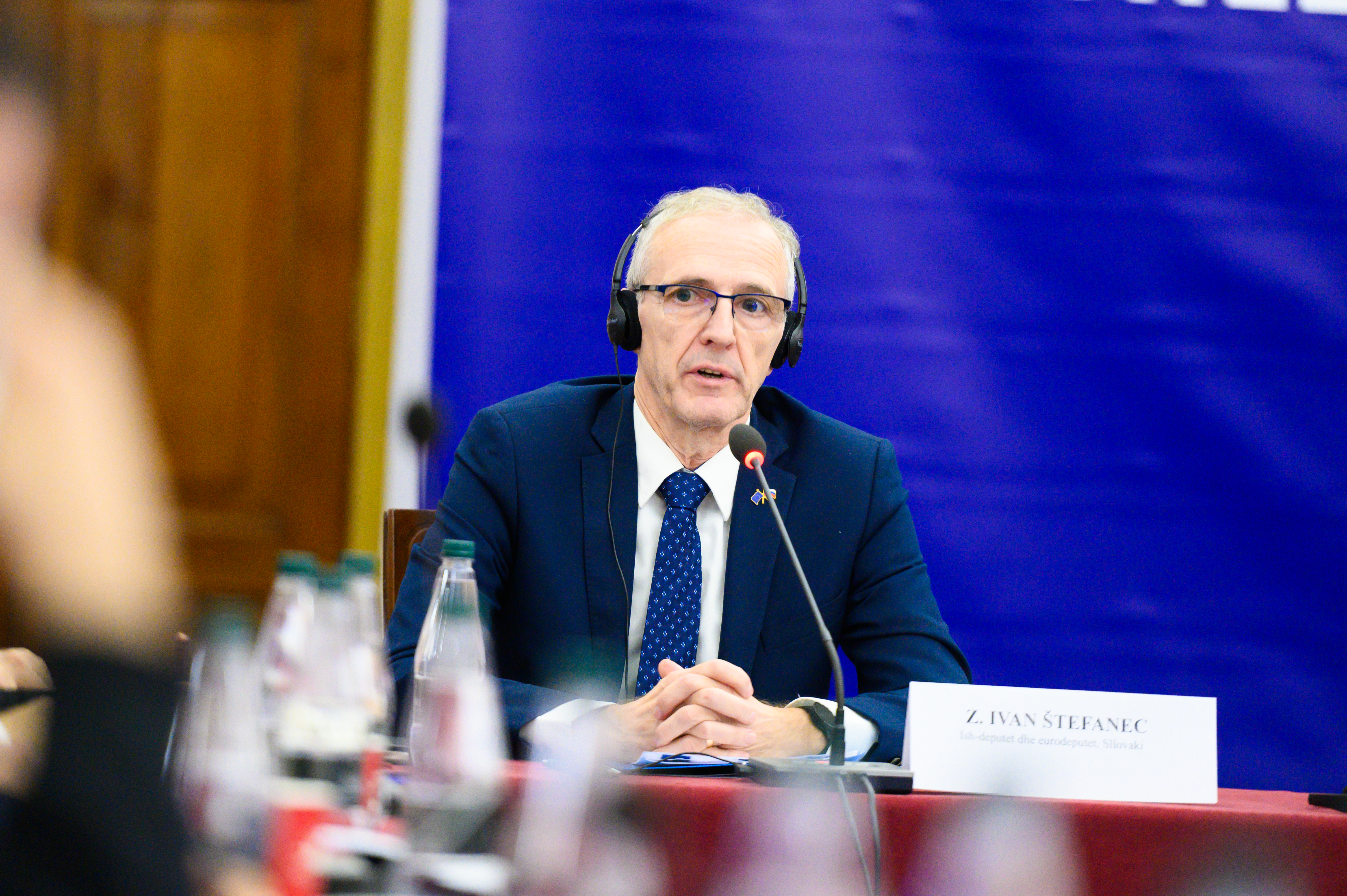 The meeting was also greeted by Ivan Štefanec, former Slovak MP and Member of the European Parliament, who praised the progress made by Albania and emphasised the importance of the support of Albanian citizens in envisioning the country’s future within the European Union. Štefanec highlighted the importance of strengthening the role of Parliament in monitoring the negotiation process and the work of the government, as well as in advancing the process. While acknowledging the achievements of the Justice Reform and the initiative to establish the first virtual government portfolio enabled by artificial intelligence, which will be responsible for all public procurement, Štefanec stressed that, despite the impressive achievements attained, continued attention must be paid to judicial independence, respect for human rights, media freedom, ensuring access for all citizens to online services, strengthening accountability and guaranteeing institutional transparency.
 In the second part of the meeting, Nirvana Deliu, Project Director at the European Movement in Albania (EMA), presented several recommendations arising from consultations with civil society and experts on human rights issues, such as addressing the problem of bullying in online media and the need for improved budgeting of independent institutions to strengthen human resources capacities, among others. Deliu assessed that the recommendations and proposals emerging from the Convention may help enhance the role of Parliament and the NCEI in advancing reforms that ensure inclusion, transparency and democratic sustainability.
The event concluded with questions and open discussions among the participants.
-
 Green Line Roundtable for Chapter 12 – The addressing of the recommendations of the European Commission Report 2025 regarding the field of food safety and the challenges related to fulfilling commitments within the framework of the negotiation process in Cluster 5 ‘Resources, Agriculture, Cohesion’ / Chapter 12, February 4, 2026
Food safety was the focus of the roundtable held by the European Movement in
Green Line Roundtable for Chapter 12 – The addressing of the recommendations of the European Commission Report 2025 regarding the field of food safety and the challenges related to fulfilling commitments within the framework of the negotiation process in Cluster 5 ‘Resources, Agriculture, Cohesion’ / Chapter 12, February 4, 2026
Food safety was the focus of the roundtable held by the European Movement in -
 Working Group for Chapter 24 – Strengthening Albania’s Response to Cybercrime and Child Online Protection: Legan Alignmenet and Institutional Capacities, 15 January 2026
Cybercrime and the protection of children online was the topic of the Working Group
Working Group for Chapter 24 – Strengthening Albania’s Response to Cybercrime and Child Online Protection: Legan Alignmenet and Institutional Capacities, 15 January 2026
Cybercrime and the protection of children online was the topic of the Working Group