


Working Group for Chapter 5 – Public Procurement: Update on the current status of meeting the closing benchmarks and the use of Artificial Intelligence (AI) in the public procurement system, 18 June 2026
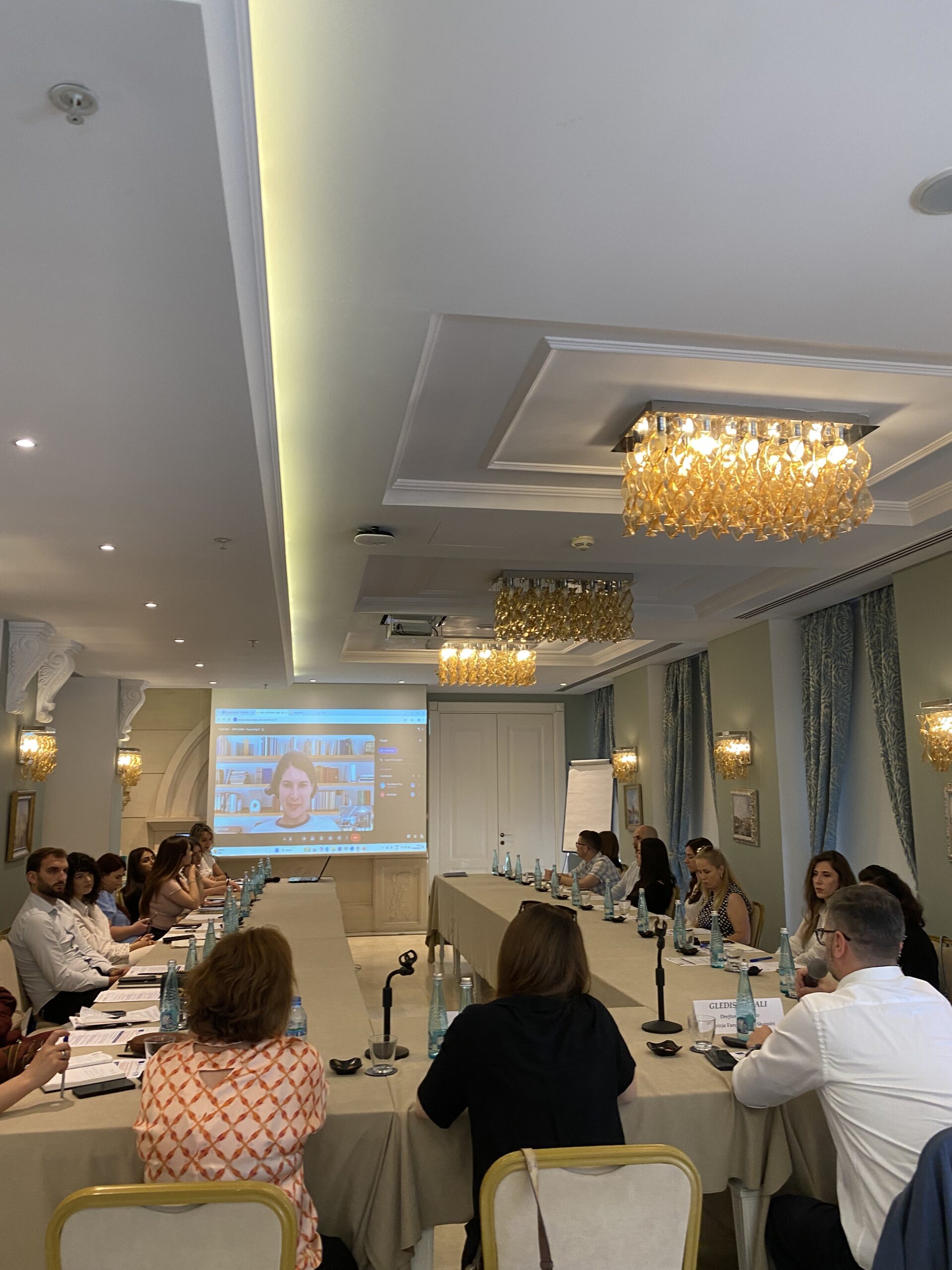 The European Movement in Albania (EMA), in cooperation with the Public Procurement Agency, organised a Discussion and Consultation Roundtable on 18 June 2026 for Chapter 5 – Public Procurement, focusing on the fulfillment of the chapter’s closing benchmarks, the current state of the process, and the use of artificial intelligence in the public procurement system. The event was held within the framework of the Partnership Platform for European Integration (PPIE) and the National Convention for European Integration for this chapter.
In his opening remarks, Mr. Gledis Gjipali, Executive Director of the European Movement in Albania (EMA), emphasized the importance of organising such roundtables as concrete mechanisms for strengthening the involvement of civil society actors in the European integration process and in monitoring sectoral reforms. He underlined that the value of these platforms lies in creating spaces for inter-institutional dialogue and contributing directly to policymaking through the development of policy papers and practical recommendations that support the alignment of Albanian legislation with the EU acquis and European standards. For this reason, he stressed that such roundtables should be organized systematically, involving not only civil society organizations but also public institutions, the business community, field experts, and stakeholder groups directly affected by reforms. Referring specifically to Chapter 5 – Public Procurement, he noted that this is one of the chapters with direct economic and institutional impact, where legal and procedural changes affect economic operators and the overall business environment, particularly in how they participate in procurement procedures, adapt to regulatory requirements, and compete on equal terms.
In a presentation delivered by Ms. Xhoana Ristani, Director of the Directorate for Strategic Policy Implementation and Integration at the Public Procurement Agency, Albania’s progress in fulfilling the closing benchmarks for Chapter 5 – Public Procurement was presented as part of the EU accession negotiation process. The presentation focused on harmonising the national legal framework with the EU acquis and strengthening institutional mechanisms that ensure the effective implementation of public procurement legislation. It was emphasized that establishing a functional, transparent, and sustainable public procurement system is essential based on the principles governing its operation. Regarding legislative alignment, it was announced that the process of amending Law No. 162/2020 “On Public Procurement” has begun. The draft amendments are being finalised in consultation with SIGMA and are expected to undergo public consultation before being submitted to the European Commission. It was also highlighted that the adoption of Law No. 88, dated 12 December 2025, “On Concessions and Public-Private Partnerships” represents an important step toward further alignment with European standards in this sector. At the same time, work is continuing on amendments to Law No. 36/2020 on procurement in the field of defence and security. Following comments from the European Commission and the incorporation of SIGMA’s recommendations, the draft is expected to be finalized by July 2026. At the secondary legislation level, the adoption of acts regulating the monetary thresholds for procurement procedures and updating the Common Procurement Vocabulary was reported. In parallel, implementing acts for concessions and PPPs are advancing, including rules governing the evaluation, award, amendment, transfer, and invalidity of the respective contracts.
Regarding administrative and institutional capacities, Ms. Ristani emphasized that the European Commission has requested detailed information on the implementation capacity of Albania’s public procurement system. To this end, a dedicated report on the current state of capacities has been prepared. A key priority is the professionalization of the procurement administration through continuous training and certification of officials from contracting authorities. In cooperation with ASPA, the Public Procurement Agency has continued organizing professional training and testing programs, and it was reported that the total number of certified officials has reached 904. She also presented the future establishment of a new institution responsible for concessions and public-private partnerships, in accordance with Law No. 88/2025, which is expected to be accompanied by a needs assessment and new training programs for the responsible structures.
Ms. Ristani then addressed the closing benchmark related to demonstrating the operation of a fair, transparent, and corruption-resistant public procurement system. In this context, the preparation of a statistical report covering the performance of the public procurement system, defence and security procurement procedures, administrative appeals, and corruption cases for the period 2022–2025 was highlighted. The completion and publication of a methodology for assessing corruption risk in public procurement was also presented, while the Public Procurement Agency continues working on its practical implementation both at the macro level, based on data from the Electronic Procurement System, and at the micro level through a pilot process with the Centralized Purchasing Operator. Another preventive instrument presented was the development of a model integrity plan for contracting authorities and contracting entities, in cooperation with relevant institutions. In conclusion, future challenges were identified as the completion of legal reforms, continued professionalization of the system, operationalization of the new PPP institution, and Albania’s advancement toward accession to the WTO Government Procurement Agreement (GPA).
Regarding the use of Artificial Intelligence (AI) in the public procurement system, the evolution of Albania’s procurement system toward a fully digitalised model and its new orientation toward integrating AI functions into procurement administration was presented. Ms. Ristani emphasized that Albania has begun institutionalizing the use of AI in public procurement through amendments to the Public Procurement Law adopted under Law No. 16/2024, which entered into force on 20 March 2024. It was explained that this amendment established the legal basis for the use of AI functions in procurement procedures. At the same time, an interinstitutional working group led by the National Agency for Information Society (AKSHI) finalized and approved the Terms of Reference for the procurement of the new electronic procurement system, a document that has also received approval from the World Bank. The presentation then outlined the specific processes where AI integration is planned. AI functions are expected to be used in calculating estimated contract values, drafting technical specifications, evaluating bids, operating the Dynamic Purchasing System and electronic auctions, managing complaints electronically, and contract management. In the concluding remarks, Ms. Ristani discussed the challenges and objectives accompanying this technological transformation. She stressed the need to balance the use of AI with compliance with procedural and legal requirements under public procurement legislation, as well as the difficulties associated with accurately evaluating contracts when similar practices or historical data are lacking. It was also noted that modernization requires interoperability with other public systems, integration of green procurement criteria, the creation of mechanisms for identifying potential corruption cases (“red flags”), harmonization with EU standard forms, and publication in TED (Tenders Electronic Daily). Finally, she underlined that a key element for the success of this process remains strengthening institutional and human capacities to effectively understand and manage technological developments in public procurement.
Ms. Alba Brojka, Digital Policy Analyst and author of the policy paper “AI in Public Procurement in Albania: A Roadmap for Balanced Innovation in Public Policies,” published by EMA, presented an analysis of the transformative potential of AI in public administration, as well as the institutional, legal, and technical limitations that must be addressed before its full implementation. At the beginning of her presentation, she emphasized that Albania is positioned as one of the most advanced countries in the region in terms of public service digitalization, with approximately 95% of public services delivered electronically through the e-Albania platform. However, she argued that the pace of adoption of new technologies, including AI, has advanced faster than the development of the necessary legal, institutional, and technical framework required for their governance. In this context, she referred to the announcement of “Minister Diella,” presented as the world’s first AI-generated minister with supervisory functions in public procurement, as an illustration of both the ambition for modernization and the need for caution in institutionalising such developments.
During the presentation, Ms. Brojka argued that AI can bring benefits to public procurement only if supported by several fundamental conditions. She identified five elements that must exist simultaneously: a functional regulatory framework; reliable and unbiased data; transparent processes; t rained personnel; and continuous human oversight. She emphasized that, in the absence of these mechanisms, AI does not automatically eliminate corruption or discrimination but may instead reproduce and legitimize existing systemic problems. Ms. Brojka then analysed where AI is currently used throughout the procurement cycle. Referring to OECD data for 2025, she explained that most international AI applications are concentrated in the preliminary stages of procurement procedures and much less in post-award contract monitoring. AI is most commonly used in drafting tender requirements, categorizing and analyzing expenditures, updating legal information in real time, automating compliance checks of bids, and identifying irregularities. In this context, she argued that the legal amendments adopted in Albania during 2024 primarily aim to increase administrative efficiency in these early stages rather than create new public oversight mechanisms.
A central part of the presentation focused on the risks associated with AI use in public procurement. Three critical areas were identified: data quality; algorithmic transparency; and monitoring mechanisms. It was emphasized that if systems are trained on distorted historical data or data influenced by problematic practices, they may continuously favour the same economic operators and institutionalize existing biases. She also argued that public institutions should use only understandable and auditable models, ensuring that automated decision-making remains explainable to citizens and economic operators. Another important element highlighted was the need to build internal institutional capacities for monitoring algorithms and controlling their outputs while preserving human decision-making authority. Placing the discussion within the European context, Ms. Brojka stressed the importance of alignment with the EU AI Act, which follows a risk-based approach. She explained that, as an EU candidate country, Albania will need to gradually harmonize its acquis in the field of AI and develop the capacity to implement it. It was noted that AI systems affecting access to public services are considered high-risk systems and are therefore subject to stricter transparency and oversight requirements. Furthermore, it was emphasized that in public procurement, AI implementation will be assessed not only under AI legislation but also under European public procurement rules.
In the section analysing the Albanian situation, the policy paper argues that the ambition to use AI in public procurement has currently progressed faster than the development of the foundations necessary to ensure its safe and responsible use. It was noted that Albania still lacks an approved National AI Strategy, that institutions have limited capacity to monitor and audit algorithms, and that historical procurement data remain incomplete and partially undigitised. In this context, it was explained that the amendments to Law No. 162/2020 allow the use of AI in several stages of the procurement cycle—including drafting tender documents, dynamic purchasing systems, electronic complaint handling, and contract implementation monitoring—but do not specify in detail the type of technology to be used, the methodology, institutional responsibilities, or personal data protection measures. In conclusion, Ms. Brojka presented a series of recommendations to ensure a balanced approach to innovation in public policy. She stressed that AI should not be expanded into public decision-making before a functional regulatory framework is established. Therefore, she recommended adopting a National AI Strategy; auditing the quality of existing data; developing protocols for data management and storage; training Public Procurement Agency staff; continuously monitoring system performance; and maintaining transparent communication with the public regarding the methods, purposes, and limitations of AI use in public administration.
*This roundtable took place within the framework of the “Building Partnership on Fundamentals: Empowered CSOs in the EU accession process” project, with the financial support of the European Union – IPA Civil Society Facility 2021, which is implemented by the European Movement in Albania and in cooperation with the Academy of European Integration and Negotiations (AIEN), Slovak Foreign Policy Association (SFPA) and the Center for Transparency and Freedom of Information (CTFI).
-
 Working Group on Chapter 23 – Digital Services in Albania within the framework of the accession negotiations – DSA Governance, Fundamental Rights, and Institutional Coordination, 30 June 2026
Gledis Gjipali, Executive Director of the European Movement in Albania (EMA), emphasised the importance
Working Group on Chapter 23 – Digital Services in Albania within the framework of the accession negotiations – DSA Governance, Fundamental Rights, and Institutional Coordination, 30 June 2026
Gledis Gjipali, Executive Director of the European Movement in Albania (EMA), emphasised the importance -
 Info Session – Access to Justice, Judicial Digitalisation, and Security Policies within Chapters 23 and 24, June 29, 2026
The European Movement in Albania (EMA) organised an info session as part of its
Info Session – Access to Justice, Judicial Digitalisation, and Security Policies within Chapters 23 and 24, June 29, 2026
The European Movement in Albania (EMA) organised an info session as part of its