


Training session on local government in Vlora
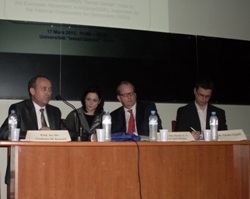 In the framework of NED funded project “Strengthening participatory democracy and demand for institutional accountability from youth in Albania”, EMA organized on July 5th, 2012 a training session at the premises of the EU Info Center, Vlore. Despite providing students with a general background information on how the local government works, this training session served as a preparatory step to better orient and structure the debate that students will develop during the TV forum, which will be organized in one of the most popular local media.
Mrs. Baisa Sefa, Junior policy researcher at EMA, who unfailingly answered questions during and after the session, introduced students to:
- The structure of local governance in Albania — under which the legal framework, the functions, and the decision-making bodies of local government were outlined.
- The correlation between central and local government — where the prefect plays an intermediate role between them. The legal framework that underlines the powers and the role of the prefect were also in the focus of that part of the training.
- Mechanisms of participatory democracy in local government— where the attention was concentrated on local government elections as a direct form of participation in decision making, under which the city council plays a relating bridge between local government and public.
- The right to be inform as a regulatory instrument —between citizen and local government, provided by the law on the right to information for official document.
The training session was followed by an open discussion on the issues that the students had faced during their internship in the different directorates within the Vlora Municipality. Also among different problems that Vlora is facing, students have picked up to further elaborated during the TV forum the issue of tourism, a very controversial and sensitive matter for the local public opinion.
-
 Working Group on Chapter 23 – Digital Services in Albania within the framework of the accession negotiations – DSA Governance, Fundamental Rights, and Institutional Coordination, 30 June 2026
Gledis Gjipali, Executive Director of the European Movement in Albania (EMA), emphasised the importance
Working Group on Chapter 23 – Digital Services in Albania within the framework of the accession negotiations – DSA Governance, Fundamental Rights, and Institutional Coordination, 30 June 2026
Gledis Gjipali, Executive Director of the European Movement in Albania (EMA), emphasised the importance -
 Info Session – Access to Justice, Judicial Digitalisation, and Security Policies within Chapters 23 and 24, June 29, 2026
The European Movement in Albania (EMA) organised an info session as part of its
Info Session – Access to Justice, Judicial Digitalisation, and Security Policies within Chapters 23 and 24, June 29, 2026
The European Movement in Albania (EMA) organised an info session as part of its