


Working Group for Chapter 23 – Regulation of Lobbying in Albania: Strengthening Transparency, Implementation Challenges, and Alignment with European Standards, 22 May 2026
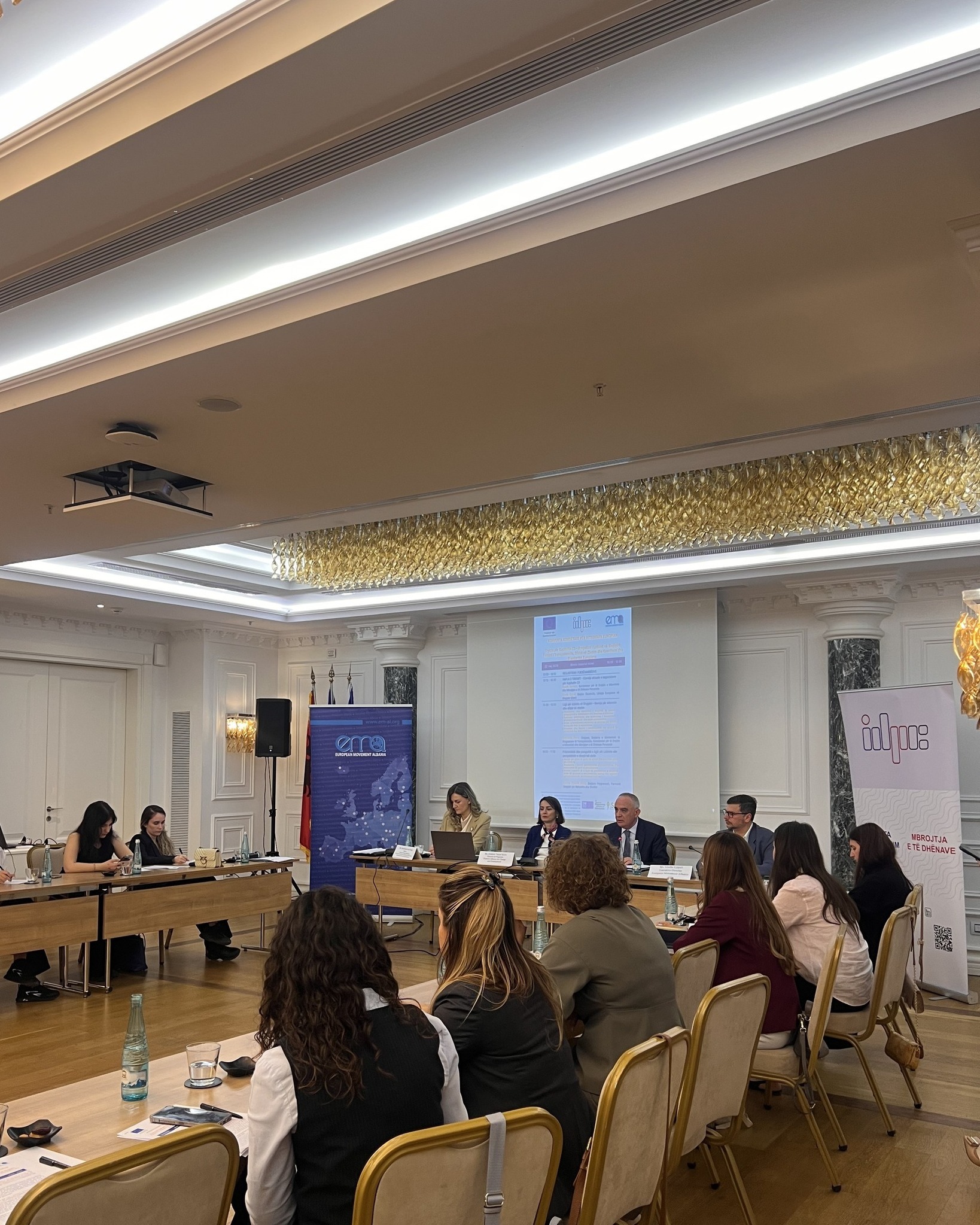 On May 22, 2026, the first institutional roundtable on the implementation of Law No. 12/2026 “On Lobbying in the Republic of Albania” was held, organised by the European Movement in Albania (EMA) and the Commissioner for the Right to Information and Protection of Personal Data. The meeting took place within the framework of the Working Group for Chapter 23 – Judiciary and Fundamental Rights, part of the National Convention on European Integration, with the support of the European Union. Representatives from various sectors participated in the roundtable, including civil society, academia, public administration, local government, and others.
Mr. Gledis Gjipali, Executive Director of the European Movement in Albania (EMA), emphasized in his opening remarks the importance of implementing the law rather than merely drafting it. According to Mr. Gjipali, this newly adopted law is extensive, and for this reason, the meeting would serve to inform stakeholders about the next steps in its implementation. The adoption of the law is accompanied by challenges and issues, mainly related to civil society advocacy and distinguishing it from lobbying. He also stressed that the implementation of this law requires new administrative capacities, as well as increased public and institutional awareness.
Mr. Besnik Dervishi, Commissioner for the Right to Information and Protection of Personal Data, underlined in his speech that although the law has been adopted in line with the standards of the Council of Europe and the OECD, institutions are still in the process of studying and analysing it. Furthermore, Mr. Dervishi stressed that lobbying should be regulated according to clear enforcement standards affecting transparency and public ethics. According to him, the law aims to ensure the alignment of private interests with the public interest and to regulate interaction with high levels of decision-making. He emphasized that the law requires strong standards of institutional integrity, since it will also apply to the involvement of senior public officials in lobbying activities. Mr. Dervishi explained the importance of implementing this law in practice, noting that despite the level of difficulty, there are partners supporting efforts to overcome challenges, and cooperation with civil society is considered important. The Commissioner also announced that the law provides for the creation and publication of a register of lobbyists, which will be accessible to the public. However, he added that the law should be viewed not only from a substantive perspective but also from a structural, organizational, and budgetary one, as it requires significant human and financial resources for effective implementation. Mr. Dervishi’s position reflects a commitment to fulfilling obligations within deadlines, with the aim of aligning standards and adopting a more European approach.
Ms. Emerlinda Pema, Director of Transparency Program Monitoring at the Office of the Commissioner for the Right to Information and Protection of Personal Data, presented the obligations introduced by the lobbying law following its adoption by Parliament on January 28, 2026, and its publication on February 16, 2026. Among other objectives, the law seeks to guarantee transparency, integrity, accountability, and effective oversight of lobbying within the framework of the EU accession negotiation process, as part of the Roadmap for the Rule of Law and Cluster I – Fundamentals. During her presentation, she highlighted several key articles of the law, clarifying the basic definitions provided in Article 4 in order to understand what is considered lobbying and what is not, as well as other terms such as “beneficiary,” “public official,” and “structured lobbying relationship.” She explained that activities such as requests for access to information, open and transparent participation in public consultation processes, publication of articles or opinions in the media, communication between political parties or between institutions, as well as independent educational, academic, or research activities, are not considered lobbying. She further focused on the obligations of the Commissioner’s Office, which, in addition to reviewing applications for registration as lobbyists under the legislation, will administer and publish the lobbying register, organize informational sessions, and monitor the implementation of the law. She noted that for the latter, seven bylaws still need to be adopted, one of the most complex of which concerns the management of conflict-of-interest situations. According to Ms. Pema, the instrument guaranteeing transparency is the lobbying register, an electronic database in which data updates must be carried out regularly, within five working days from the submission date of the relevant documentation to the Commissioner’s Office. This data will be maintained and administered by the Commissioner’s Office and simultaneously published on its official website, in accordance with the principles of transparency and personal data protection. Ms. Pema also placed particular emphasis on Article 5 regarding the mandatory conditions and criteria that natural or legal persons must meet in order to conduct lobbying activities. This article provides prohibitions on lobbying activities, particularly for persons convicted of criminal offenses, entities with tax or financial problems, and those failing to comply with reporting and transparency obligations. Regarding the main challenges, she mentioned the need for interinstitutional cooperation with other authorities involved in the process, securing the necessary funding, and the need for at least eight dedicated employees to monitor and enforce the law.
Ms. Klodiana (Tavani) Kosta, Program Director at Partners Albania for Change and Development, assessed that the drafting of the Law “On Lobbying” is an important development for strengthening transparency, accountability, and ensuring integrity in public decision-making. She stressed that the law reflected many of the recommendations gathered through various consultation roundtables and meetings, but that several other points still require broader discussion. She raised specific concerns regarding the way the law defines and extends its scope of application. According to her, the problem lies in the fact that the current definition of lobbying is overly broad and fails to make the necessary distinction between advocacy activities of nonprofit organizations acting in the interest of citizens and lobbying serving private interests. This overlap, she emphasized, risks imposing bureaucratic burdens on civil society and, above all, weakening its role as a legitimate voice in decision-making. She also highlighted the need for reasonable deadlines for reporting obligations by public officials, which should not serve as obstacles discouraging public officials from maintaining contact and communication with lobbyists or civil society actors. Another important element to consider, according to Ms. Kosta, concerns sanctions, which are necessary but should remain proportionate depending on the violations and their seriousness.
Michal Piško, Director of Transparency International Slovakia, participated online and presented the European situation regarding lobbying regulation. He noted that only 16 of the 27 EU member states have a dedicated lobbying law. Piško explained that Slovakia still lacks such legislation, which has allowed hidden influence over decision-making without public oversight. He argued that the process should be managed by an independent institution. Referring to Slovakia’s case, he mentioned that it was initially proposed for the Ministry of Interior to perform this function, although there had been advocacy for assigning this role to the whistleblower protection office. Piško also presented international standards for lobbying regulation, according to which a functional system should include a mandatory and public register of lobbyists, a mandatory code of conduct, and publication of the “lobbying footprint,” meaning information about who is carrying out lobbying activities, on whose behalf, and regarding which issue. From European practices, he cited the example of the Czech Republic, which adopted its lobbying law in July 2025 as part of its Recovery Plan. After eight months of implementation, the Czech register counted 621 lobbyists and 2,310 public officials involved in lobbying processes. Nevertheless, he also highlighted weaknesses in this model, such as oversight by a politically led ministry and the lack of strong lobbying footprints. Piško warned that the way the law is designed is crucial to its effectiveness. He referred to Poland as an example where a very narrow definition of lobbying resulted in the registration of only 19 lobbyists, while countries such as Ireland, France, and Germany count thousands of registrations. He also identified several key risks to avoid, including focusing only on lobbyists without imposing obligations on public officials as well, political control over the oversight institution, excessive exemptions, and the use of the law to restrict the activities of nonprofit organizations.
During the discussions held at the roundtable, participants raised issues related to the role of the lobbying oversight institution, including whether it should have proactive and investigative powers, as well as how many EU member states have entrusted this role to an independent institution. The discussion also addressed the time needed for proper preparation of the administration for implementing the law, as well as the importance of transparency in declaring lobbyists’ links with third parties and reporting financial data.
*This WG session for Chapter 23 took place within the framework of the “Building Partnership on Fundamentals: Empowered CSOs in the EU accession process” project, with the financial support of the European Union – IPA Civil Society Facility 2021, which is implemented by the European Movement in Albania and in cooperation with the Academy of European Integration and Negotiations (AIEN), Slovak Foreign Policy Association (SFPA) and the Center for Transparency and Freedom of Information (CTFI).
-
 Information and Discussion Roundtable “Combating corruption at the heart of the European Integration Journey: The Perspectives of Youth, Civil Society, and Academia”, 14 October 2026
The European Movement in Albania (EMA), in cooperation with “Aleksandër Moisiu” University of Durrës
Information and Discussion Roundtable “Combating corruption at the heart of the European Integration Journey: The Perspectives of Youth, Civil Society, and Academia”, 14 October 2026
The European Movement in Albania (EMA), in cooperation with “Aleksandër Moisiu” University of Durrës -
 Working Group on Chapter 23 – Digital Services in Albania within the framework of the accession negotiations – DSA Governance, Fundamental Rights, and Institutional Coordination, 30 June 2026
Gledis Gjipali, Executive Director of the European Movement in Albania (EMA), emphasised the importance
Working Group on Chapter 23 – Digital Services in Albania within the framework of the accession negotiations – DSA Governance, Fundamental Rights, and Institutional Coordination, 30 June 2026
Gledis Gjipali, Executive Director of the European Movement in Albania (EMA), emphasised the importance