


Module 5, School for Consumer Protection and European Integration, “Competition and Public Procurement”, May 27-28, 2022
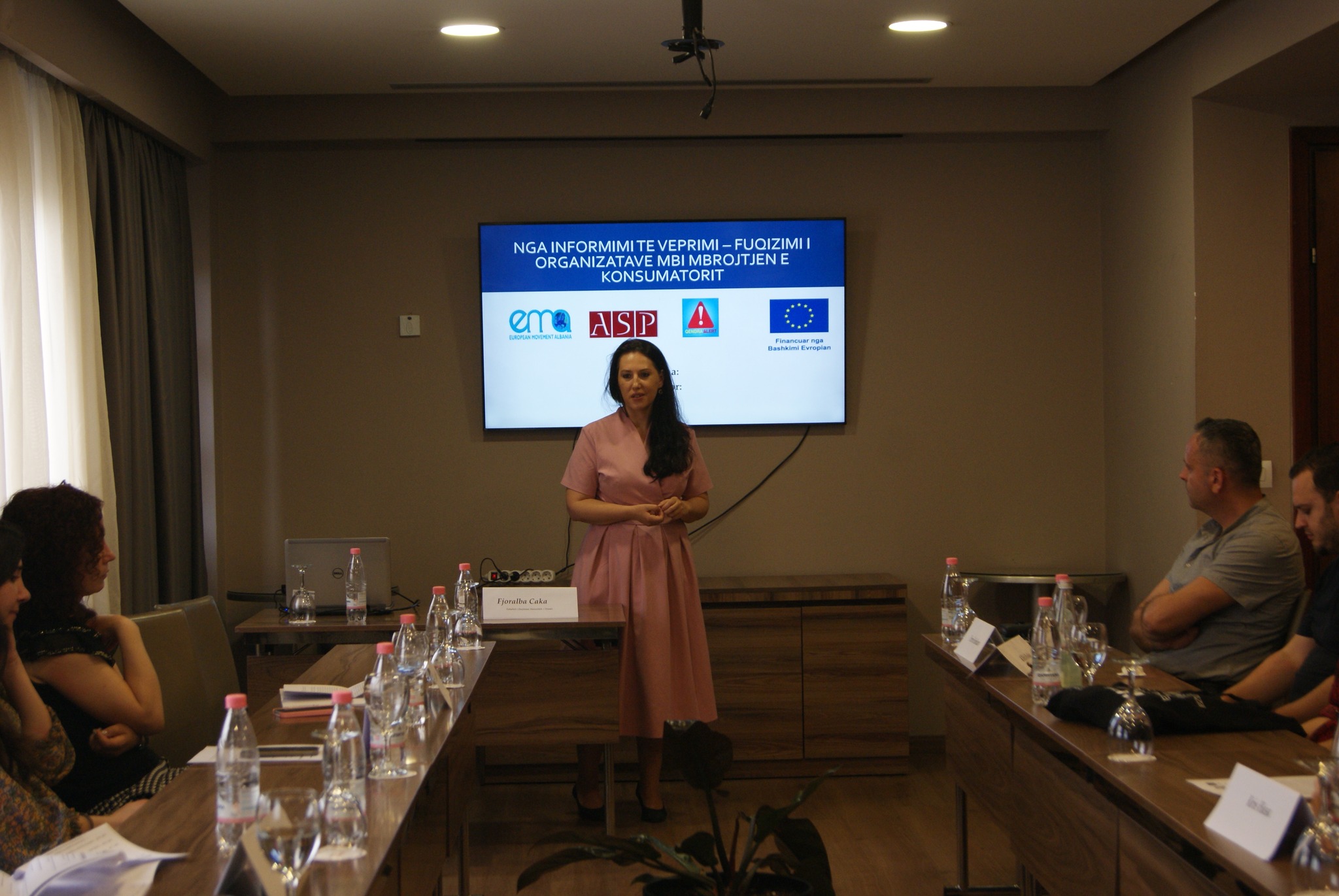 On May 27 and 28, 2022 was held Module 5 of the School for Consumer Protection and European Integration, a component of the project “From Information to Action – Empowerment of Organizations on Consumer Protection”. This project is implemented by European Movement in Albania in cooperation with the Academy of Political Studies and Alert Center, with support of European Union within the IPA 2017 funds. The topic of this module was “Competition and Public Procurement”.
The first session was held by Reida Kashta (Shahollari) from the Public Procurement Agency (PPA). The lecturer began her presentation with a brief history of the public procurement legislation in Albania and how it has evolved during the years. She introduced the participants with the general obligations of Albania to approximate the legislation with the EU Acquis, as well as the institutional framework of the working group focused on Chapter 5. The law 162 / 2020 “On public procurement”, legal acts and recommendations were analyzed in details. Moreover, Kashta discussed the European Commission’s recommendations and the Screening process for this chapter. The session was concluded with an analysis of priorities and challenges for the future, which among other things highlighted the need for approximation of the legal framework, improvement of administrative capacity and the implementation of the National Public Procurement Strategy 2020 -2023.
The second session was held by Aranita Brahaj, Executive Director at the Albanian Institute of Science, who introduced the participants to the “Open Data Albania” project that collects, processes and publishes in reusable formats data given from Albanian public institutions. During this session, the lecturer demonstrated the use of the website through a random search in the Public Procurement section dedicated to the local government. Lastly, the discussion was focused on PP and the database dedicated to the health sector.
Fjoralba Caka, Faculty of Law, University of Tirana was the lecturer of the third session. She provided an overview of the case law of the EU Court of Justice in relation to Articles 101 and 102 of the Treaty on the Functioning of the European Union. The presentation continued with a detailed analysis of agreements that distort the market and free competition. During this session, cartel agreements and the notion of “enterprise” were defined based on EU jurisprudence. Accordingly, ‘’enterprise’’ was defined as any entity that carries out economic activity regardless of its legal status and method of financing. Subsequently, in relation to Article 102 TFEU, the abuse of a dominant position was analyzed, accompanied by cases and considerations from EU practice.
During the fourth session Daniela Laze, Competition Expert introduced the current legal and institutional status of the screening process in relation to Chapter 8. The lecturer discussed the organization, composition and decision-making of the Competition Authority. Laze shared with the participants the data on the number of decisions taken over the years by this authority. From 2021, 94 decisions resulted out of which: 28 prohibited agreements, 8 recommendations, 1 exemption from the agreement, 31 authorizations of concentrations, 16 abuses of dominant position. Furthermore, Laze analysed the legislation, the volume of acts of the EU Acquis on this chapter, as well as the organization of the negotiating group in the field of competition. In the 2021 report, Albania was assessed as having a certain level of preparation/is moderately prepared in competition policy. The session concluded with a discussion on Albania’s challenges during the process of harmonization of competition law underlining that there is no need to change the institutional structure of the Competition Authority, but it is necessary to work with coordination mechanisms.
In the fifth session, Besar Likmeta, Editor-in-Chief- BIRN Albania, reviewed the role of media in identifying and investigating corruption in public procurement. Likmeta shared his experience with the participants, listing the reasons why journalists investigate public procurement and the importance that this process has in increasing transparency, informing the public and fighting corruption. During this session, the need to build databases for research programs, thematic investigations for large procurement programs such as: earthquake reconstruction, alert-based investigations and money-focused investigations was highlighted. The lecturer presented the methodology and types of procurements that are monitored such as contracts with large monetary values, secret contracts and PPP.
Armando Bode, Business Lawyer, held the last session and addressed the impact that competition and public contracts have on the consumer. Bode presented the role and competencies of the Competition Authority and provided practical cases from concession/PPP contracts. He explained two moments of the competition process that affect the state and the consumer: a) the case when irregular competition procedures are followed and b) the case when the exclusive rights are abused. At the end of the presentation, Bode together with the participants analyzed the practical case of the MBM port in Porto Romano, Durrës. Law no. 104/2015 “On the approval of the concession contract in the form of “BOT” (build, operate and transfer) and the decision of the Competition Authority was analyzed.
-
 Working Group on Chapter 23 – Digital Services in Albania within the framework of the accession negotiations – DSA Governance, Fundamental Rights, and Institutional Coordination, 30 June 2026
Gledis Gjipali, Executive Director of the European Movement in Albania (EMA), emphasised the importance
Working Group on Chapter 23 – Digital Services in Albania within the framework of the accession negotiations – DSA Governance, Fundamental Rights, and Institutional Coordination, 30 June 2026
Gledis Gjipali, Executive Director of the European Movement in Albania (EMA), emphasised the importance -
 Info Session – Access to Justice, Judicial Digitalisation, and Security Policies within Chapters 23 and 24, June 29, 2026
The European Movement in Albania (EMA) organised an info session as part of its
Info Session – Access to Justice, Judicial Digitalisation, and Security Policies within Chapters 23 and 24, June 29, 2026
The European Movement in Albania (EMA) organised an info session as part of its