


Info session on the guidelines for monitoring rule of law reforms in the framework of the European integration process and the involvement of civil society, 2 April 2026
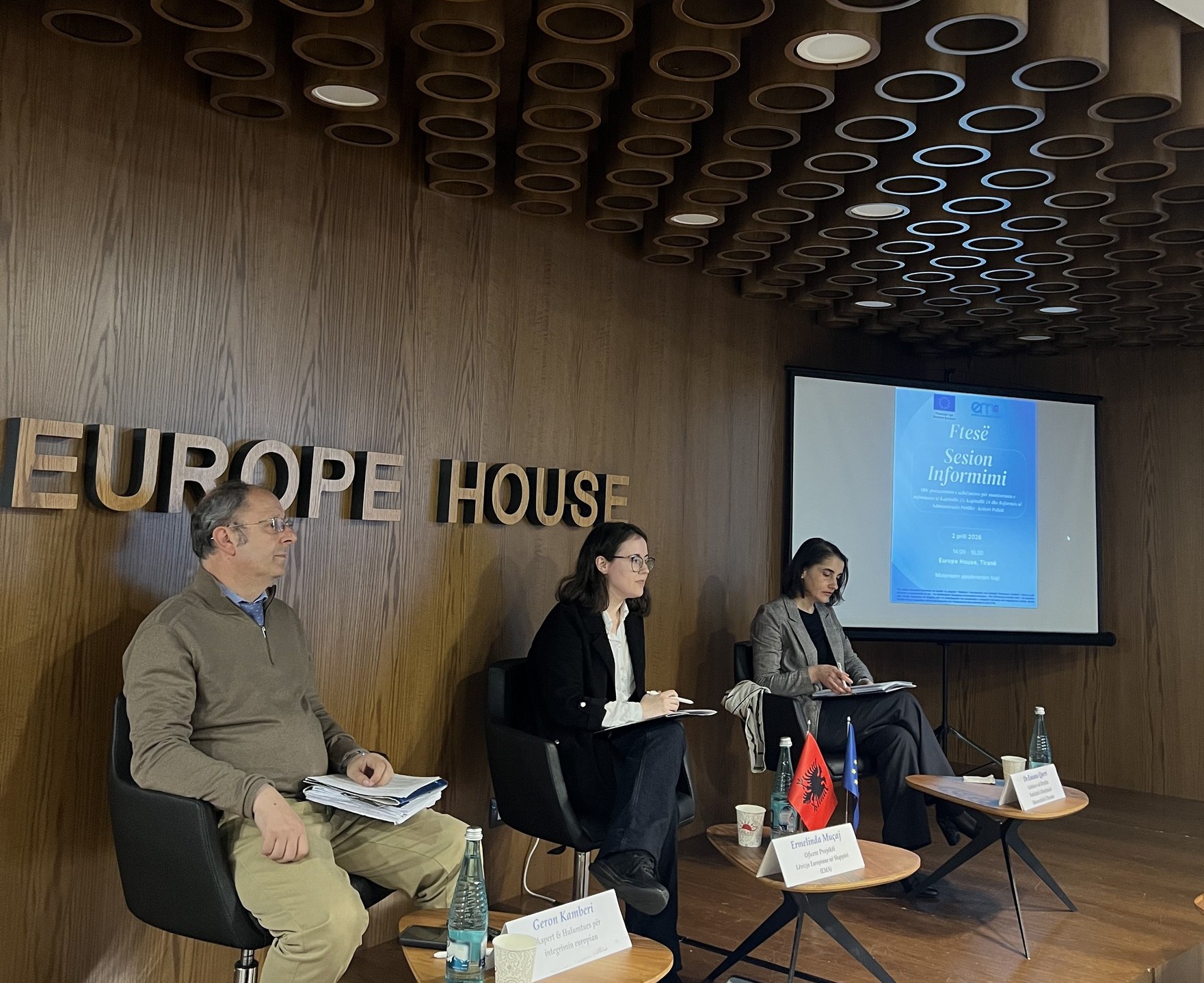 On 2nd of April 2026, The European Movement Albania (EMA) held an info session to present the Monitoring Guidelines for Rule of Law reforms, specifically for Chapter 24 – Justice, Freedom, Security and for the Public Administration Reform – Political Criteria. The invited participants included the authors of these guidelines, and other representatives from civil society, public administration, academia, and various interest groups.
In her opening remarks, Ermelinda Muçaj, Project Officer, EMA, emphasized the methodological and practical importance of monitoring guidelines for Rule of Law reforms. She noted that these guidelines assist civil society and academic representatives continuously monitoring reforms undertaken within the integration process, providing practical examples, such as the RAP Guideline, which draws on analogous cases from the National Strategy for Public Administration Reform 2024-2030. In addition to these two guidelines, three others have also been developed under the project “Building Partnership on Fundamentals: Empowered CSOs for the EU Accession Process”, supported financially by the EU. These include guidelines for Chapter 23 – Judiciary and Fundamental Rights, Functioning of Democratic Institutions, and the Economic Criteria, reflecting the acceleration of the integration process. Currently, the process is at a crucial stage, awaiting the IBAR (Interim Benchmark Assessment Report) for Chapters 23 and 24 from the European Commission, before moving on to subsequent steps.
Geron Kamberi, Expert on European Integration, first presented the importance of Cluster 1– Fundamentals in the integration process, which opens first and closes last, before presenting the guideline for Chapter 24 – Justice, Freedom, Security. He emphasized that since October 2012, with the new Enlargement Strategy, and later on February 5th, 2020, with the introduction of the New Enlargement Methodology, the “fundamentals first” approach has focused on fulfilling rule of law standards. After 15 October 2024, with the opening of negotiations for Cluster 1 – Fundamentals, Albania must be even more prepared to address any issues required by the EU and to meet the standards outlined in the Rule of Law Roadmap , prepared by the Albanian government as opening benchmarks. Once these challenges are addressed, the European Commission decides on the progress of Albania’s EU integration process, but it may also reintroduce benchmarks if corrections are deemed insufficient, as is the case for Chapters 23 and 24. Based on the IBAR report assessment of interim benchmarks, the EU may set closing benchmarks for these chapters. Kamberi further highlighted that EU policies aim for the EU to remain an area of justice, freedom, and security. In this regard, Chapter 24 covers sub-areas such as combating organised crime, human trafficking, judicial cooperation in criminal and civil matters, and asylum and migration policies, where the EU requires administrative capacities. Within the Guideline, Kamberi emphasised that monitoring the strategic and institutional framework is a key element in fulfilling interim benchmarks. The national strategic framework is continuously updated with new strategies, which must meet EU political document standards. Monitoring action plans and updating them with appropriate timelines is particularly important for Chapter 24. Some strategies in this field include the National Migration Strategy 2024-2030, and the Intersectoral Border Management Strategy 2021-2027, among others. Institutional coordination for strategy drafting is carried out by the Institutional Working Groups (GNPIE). Kamberi also highlighted institutional monitoring, involving 19 structures where cooperation is essential, including ministries such as the Ministry of Internal Affairs, the Ministry of Justice, and the Ministry for Europe and Foreign Affairs, as well as independent agencies reporting to Parliament, such as the Audiovisual Media Authority (AMA) and the Institute of Statistics (INSTAT). In this context, the Ministry of Internal Affairs, responsible for this chapter in negotiations, is subject to continuous monitoring by the European Commission at three levels, first in monitoring the implementation of activities; second in monitoring the implementation of sub-area activities under Chapter 24 and third in monitoring the overall delivery of activities. Consequently, civil society representatives using this guideline can focus on building capacity in 1) asset recovery from criminal activity and the establishment of the Asset Recovery Office; 2) combating drugs, including a new mechanism for identifying emerging substances and monitoring the establishment of a National Drugs Observatory; 3) addressing the rise in cyberattacks, including the criminalisation of all forms of online sexual abuse of children and implementation of the new Action Plan against Human Trafficking; 4) careful monitoring of migration policies and implementation of the National Migration Strategy; and lastly, monitoring anti-money laundering, including tracking the systematic use of financial investigations in serious and organised crime cases. Regarding monitoring sectoral strategy indicators for Chapter 24, Kamberi emphasised that deadlines and data related to policy aspects and compliance with integration obligations must be included. Secondly, performance indicators must be identified for each strategic objective in order to measure progress. Thirdly, additional indicators should be considered to track objectives not included in the strategies, and lastly, data sources must be identified and analysed in accordance with the methodology, comparing results with reference values. These sources may include reports from international organisations as well as domestic institutions. Finally, the monitoring report of the strategic document should have a clear structure. Kamberi concluded that, since these reports track the fulfilment of reforms under EU integration, it is important to understand the distinction between membership and integration.
Eniana Qarri, Lecturer of Law, Faculty of Law, University of Tirana, presented the Guideline for Public Administration Reform (RAP), emphasising that the reform meets EU criteria and is both functional and fundamental for the state, as it is directly linked to governance. Since gaps relate to formal compliance versus practical implementation, monitoring is especially important to ensure transparency, accountability, and evidence-based policies, helping to assess whether reforms truly work. Qarri then explained the methodology used to develop this guide, highlighting questions such as how RAP can be monitored efficiently and how monitoring is related to the integration process. This methodology is based on Monitoring & Evaluation, OECD/SIGMA standards, and the IPA III approach. She described monitoring in three directions for RAP, including monitoring the policy–making process, examining how policies are developed; monitoring compliance with EU standards, analysing whether the legal framework is functional; and lastly, monitoring results, measuring the real impact of reforms. The tools mentioned in the guideline for RAP monitoring include SMART indicators, monitoring matrices, CSO checklists, and shadow report models. Qarri stressed that CSOs play a key role in independent monitoring and increasing accountability, thereby fostering institutional dialogue and advocacy. Challenges in monitoring are mainly linked to a lack of transparency, limited access to data, weak implementation, and limited capacities. Nevertheless, RAP remains crucial for the integration process, and CSOs play an essential role in this mechanism.
Participants discussed ways to extend the monitoring of measures to the local level, not only to the central one. It was emphasised that local government should have sufficient financial resources, while currently a significant share of revenues (around 70%) is concentrated in Tirana and Durrës, reducing the capacities of local units. It was also highlighted that local government is often excluded from costing and negotiation processes, indicating that interinstitutional cooperation, in its current form, is not sufficient. The lack of funding, combined with the introduction of additional standards, has created management difficulties in some municipalities. Regarding public administration reform, the need to use additional monitoring mechanisms was discussed, as well as placing greater focus on transparency programs. It was suggested that action plan budgets should include dedicated monitoring structures, where civil society would also play an important role.
*This infomative session took place within the framework of the “Building Partnership on Fundamentals: Empowered CSOs in the EU accession process” project, with the financial support of the European Union – IPA Civil Society Facility 2021, which is implemented by the European Movement in Albania and in cooperation with the Academy of European Integration and Negotiations (AIEN), Slovak Foreign Policy Association (SFPA) and the Center for Transparency and Freedom of Information (CTFI).
-
 Working Group on Chapter 23 – Digital Services in Albania within the framework of the accession negotiations – DSA Governance, Fundamental Rights, and Institutional Coordination, 30 June 2026
Gledis Gjipali, Executive Director of the European Movement in Albania (EMA), emphasised the importance
Working Group on Chapter 23 – Digital Services in Albania within the framework of the accession negotiations – DSA Governance, Fundamental Rights, and Institutional Coordination, 30 June 2026
Gledis Gjipali, Executive Director of the European Movement in Albania (EMA), emphasised the importance -
 Info Session – Access to Justice, Judicial Digitalisation, and Security Policies within Chapters 23 and 24, June 29, 2026
The European Movement in Albania (EMA) organised an info session as part of its
Info Session – Access to Justice, Judicial Digitalisation, and Security Policies within Chapters 23 and 24, June 29, 2026
The European Movement in Albania (EMA) organised an info session as part of its