


Book promotion: Politics and Passion
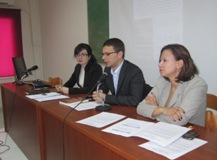 On 22 December 2011, EMA in cooperation with “Dudaj” Publishing House and University “Marin Barleti” presented in the auditorium of this university one of the world’s masterpieces in the field of political science and international relations, which comes for the first time in Albanian language “Politics and Passion: Towards a more egalitarian liberalism”. This initiative was undertaken in the framework of the project “Upgrading the understanding of International Relations and Changing the Role of the State” supported by the Embassy of the United States of America in Albania. This initiative of translating in Albanian three of the most famous authors in the field of political science and international relations aims to enhance and enrich the debate and understanding on these issues at the academic and political level, media and civil society, which would then be reflected in society at large.
During this activity, Mr. Gledis Gjipali, Executive Director of EMA, made a brief summary of the book, focusing in particular on innovation and diverse topics it covers. After introducing the author, Michael Walzer, a prominent philosopher and political theorist, professor at Princeton University, Mr. Gjipali stressed that this book contributes to better understanding the way how the state and society are organized in modern times. By criticizing the liberal theory, Walzer suggests ways in which liberal theory may be revised to bring it closer to the claims of equality. The book addresses highly controversial issues such as multiculturalism, pluralism, diversity, civil society, and racial and gender justice — all analyzed within the liberal doctrine framework combining sound knowledge with practical wisdom.
Mrs. Eurona Leka, Lecturer at “Marin Barleti” University, analyzed the book under a comparative view of liberal democracy in Albania. Starting from deontology of the title that connects the terms of: Passion and Politics, which throughout the journey of political philosophy are seen in antagonism of each other, Mrs. Leka emphasized that passion has always been a central and inevitable component of a country’s political life. In her speech — by reiterating the fact that the book is a representation of the crisis situation in which the liberal theory is as a result of the division of society into mini-clans, where everyone aspires to be more transformative than others — she highlighted the structure of the book build on the form of essays, where each of them offers a provocative reassessment of the basic principles of liberal thought. In conclusion, suggesting that liberalism is a doctrine that undermines itself, ignores traditions, in every generation creates an absolute freedom from history as well as from society, Mrs. Leka presented the need of community correction as the main solution proposed by Walzer.
Mrs. Elona Bano, Dean of students and lecturer at the Department of Public Law, addressed the third chapter of the book devoted to cultural rights, brought by the author in a socio-political perspective, different from the legal one. Mrs. Bano underlined the importance that respecting and guaranteeing cultural rights has for the whole society. She has widely discussed notions of “cultural community”, “cultural identity” and the fact of having a comprehensive legislation that guarantees the reproduction of different cultural communities, which as Michael Walzer claims, are considered stigmatized and therefore victimized. The referral of Mrs. Bano was illustrated with quotes from the book “Politics and Passion” as well as the ECHR cases.
The activity was followed up by an open discussion session during which students and academic staff exchanged their views on a range of issues addressed in the book, as well as ways of applying them in the Albanian reality.
“Politics and Passion: Toward a more egalitarian liberalism” should be read by anyone who is interested in social justice and the ways through which we seek to attain it. This book is in the Library of European Studies and International Relations at EMA, as well as in the Albanian libraries.
-
 Working Group on Chapter 23 – Digital Services in Albania within the framework of the accession negotiations – DSA Governance, Fundamental Rights, and Institutional Coordination, 30 June 2026
Gledis Gjipali, Executive Director of the European Movement in Albania (EMA), emphasised the importance
Working Group on Chapter 23 – Digital Services in Albania within the framework of the accession negotiations – DSA Governance, Fundamental Rights, and Institutional Coordination, 30 June 2026
Gledis Gjipali, Executive Director of the European Movement in Albania (EMA), emphasised the importance -
 Info Session – Access to Justice, Judicial Digitalisation, and Security Policies within Chapters 23 and 24, June 29, 2026
The European Movement in Albania (EMA) organised an info session as part of its
Info Session – Access to Justice, Judicial Digitalisation, and Security Policies within Chapters 23 and 24, June 29, 2026
The European Movement in Albania (EMA) organised an info session as part of its