


Exploring the impact of visa-free travel in the Schengen area on the Albanian society
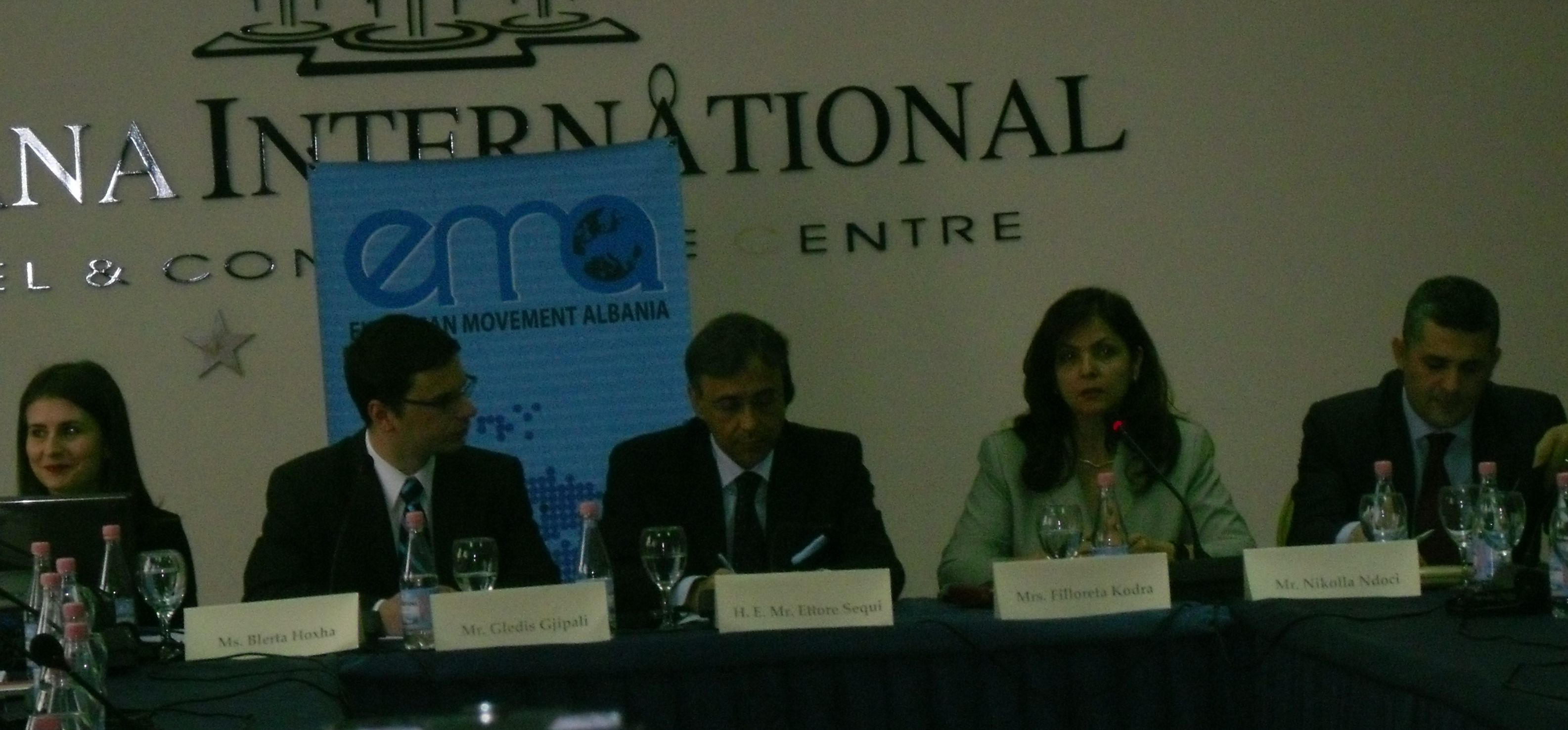 On 27th of April 2011, EMA organized a conference on: “Exploring the impact of visa-free travel in the Schengen area on the Albanian society”. This event aimed to present and discuss data and exchanged views of stakeholders on the socio-economic dynamics triggered by the visa-free travel in place since 15 December 2011. This conference concluded the series of information activities undertaken in different Albania’s cities in the framework of the project “Visa Liberalization Process with Albania: How to make it a successful story” supported by Open Society Foundation for Albania (OSFA). During the conference, EMA published the main findings of the study and national survey realized with the support of Balkan Trust for Democracy (BTD), which focused on the effect of relaxed regulation concerning people’s movement and the propensity of temporary or permanent migration flows. Distinguished guest in the conference included: Mrs. Filloreta Kodra, Deputy Minister of Labor, Social Affairs and Equal Opportunities, H. E. Mr. Etorre Sequi, Ambassador of EU in Albania, and Mr. Nikolla Ndoci, Head of Migration and Readmissions Directorate, Border and Migration Police.
The meeting was welcomed by Mr. Gledis Gjipali, Executive Director of EMA, who moderated the event.
Deputy Minister of Labor, Social Affairs and Equal Opportunities, Mrs. Filloreta Kodra, underlined that the fall of the Schengen wall marks an important phase for the Albanian government as well as its citizens. Mrs. Kodra revealed in details the role that the Ministry she represents played in this process, emphasizing that the use with high responsibility of the right to travel without visa in the Schengen area from the Albanian citizens is an incentive to facilitate the condition of working, living, studying, family reunion and integration of the Albanian emigrants in the foreign societies. Conclusion her speech, the Deputy Minister pointed out that: “National Strategy on Reintegration of Returned Albanian Citizens 2010 — 2015” manifests the vision of Albanian government regarding the reintegration of the returnees in the political, economic and social life of the country.
The Ambassador of EU Delegation in Albania H. E. Mr. Ettore Sequi expressed his gratitude to EMA for organizing this event and its role in increasing the information and awareness of the public opinion on visa liberalization process. According to his opinion, the most positive impact the visa liberalization has had on young people, who have now more opportunities to travel in the countries of the Schengen area. He emphasized that the visa liberalization is just one step in the European integration process, which demands lots of reforms to be accomplished by the Albanian government. “EU Membership has to do with the maturity of democracy related with the respect of the human rights and guaranteeing the rule of law”- concluded the Ambassador.
Mrs. Blerta Hoxha, policy researcher at EMA provided the audience with a short presentation of the key findings of the information campaign realized throughout the year. Some of the key findings of the national survey are listed as below:
- More than half of the Albanian citizens are aware on the obligations deriving from the visa liberalization
- Visa liberalisation seems to affect largely positively people’s decision to travel: number of those who will travel without visa in this year ranges from a minimum of 181,842 to a maximum of 472,789 people.
- Urban areas have consistently higher propensity to migrate compared to rural areas
- Employed citizens and students seem to be the main beneficiaries of VL
- Individuals of age 25-30 years old are the most active participants in any expected outflow of emigrants
- Short term visits abroad (0 – 3 months) show an interesting high pick at age category of 50-59 years old. We expect that an important part of people leaving the country temporary (in short visits) are those of parents that visit their children family in migration, most probably providing support in child care or other household type of work
- People with higher education or graduate studies have the highest propensity to undertake short term visits.
- The same category remains the most interested to migrate permanently, a fact that shows Albania is still in danger of experiencing brain drain.
- More developed (socially and economically) areas of living as well as cities with previous large flows of migration seem to have very high propensity to undertake short term visits. Tirana, Durres, Elbasan Vlore and Shkoder are districts with the highest propensity to travel abroad
- Areas sharing a common border with schengen area country (Italy and Greece) such as: Korçë, Sarandë, Gjirokastër manifesting lower propensity to undertake short term visits.
Head of Migration and Readmissions Directorate, Border and Migration Police, Mr. Nikolla Ndoci, during his speech was focused on the monitoring mechanism set up from the government in order to react on time if any problem might happen during the process. He pointed out the role of the state police as one of the main bodies in this process. Notwithstanding this fact, state police serves as an information source for the FRONTEX, equipping it with latest data. Mr. Ndoci claimed that according to the official data from the State Police until now the process has proceeded very well . Currently there is not a single person turned back because of breaching the duration of stay limit in Schengen area.
The activity was attended by representatives of the diplomatic corps in Albania, civil society, academics, students, experts and media representatives. In the end of the vent the audience addressed questions on the key findings of the national survey. They exchanged views and expectations on the impact that visa liberalization produced on the mobility of different categories. The activity was broadcasted live from two main TV news media.
-
 Working Group on Chapter 23 – Digital Services in Albania within the framework of the accession negotiations – DSA Governance, Fundamental Rights, and Institutional Coordination, 30 June 2026
Gledis Gjipali, Executive Director of the European Movement in Albania (EMA), emphasised the importance
Working Group on Chapter 23 – Digital Services in Albania within the framework of the accession negotiations – DSA Governance, Fundamental Rights, and Institutional Coordination, 30 June 2026
Gledis Gjipali, Executive Director of the European Movement in Albania (EMA), emphasised the importance -
 Info Session – Access to Justice, Judicial Digitalisation, and Security Policies within Chapters 23 and 24, June 29, 2026
The European Movement in Albania (EMA) organised an info session as part of its
Info Session – Access to Justice, Judicial Digitalisation, and Security Policies within Chapters 23 and 24, June 29, 2026
The European Movement in Albania (EMA) organised an info session as part of its