


Module III ‘Consumer Protection and Food Safety’ (Chapter 28 and 12), School for Consumer Protection and European Integration” April 8-9, 2022
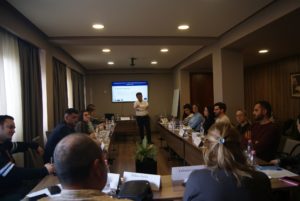 On April 8-9, 2022, Module III of “School for Consumer Protection and European Integration”, component of the project “From Information to Action-Strengthening of Organizations on Consumer Protection” was held in Tirana. This project is implemented by European Movement in Albania, in cooperation with the Academy of Political Studies and Alert Centre and supported financially by European Union within the framework of IPA 2017. The topic of this module was ‘Consumer Protection and Food Safety’- Chapter 28 and 12′ where 20 participants took part.
During the first session, journalist Dafina Hysa, introduced the role of media in communicating the risk for consumers concerning food products to the participants. This session was focused on four important themes: the role of media in informing consumers, distinguishing facts from speculation, ‘scam’ commercials and ‘Fake’ news during the pandemic. Hysa pointed out that according to AMA: 51% of the information is taken from TV, 26.6% from social networks and 22.4 % form other media platforms. Also, the phenomenon of ‘fake news’ as an added danger during the digital era was brought up for discussion. Terms directly related to information were defined and explained. Moreover, a few published cases were analyzed to demonstrate how sources are used to influence individual choices. Data from ISHM gave more insights regarding the commercial market in Albania where television takes up to 80%, online media 6%, press 6% and radio 8% of the marketing space. The participants analyzed cases that can be considered as misleading for consumers and examples of tolerable behaviors in this field.
The second session was held by Luljeta Çuko, from the Ministry of Agriculture and Rural Development, who analyzed Albania’s obligations within the framework of Chapter 12 of the EU Acquis including food safety, veterinary and phytosanitary policies. Çuko explained the objectives of these policies to ensure a higher level of food security, animal health, plant care, and at the same time the effective functioning of the internal market. In this line, she clarified the phases of the membership process, the current situation of Albania, the EC recommendations and their implementation. Çuko, mentioned the main challenges and priorities and analyzed what different stakeholders can do to achieve progress.
The third session was held by Yllka Allaraj from the National Food Authority, who explained the food safety chain and the role of the National Food Authority. The following questions were discussed: what is food safety? How safe are the products offered to the Albanian consumers? What indicators measure food safety? What are the perspectives on food safety? Moreover, Allaraj explained the step by step the procedure undertaken to conduct official food safety controls.
During the fourth session, Admir Ago, expert in the field of veterinary medicine, presented the challenges in protecting consumer health by ensuring the preservation of animal health and food safety of products of animal origin. Ago acquainted the participants with the legal and institutional framework on hygiene and veterinary controls in accordance with EU normative acts and their implementation.
The fifth session was held by Eranda Selmanaj, from the Agency for Agricultural and Rural Development, who addressed the support programs for rural development in Albania with a focus on national schemes, the environmental services project and the IPARD II program. Moreover, Selmanaj analyzed the role and functions of the Agency for Agricultural and Rural Development as well as the standards required according to the IPARD II program.
This module ended with the sixth session by Alban Zusi, representative of agribusiness, who introduced the participants to the challenges that the food industry faces and the adaptations of this sector in an effort to meet European standards. Zusi analyzed food safety and how EU standards promote export and domestic production. Lastly, the lecturer listed a series of measures that need to be taken by different sectors in order to achieve these standards including a needs inventory, industrialization and a cooperation between education and production.
-
 Information and Discussion Roundtable “Combating corruption at the heart of the European Integration Journey: The Perspectives of Youth, Civil Society, and Academia”, 14 October 2026
The European Movement in Albania (EMA), in cooperation with “Aleksandër Moisiu” University of Durrës
Information and Discussion Roundtable “Combating corruption at the heart of the European Integration Journey: The Perspectives of Youth, Civil Society, and Academia”, 14 October 2026
The European Movement in Albania (EMA), in cooperation with “Aleksandër Moisiu” University of Durrës -
 Working Group on Chapter 23 – Digital Services in Albania within the framework of the accession negotiations – DSA Governance, Fundamental Rights, and Institutional Coordination, 30 June 2026
Gledis Gjipali, Executive Director of the European Movement in Albania (EMA), emphasised the importance
Working Group on Chapter 23 – Digital Services in Albania within the framework of the accession negotiations – DSA Governance, Fundamental Rights, and Institutional Coordination, 30 June 2026
Gledis Gjipali, Executive Director of the European Movement in Albania (EMA), emphasised the importance