


NCEI, Final Plenary Session for the National Convention on European Integration in Albania 2019-2021, 22 july 2021
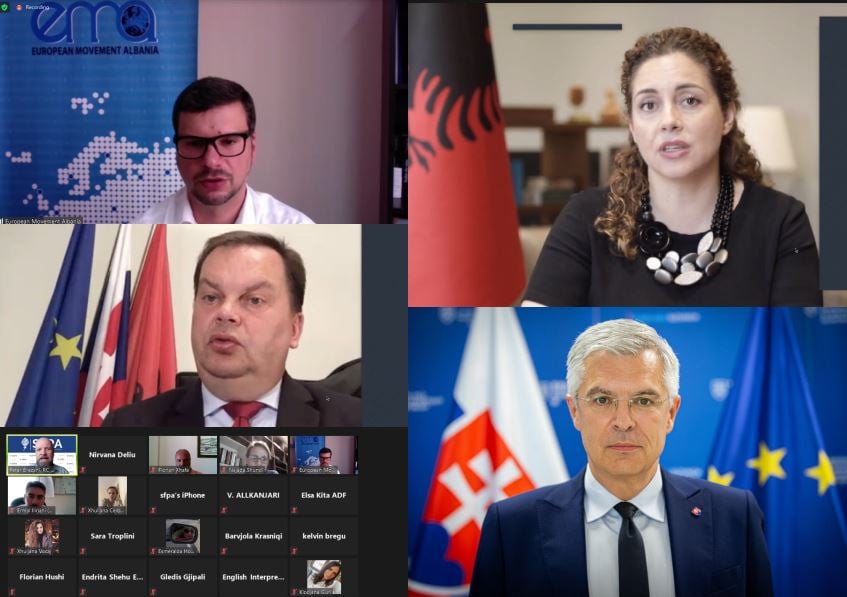 The European Movement in Albania (EMA), in partnership with the Slovak Foreign Policy Association (SFPA) and with the financial support of Slovak Aid / Official Development Assistance of the Slovak Republic, held on July 22, 2021, the f. During the current period (2019-2021), five working groups have been established and 20 sessions have been organized, more specifically: WG I – Judiciary and Fundamental Rights (Chapter 23); WG II – Justice, Freedom, Security (Chapter 24); WG III – Agriculture and Consumer Protection (Chapters 11, 12 and 28); WG IV – Regional Policy and Structure Coordination Instruments (Chapter 22) and WG V – Trade and Economy Issues (Four Freedoms and Chapter 20).
This plenary session organized online gathered around 60 participants from State institutions and civil society organizations, business sector and social partners, and representatives from academia and youth sector.
It was Mr. Gledis Gjipali, Executive Director of the European Movement in Albania (EMA) who welcomed the activity. In his speech he highlighted the importance of this platform and thanked the Slovak Foreign Policy Association (SFPA) and Slovak Aid, and all other actors who have contributed and have been actively engaged in the realization of the Convention. According to Mr. Gjipali, the Convention has facilitated the dialogue and cooperation between state institutions, civil society, business groups, workers’ associations, academia, and media, about European Integration in Albania.
Mr. Peter Brezani from Research Center of the Slovak Foreign Policy Association, RC SFPA as partner of Convention in Albania stated that the institution, he represents aims to promote public discussion about Albania’s European integration among not only state bodies and institutions but also civil society, business representatives, academic actors, and the media. He further stressed the importance of establishing a tradition of public discussion on EU Policy issues in Albania, and pledged support for the continuation of the Convention in Albania for the next two years.
The final plenary session of the Convention was also greeted by distinguished representatives such as the Minister for Europe and Foreign Affairs of Albania and the Minister of Foreign Affairs and Europe of Slovakia. Although they could not be present, through video messages they praised the work done so far by EMA and partners and expressed support for the Integration Process for Albania. Also in their video message, they expressed support for future cooperation.
H.E. Ms. Olta Xhaçka, Minister for Europe and Foreign Affairs of Albania through a video message praised the work done by EMA and collaborators in developing this comprehensive initiative for the negotiation process. According to Ms. Xhaçka, the project assists Albania to benefit from the Slovak experience in European integration. She also stated that this project underlines the importance that civil society plays in the discussion about European integration. Further, Mrs. Xhaçka thanked her Slovak counterpart Mr. Korčok not only for the assistance in this project, but also for the contribution that the Slovak state is providing for the integration of Albania in the EU.
H.E. Mr. Ivan Korčok, Minister of Foreign Affairs and Europe of Slovakia, in his message through the Ambassador of Slovakia to Albania, H.E. Mr. Peter Spisiak, praised the work of the convention on Albania’s integration into the EU. He assured that Slovakia would help Albania benefit from the Slovak experience with expertise and guidance to achieve European integration. Also in his message, Minister Korčok added that Slovakia would like Albania to participate in the Conference on the Future of Europe. He also guaranteed the continuation of the SlovakAid support of the National Convention on the European Integration in Albania for the next period.
The first panel of this activity was focused on the role of state institutions on the process of EU integration and the state of play in chapters covered by the Convention. Thus representatives of state institutions such as the Ministry of Justice in Albania and the Albanian Development Fund who have been close collaborators of EMA during the NCEI 2019-2021, the discussion was focused on the challenges that the relevant state institutions face on the path to the Integration Process concerning capacities, legislative process and standards to be fulfilled.
Ms. Najada Shundi, Director from Ministry of Justice in Albania as Lead Institution for Chapter 23, shared the actions and experiences undertaken by the Ministry of Justice for the European integration process. She stated that so far, all the chapters of the Acquis have been explained, and it is expected to be followed by bilateral meetings which are the second phase of the screening process, which are expected to take place after the First Intergovernmental Conference. She explained that at this stage Albania is required to present the level of approximation of the legislation of preparation and professional skills for the implementation of the Acquis as well as the plans it has for the future in this regard. She further added that Chapters 23 and 24 play an important role in the progress of the whole process, as these chapters contain the key aspects of the rule of law and fundamental freedoms and rights, which are essential for EU integration. She further clarified Chapter 23, where the Acquis for this chapter consists of a volume of 126 acts, from which: there are 61 acts considered “hard acquis” and 65 acts considered as “soft acquis” and is divided into three areas which are the judiciary, anti-corruption, and the field of fundamental rights. She also added that the Ministry of Justice is working on the approximation of the criminal code with the 10 EU directives which is foreseen in the National Plan of European Integration 2021-2023. In the end Shundi added that this whole process cannot take place without the help of partners, civil society, and academia, as this process is very challenging. She stated that the process needs to strengthen the state administration and build capacity to continue the right path involving all state and civil actors.
Mr. Ermal Ilirjani, Director from Albanian Development Fund linked with Chapter 22, during his speech explained that for the implementation of the Operational Program for Regional Development and Cohesion, EU legislation must be followed. He added that Chapter 22 requires the establishment of an institutional framework and appropriate administrative capacity to ensure the planning and programming part as well as implementation and monitoring based on the timelines set by the EU. According to Mr. Ilirjani, the increase of administrative capacities is important, for Albania to be well prepared during the advancement of the stages of integration in regional development and cohesion.
The second panel consisted of representatives of business groups and Civil Society, who shared their work experience and provided recommendations for relevant chapters. In their presentation, representatives of business groups and Civil Society were willing to offer support in future collaborations.
Mr. Agim Rrapaj, Chairman of Albanian Agribusiness Council (Chapter 11&12) stated that the cooperation with foreign experts engaged by EMA has had a positive effect on the information and facilitation process of disbursement of funds in the field of agriculture and their importance. He further added that the private sector in agriculture has great potential to disburse funds allocated by the EU for the development of the sector. Rrapaj secured to use all capacities available for the success of the process.
Mr. Florian Xhafa, Expert explained the path that Albania should follow for the implementation of the Acquis and chapters 11. He underlined that the establishment of institutions alone is not enough, but an important role is played by the adaptation and the way the built structures will function. Another important aspect, according to Xhafaj, is the implementation of policies by Albania in preparation for Chapter 11. Xhafaj emphasized that the selection of policies for Chapter 11 should be preceded by a careful analysis of the sector at the macro and microeconomic level, so that after implementation policies in the future should not have negative effects on the sector.
Ms. Nirvana Deliu, European Movement Albania (Chapter 24) explained that Chapter 24 has received special attention since the beginning of the Convention, since the topics covered in Chapter 24 such as migration and irregular immigration have been considered sensitive issues. Deliu underlined the successful cooperation with the institution of the Ministry of Interior and the State Police on these issues. According to her, an important focus has been on giving voice to non-state actors in relation to the topics of Chapter 24. She emphasized as important to inform and engage all state and non-state actors and to activate all capacities, since Chapter 24 is a delicate and challenging chapter.
After the speeches from both panels, Mr. Gjipali closed the activity by providing an overview of the recommendations drafted during all NCEI WG meetings 2019-2021 – highlighting the Chapters covered by these WGs as Chapters 23, 24, 22, 11 and 12, the 4 freedoms of movement and Chapter 28 which deals with Consumer Protection.
You may find the activity on Youtube: Final Plenary Session
http://eurokonventa.al/en/
-
 Working Group for Chapter 5 – Public Procurement: Update on the current status of meeting the closing benchmarks and the use of Artificial Intelligence (AI) in the public procurement system, 18 June 2026
The European Movement in Albania (EMA), in cooperation with the Public Procurement Agency, organised
Working Group for Chapter 5 – Public Procurement: Update on the current status of meeting the closing benchmarks and the use of Artificial Intelligence (AI) in the public procurement system, 18 June 2026
The European Movement in Albania (EMA), in cooperation with the Public Procurement Agency, organised -
 WG for Chapter 24 – Cooperation Police–Media: Freedom of Speech and Public Security in the Process of European Integration, 10 June 2026
The Chapter 24 Roundtable – Justice, Freedom and Security, organized in cooperation with the
WG for Chapter 24 – Cooperation Police–Media: Freedom of Speech and Public Security in the Process of European Integration, 10 June 2026
The Chapter 24 Roundtable – Justice, Freedom and Security, organized in cooperation with the