


WG for Chapter 24 – Cooperation Police–Media: Freedom of Speech and Public Security in the Process of European Integration, 10 June 2026
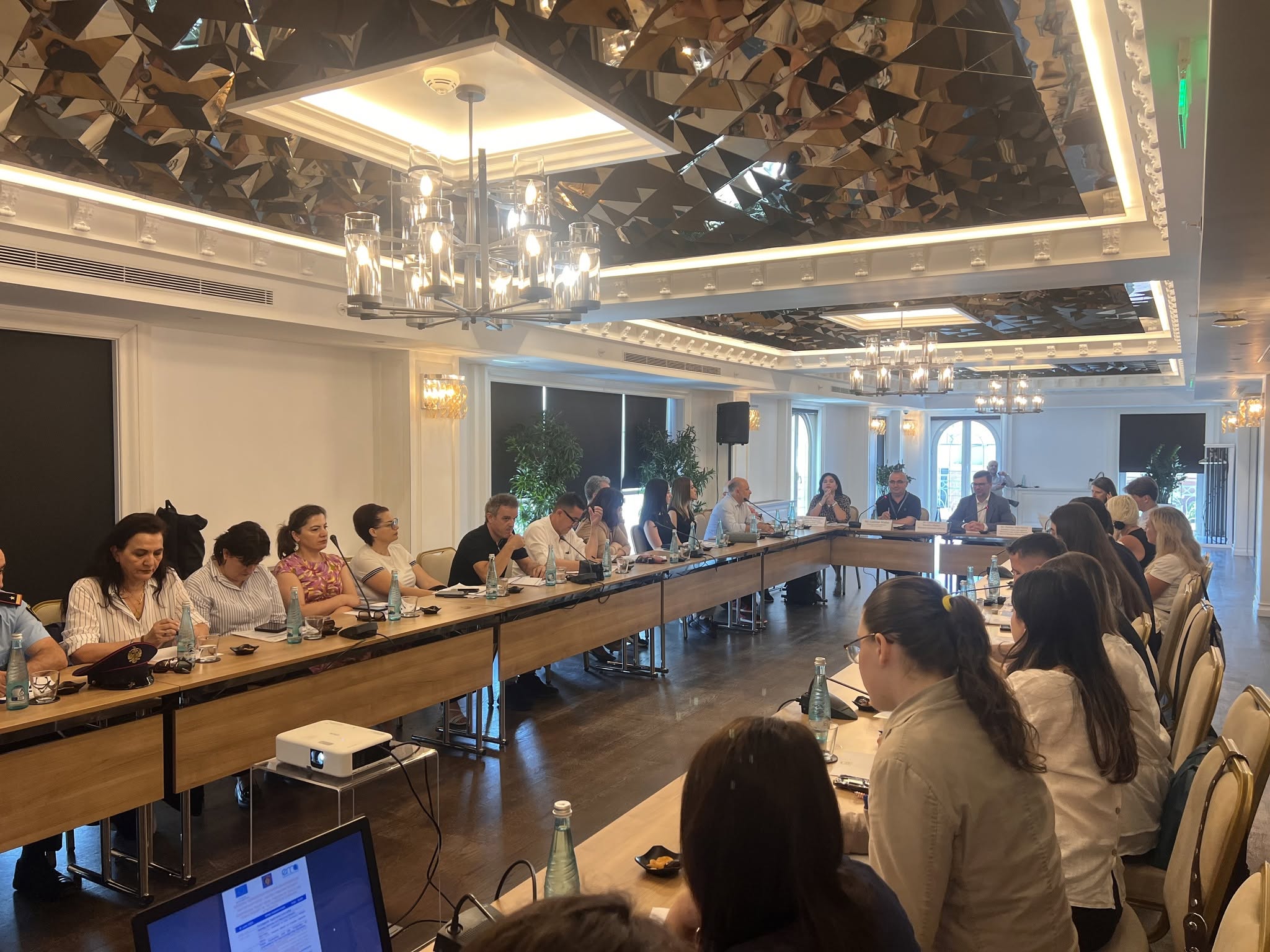 The Chapter 24 Roundtable – Justice, Freedom and Security, organized in cooperation with the State Police within the framework of the National Convention on European Integration on 10 June 2026, focused on cooperation between the State Police and the media, an area where human rights standards intersect with the requirements of public security, public order, and the protection of journalists. Participants included representatives from civil society, the media, academia, and public administration.
In his opening remarks, Gledis Gjipali, Executive Director of EMA, emphasized the importance of this discussion in the context of Albania’s progress in the EU accession process. He stated that the roundtable aimed to present various practices and experiences of interest for analysis and improvement, while also creating a space for open discussion on key issues and regulatory developments taking place in Albania in this field. He also highlighted the significance of these roundtables as platforms for interinstitutional cooperation, stressing that continuous dialogue among public institutions, the media, and civil society actors is essential for ensuring the rights and safety of journalists in the exercise of their profession.
Gentian Mullai, Coordinator for Public Information at the State Police, described such meetings as valuable opportunities for exchanging ideas, building new platforms for cooperation, and strengthening institutional capacities. He emphasized that in a democratic society, the media and the police constitute two important pillars of the rule of law, and that their relationship should be built on partnership, trust, and accountability. According to him, for the State Police, journalists are not merely reporters of events but a public asset and a bridge between institutions and citizens, playing a key role in strengthening democracy and transparency.
As the contact point for journalists’ safety, he presented several measures undertaken to strengthen police–media cooperation and guarantee journalists’ security. Among these, he mentioned the adoption of the Guidelines on the Safety of Journalists, which include clear mechanisms for cooperation with the media community and organizations defending freedom of expression; the institutionalization of communication channels for reporting incidents; and the continuation of training for police officers focused on protecting journalists’ rights and ensuring their safety during assemblies, protests, and public events. These topics have also been incorporated into the curricula of the Security Academy and the operational structures of the State Police. According to him, the increase in the number of cases reported to the police should be seen as an indicator of growing trust in existing mechanisms rather than necessarily as an increase in incidents. Journalists today feel more secure in reporting cases that affect their safety or professional activities, which suggests that the measures undertaken are yielding results. Nevertheless, he stressed that further work remains to be done and that the State Police will continue strengthening communication with the media, improving response mechanisms, and investing in professional capacity-building. In conclusion, he underlined that public security and freedom of expression are values that reinforce one another, and that the safer journalists are, the stronger the democratic system becomes.
Miranda Boshnjaku, from the Directorate for Planning and Administration of Police Training, then presented the steps undertaken by the State Police to strengthen the institutional and operational framework supporting journalists’ safety. She explained that, in addition to the legal and regulatory framework, the State Police operates on the basis of a wide range of standard procedures, guidelines, and internal instruments necessary for an institution with nationwide territorial coverage and both central and local competencies. Considering the media an important instrument for freedom of expression and the protection of human rights, she stressed that the State Police serves every journalist with the same professionalism as any other citizen. One of the concrete measures undertaken was the drafting and adoption of the Guidelines on the Safety of Journalists. For this purpose, a working group was established on 21 November 2024, which collaborated for approximately one and a half years with media organizations, civil society, and experts supported by the Council of Europe. Representatives of public institutions, media organizations, and other stakeholders participated in the process. She noted that the guidelines were adopted on 21 May 2025 by order of the Director General of the State Police and are intended to improve the institutional response to attacks or incidents affecting journalists’ safety, ensuring prompt legal and professional action, support for journalists and their employers, and increased public awareness of the importance of the media’s role. The guidelines include elements such as responsible structures and units, police investigations, protective measures, victim support, interinstitutional coordination, monitoring, and reporting.
Particular attention was devoted to complaint mechanisms for journalists, addressing concerns previously raised regarding lack of trust or reluctance to report incidents. In this context, journalists may submit their concerns through electronic platforms, official communication channels, and the designated contact point within the State Police. Boshnjaku also stressed that efforts do not stop with the drafting of the guidelines. The State Police continues to provide regular training on the protection of journalists and the integration of this topic into mandatory professional development programs. The in-service training programme for 2025–2026 includes dedicated modules on police–media relations, interinstitutional cooperation, and journalists’ safety, delivered across all levels of police structures. In addition to training, she highlighted the existence of regular professional evaluation and testing mechanisms for police officers, aimed at ensuring not only participation in training but also the effective acquisition of knowledge and professional standards.
Pauline Adès-Mével, journalist, trainer, and expert on journalists’ safety, former editor-in-chief and spokesperson for Reporters Without Borders, presented European standards and practices in this field. She emphasized that institutions have an obligation to ensure preventive measures, effective coordination, and continuous training regarding journalists’ safety. She further discussed the protection of journalists in the context of public order in Albania and analyzed how the institutional progress achieved so far can be translated into effective protection in practice. At a time when the European integration process places increasing emphasis on the rule of law, freedom of expression, and the democratic functioning of institutions, journalists’ safety is considered an important indicator of the quality of democracy and institutional credibility. She stressed that guaranteeing a safe environment for journalists, particularly when covering protests, public events, or politically sensitive situations, is directly linked to the protection of the public interest and citizens’ right to be informed.
Developments in recent years in Albania demonstrate concrete efforts to align national practices with European standards and to create clearer mechanisms for preventing and addressing incidents affecting journalists. However, current challenges lie in the practical implementation of the legal framework. Despite institutional progress, available data show that journalists continue to face obstacles and insecurity in carrying out their professional duties. During 2025, 42 violations against journalists were recorded; a significant proportion involved threats and intimidation, while many others encountered restrictions during field reporting. Furthermore, limited awareness of existing protection mechanisms and a lack of institutional trust make it even more difficult to effectively use the instruments that have been established. In this context, Adès-Mével raised several practical questions that remain open, including the proper identification of journalists during the management of public events; whether communication structures and liaison officers between the police and the media are fully functional; whether incidents are investigated swiftly and transparently; and whether specific risks faced by women journalists are adequately taken into consideration.
To guide further improvements in Albania, Pauline referred to European standards and good practices from other countries. An important reference is Recommendation CM/Rec(2016)4 of the Council of Europe, which underlines that journalists should not be treated as participants in protests or as factors disrupting public order while carrying out their professional duties. European standards emphasize the importance of prevention, institutional coordination, communication, and continuous training. In this regard, Pauline provided concrete examples from European countries that have developed effective protection models. Germany has invested in specialized safety training for journalists reporting on high-risk events. Sweden has developed a dialogue-based model, emphasizing communication before, during, and after demonstrations. The Netherlands established PersVeilig, a comprehensive partnership bringing together journalists, the police, and the prosecution service to support reporting, follow-up on cases, and provide assistance to journalists facing threats. France, Croatia, and Ireland have also designated liaison officers, reporting mechanisms, and structured communication channels between authorities and the media. These examples demonstrate that effective protection depends on the actual functioning of mechanisms on the ground.
During the discussion, participants highlighted the need for a clear distinction between the roles of the police and journalists during protests, as well as stronger mutual information-sharing and coordination with the media in order to guarantee reporting that is both free and safe in the field. Participants also discussed incidents occurring during protests, such as damage to journalists’ professional equipment and interference with live broadcasts, emphasizing the importance of clarifying whether such cases are treated as administrative or criminal matters. These issues are directly linked to the police’s capacity to protect journalists and strengthen their safety while carrying out their work in the field.
*This WG session for Chapter 24 took place within the framework of the “Building Partnership on Fundamentals: Empowered CSOs in the EU accession process” project, with the financial support of the European Union – IPA Civil Society Facility 2021, which is implemented by the European Movement in Albania and in cooperation with the Academy of European Integration and Negotiations (AIEN), Slovak Foreign Policy Association (SFPA) and the Center for Transparency and Freedom of Information (CTFI).
-
 Working Group on Chapter 23 – Digital Services in Albania within the framework of the accession negotiations – DSA Governance, Fundamental Rights, and Institutional Coordination, 30 June 2026
Gledis Gjipali, Executive Director of the European Movement in Albania (EMA), emphasised the importance
Working Group on Chapter 23 – Digital Services in Albania within the framework of the accession negotiations – DSA Governance, Fundamental Rights, and Institutional Coordination, 30 June 2026
Gledis Gjipali, Executive Director of the European Movement in Albania (EMA), emphasised the importance -
 Info Session – Access to Justice, Judicial Digitalisation, and Security Policies within Chapters 23 and 24, June 29, 2026
The European Movement in Albania (EMA) organised an info session as part of its
Info Session – Access to Justice, Judicial Digitalisation, and Security Policies within Chapters 23 and 24, June 29, 2026
The European Movement in Albania (EMA) organised an info session as part of its