


Info Session – Access to Justice, Judicial Digitalisation, and Security Policies within Chapters 23 and 24, June 29, 2026
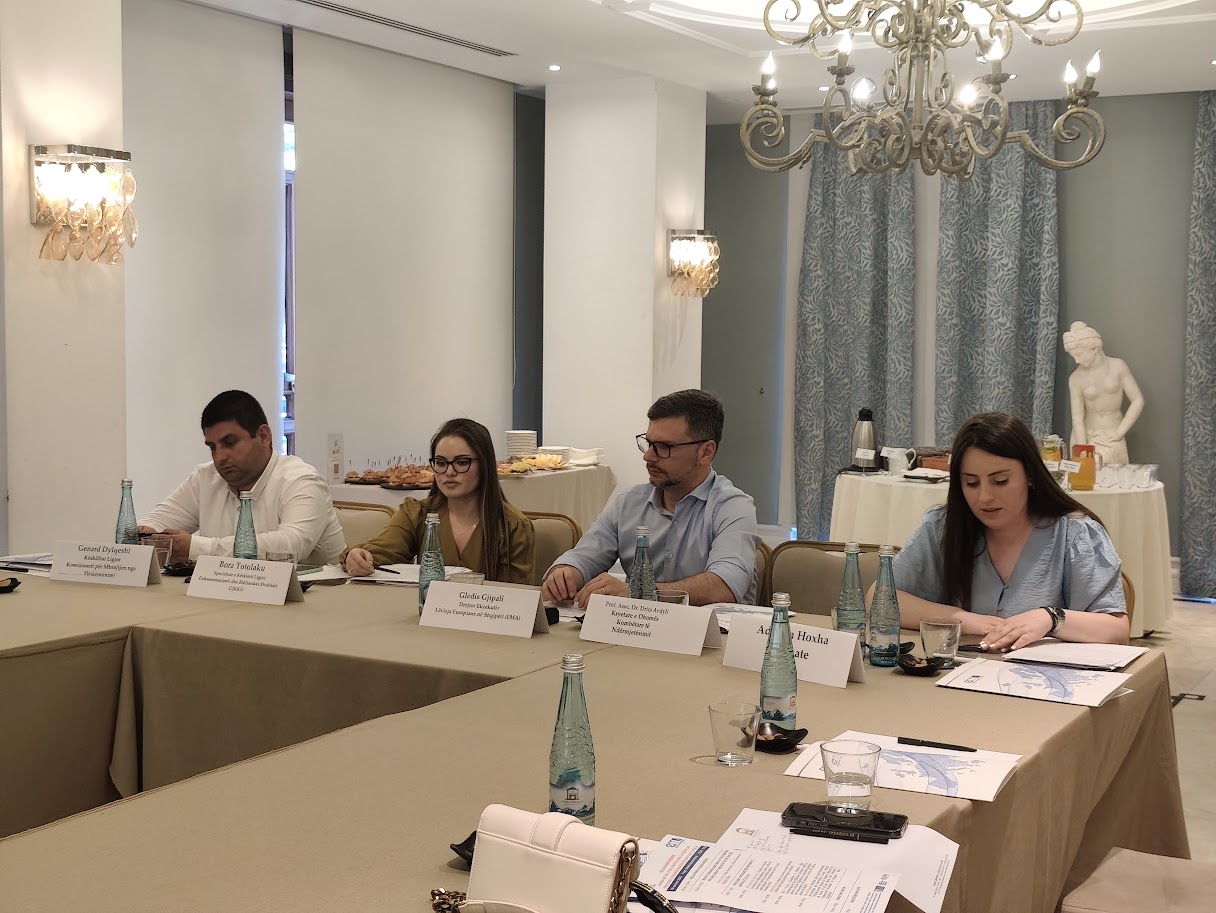 The European Movement in Albania (EMA) organised an info session as part of its efforts to promote professional debate and knowledge transfer on Albania’s European integration process. The event held on 29 June 2026 brought together authors from the Albanian Law Journal (ALJ), representatives of public institutions, civil society, academia, legal professionals, and other key stakeholders.
During the session, four articles published in the Albanian Law Journal were presented, addressing key developments and priorities under Chapter 23 – Judiciary and Fundamental Rights and Chapter 24 – Justice, Freedom and Security. Discussions focused on the development of mediation, free legal aid, the digitalisation of the judicial system, and the establishment of the National Drugs Observatory, highlighting current challenges and recommendations for improving the legal and institutional framework.
The session was opened by Mr. Gledis Gjipali, Executive Director of the European Movement in Albania (EMA), who emphasised that the main objective of creating the Albanian Law Journal was not merely the publication of articles, but the creation of a space for debate, reflection, and research on issues that are crucial to the European integration process, yet often insufficiently addressed in judicial literature or public debate. He underlined that the journal aims to provide high-quality analysis and contribute to diversifying the topics addressed, bringing attention to areas where data and studies remain limited. According to him, the value of the articles lies not only in their publication, but also in the opportunity for authors to present their findings in public discussions, where recommendations can be put forward for debate and enriched through the contributions of institutions, experts, and other key stakeholders.
Next, Ms. Adelina Hoxha, lawyer and author of the article “Free legal aid from the Albanian legal perspective”, explained that the choice of this topic stems directly from her professional experience and the recurring challenges citizens encounter when accessing justice. She highlighted that a significant number of citizens discontinue legal proceedings due to financial constraints, whilst very few are aware of the legal mechanisms to obtain free primary and secondary legal aid. According to her, even exemption from court fees is not granted automatically, as individuals must submit a request themselves, with the final decision remaining at the court’s discretion. She stressed that entitlement to legal aid is not determined exclusively by income criteria. The legal framework also recognises specific categories that qualify regardless of their financial situation, such as victims of domestic violence, children in conflict with the law, persons with disabilities, and other vulnerable groups. However, according to her, she identified the limited level of public awareness as the principal obstacle. Citizens are often unaware of their right to receive primary legal aid or exemption from court fees, whilst guidance from judicial institutions themselves remains limited. Another challenge relates to the administrative burden of securing the necessary documentation, which weighs heavily on the applicant. The discussion also highlighted that the system faces difficulties regarding the lawyers providing this service; payments and the structural organisation of the scheme do not create sufficient incentives for professionals, thereby affecting motivation and the quality of service provided. She also emphasised the need to strengthen cooperation with the National Chamber of Advocacy, as well as to organise ongoing training and information campaigns.
Ms. Bora Totolaku, Legal Research, Documentation and Digital Library Specialist at GJKKO and author of the article “Digitalisation of judicial processes and data management – impact on increasing access to justice”, presented a practice-oriented analysis of the implications of digital transformation on the judicial system. She emphasised that access to justice should not be understood merely as the right to bring a case before a court, but also as the opportunity to have effective access to case documentation, information regarding proceedings, and the development of the process. According to her, many administrative obstacles, such as geographical distance, long waiting times, or the need for citizens to obtain documentation through in-person procedures , can be addressed through the digitalisation of court processes. She highlighted three main benefits of this process: reduced costs for citizens and professionals, enhanced traceability of proceedings, and the strengthening of transparency and accountability within the judicial system. However, Totolaku stressed that Albania continues to face fragmentation across electronic case management systems, which do not communicate fully with one another and do not always provide accurate statistics or data. In this regard, the creation of electronic files and automatic inter-institutional connectivity would significantly improve the system’s efficiency. On the other hand, she underlined that digital transformation also incurs costs, requiring substantial financial investments, human capacity building, and the guarantee of high standards for personal data protection.
Genard Dylqeshi, Legal Advisor to the Commissioner for Protection from Discrimination and author of the article “Anti-Drug Policies under Chapter 24 of the EU Acquis: Establishment and Functioning of the National Drugs Observatory – The Case of Albania”, presented the latest institutional developments in this field. He explained that until 2025, Albania lacked a centralised structure for collecting and analysing data on drugs. With the establishment of the National Drugs Observatory in July 2025 and the Early Warning Mechanism, the country has taken an important step towards fulfilling obligations stemming from Chapter 24 and European standards. However, he stressed that one of the main challenges relates to the identification and handling of new psychoactive substances. In practice, if a substance is not officially identified and classified, it hinders criminal prosecution,t, despite their increasing circulation within the illicit drug market . He also highlighted shifts in drug use patterns in Albania, where heroin use has been gradually replaced by cocaine and synthetic substances, posing new challenges for responsible institutions. In conclusion, Dylqeshi underlined that alongside strengthening institutional mechanisms, it remains essential to raise public awareness and shift the approach towards drug addiction, treating it as a health issue rather than just a crime matter. He highlighted the persistent stigma faced by individuals with substance use disorders, noting that discriminatory attitudes continue to exist not only within society at large but, in some instances, also among professionals working in the field. Such stigma, he argued, constitutes a significant barrier to the effective rehabilitation and social reintegration of persons affected by addiction. .
At the end of the session, an open discussion took place between the authors, representatives of public institutions, civil society organisations, academia, and legal professionals. Participants shared comments and reflections on current practices, emphasising the need to enhance inter-institutional cooperation, strengthen professional capacity, and actively engage experts and civil society in reform processes. The discussion also underlined the importance of the Albanian Law Journal as a platform that not only promotes high-quality analysis of key legal and institutional developments, but also fosters professional debate on topics that often remain under-addressed in Albanian legal literature. It was emphasized that bringing authors and stakeholders together in public discussions adds a significant value to the research process, creating opportunities for direct exchanges of ideas, critical discussion, and the formulation of concrete recommendations that can contribute to improving public policies and advancing Albanians European integration process.
*This info session took place within the framework of the “Building Partnership on Fundamentals: Empowered CSOs in the EU accession process” project, with the financial support of the European Union – IPA Civil Society Facility 2021, which is implemented by the European Movement in Albania and in cooperation with the Academy of European Integration and Negotiations (AIEN), Slovak Foreign Policy Association (SFPA) and the Center for Transparency and Freedom of Information (CTFI).
-
 Information and Discussion Roundtable “Combating corruption at the heart of the European Integration Journey: The Perspectives of Youth, Civil Society, and Academia”, 14 October 2026
The European Movement in Albania (EMA), in cooperation with “Aleksandër Moisiu” University of Durrës
Information and Discussion Roundtable “Combating corruption at the heart of the European Integration Journey: The Perspectives of Youth, Civil Society, and Academia”, 14 October 2026
The European Movement in Albania (EMA), in cooperation with “Aleksandër Moisiu” University of Durrës -
 Working Group on Chapter 23 – Digital Services in Albania within the framework of the accession negotiations – DSA Governance, Fundamental Rights, and Institutional Coordination, 30 June 2026
Gledis Gjipali, Executive Director of the European Movement in Albania (EMA), emphasised the importance
Working Group on Chapter 23 – Digital Services in Albania within the framework of the accession negotiations – DSA Governance, Fundamental Rights, and Institutional Coordination, 30 June 2026
Gledis Gjipali, Executive Director of the European Movement in Albania (EMA), emphasised the importance