


Info – Session – Civil Society in Action: Monitoring Fundamental Reforms in the Context of European Integration, 04 April 2025
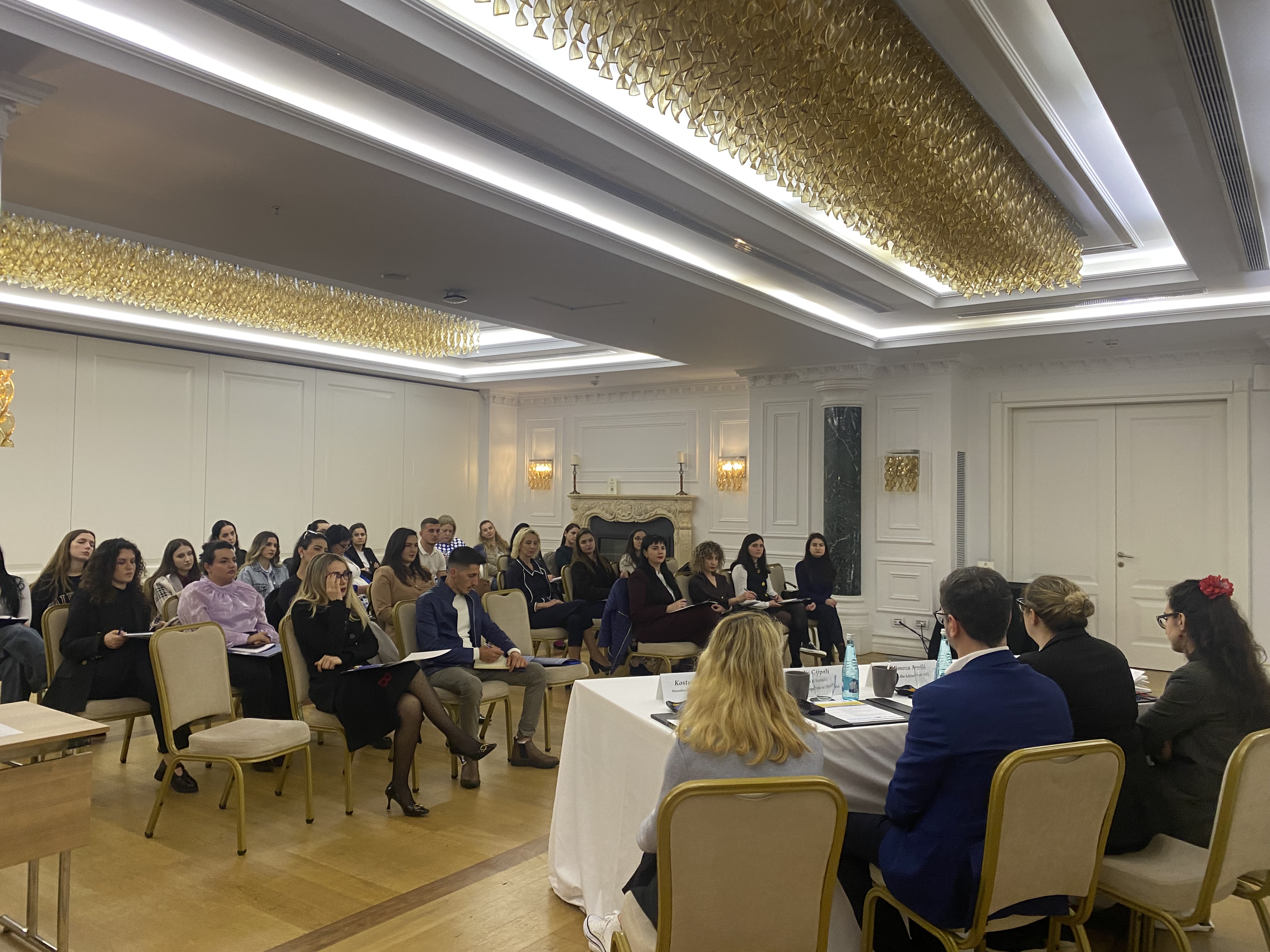 In the next Info Session, organized by the European Movement in Albania (EMA) in Tirana on April 4, 2025, the focus of the meeting, which brought together civil society actors, field experts, legal professionals, and representatives of the academic community, was centered on the role that civil society should play in monitoring fundamental reforms at this moment when the country is engaged in negotiations for Cluster 1.
Gledis Gjipali, Executive Director of EMA, explained in his speech how civil society actors can and should be involved not only in the policymaking process but also in monitoring the implementation of these policies, even though he is aware that, in many cases, civil society lacks sufficient capacity or space to engage in a high-quality and sustainable manner. Gjipali emphasized that the focus now should be on monitoring and evaluating the measures foreseen for Chapters 23 and 24, based on the Roadmaps adopted and the National Reform Agenda, so that civil society can play its active role in advancing these measures proposed by the Albanian state, which are also criteria set by the European Union. He underlined that various projects supported by foreign donors, such as this project funded by the European Union, serve as platforms where civil society can engage in dialogue with public institutions, but also for capacity building and collaboration for CSOs and other interest groups, such as the Integrated Modules Program for MEL for Civil Society in the Rule of Law Policies.
Mimoza Agolli, Expert on MEL, explained in more detail why such a program is necessary to strengthen civil society’s capacities, emphasizing the indispensability of MEL as a process that must be inseparable when it comes to policy making and implementation. She stated that Monitoring and Evaluation (MEL) increase transparency and accountability of public institutions to civil society actors and the broader public, making them more responsible and collaborative. Agolli mentioned that for the design and implementation of a successful MEL procedure, answers must be provided to three important questions: 1) What is the problem/issue that needs to be monitored? 2) What do we aim to achieve with this monitoring? and 3) What will the approach be to solve the issues and address the process? According to Agolli, MEL is not a difficult procedure if the problem, objective, and method for achieving the objective are clear. However, she emphasized that it is an important element that helps in decision-making to improve the situation. In conclusion, Agolli explained that the involvement of civil society actors—and not just them—in these training programs and capacity-building initiatives is valuable because, as a starting point, it provides them with knowledge and information that is not widely disseminated in Albania today. The combination of theory with practice makes the information clearer and more tangible, and enhances their ability to better play the role of monitoring the implementation of policies at the national level.
Kostandina Keruti, Programme Manager, Partners Albania for Change and Development, as one of the participants in the Integrated MEL Modules Program, shared her experience and explained why she values it as important. Keruti emphasized that this training helped her realize that MEL is not as technically difficult (it remains part of the daily work for civil society actors), but it allows you to be clearer about the process, the steps to follow, and the goals and impact of each step or action taken. She expressed that such training opportunities, where you have the chance to collaborate and interact with other actors—who, although from the same sector, have different experiences and profiles—add value by allowing the sharing of experiences and ideas. An added value of such training is the integration of theory with practical cases, which makes the theoretical information absorbed clearer and more tangible. One important point for Keruti is also the opportunity to expand her professional network and collaborations, which opens up possibilities for future partnerships.
Aleka Papa, Portfolio Manager at Swisscontact Albania, as another participant in this Module, expressed that the technical capacities and appropriate tools for implementing MEL are lacking in civil society organizations, not only in Albania but across the entire Western Balkans. She emphasized that strengthening the monitoring and evaluation capacities of civil society actors would increase the demand for transparency and accountability from public institutions and apply pressure in a sustainable way. This should not only be relevant in the current phase of the integration process, but also when we become a part of the European Union, and perhaps when EU monitoring of reform implementation will no longer be as intensive. Papa stressed that this should be seen as a very positive effort for civil society organizations and the potential for sustainability and long-term continuation of such a program, which is missing in Albania but is necessary. Interacting with other colleagues from the civil society sector, preparing group tasks, and discussing and obtaining seemingly technical but highly valuable information were key points during her speech that make such a program valuable and important.
After the panelists’ speeches, the certificate distribution ceremony took place, followed by a presentation and discussion with the participants of the third edition of the Integrated MEL Modules Program. The participants expressed their enthusiasm for being part of this program and assured that they would engage qualitatively and seriously during the discussions, group tasks, and collaboration among them.
-
 Working Group on Chapter 23 – Digital Services in Albania within the framework of the accession negotiations – DSA Governance, Fundamental Rights, and Institutional Coordination, 30 June 2026
Gledis Gjipali, Executive Director of the European Movement in Albania (EMA), emphasised the importance
Working Group on Chapter 23 – Digital Services in Albania within the framework of the accession negotiations – DSA Governance, Fundamental Rights, and Institutional Coordination, 30 June 2026
Gledis Gjipali, Executive Director of the European Movement in Albania (EMA), emphasised the importance -
 Info Session – Access to Justice, Judicial Digitalisation, and Security Policies within Chapters 23 and 24, June 29, 2026
The European Movement in Albania (EMA) organised an info session as part of its
Info Session – Access to Justice, Judicial Digitalisation, and Security Policies within Chapters 23 and 24, June 29, 2026
The European Movement in Albania (EMA) organised an info session as part of its