


Study Visit “The practical functioning of the Food Safety and Veterinary Institute (ISUV) and its role in ensuring food safety”, 21 April 2026
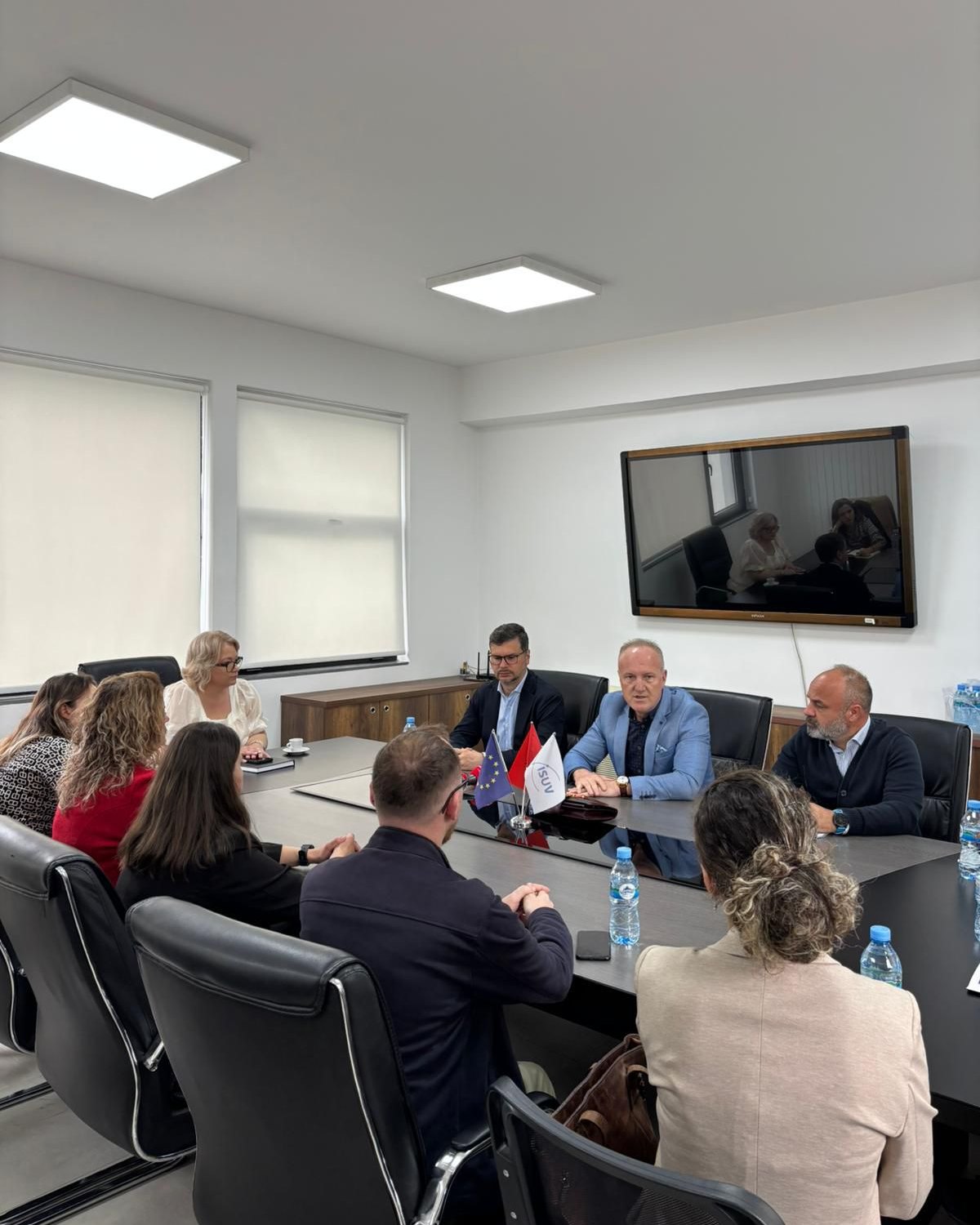 The European Movement in Albania (EMA), in cooperation with the Institute of Food Safety and Veterinary (ISUV) and the ALERT Center organised a study visit to the ISUV premises with the aim of gaining a closer understanding of the institute’s activities and the functioning of its five constituent departments. Representatives of civil society organizations, independent food safety experts, and young professionals participated in this activity, seeking to better understand the role of ISUV as a national reference laboratory under the Ministry of Agriculture and Rural Development, which has around 1,945 accredited tests in accordance with ISO 17025:2017 and EU standards.
During the opening remarks, Granit Sokolaj, Executive Director of the ALERT Center, emphasized that ISUV is a reference center, but the laboratory and testing system is much broader, and ISUV is the institution overseeing this entire system. He further noted that laboratories must be accredited, although private laboratories also operate in the market. In this regard, it is important to better understand the entire chain, the main challenges faced by food business operators, and consumer risk perception, since perception is not always linked to reality.
Gledis Gjipali, Executive Director of the European Movement in Albania (EMA), underlined that this study visit also touches upon the practical implementation of standards, especially in laboratories and within the food safety system. He stressed that this issue directly affects citizens, consumers, and individuals interested in the field, not only as part of the EU integration process but also in relation to public health. He added that continuous cooperation with the media is very important because, through public communication, the process should not remain merely technical. Signing the EU accession treaty alone is not enough; this is an ongoing process, and citizens need continuous information even after membership.
Jonida Boçi, Director General of ISUV, explained during her presentation that through continuous analyses and controls, ISUV ensures the quality of the agri-food chain, guarantees product safety, and protects animal health and biodiversity. This increases consumer confidence, supports domestic producers, and strengthens the competitiveness of Albanian products. She clarified that without farms meeting EU standards and healthy animals and plants, food safety cannot be achieved, since everything is connected to the final product reaching the market. ISUV stands at the center of this chain, alongside the National Food Authority (AKU), which oversees food safety for products traded domestically and exported abroad. Maintaining a balance between the activities of food business operators and the state is very difficult in this field, but significant work has been done in this direction. For example, in 2006, food business operators began requesting support for fish and mollusk exports at a time when Albania still had limited knowledge of how the EU and its standards functioned. By 2011, harmonized legislation and concrete progress had been achieved, although the integration process itself still remained unclear. Through the Italian accreditation body, the first six accredited analyses for this type of export were secured. It is worth noting that the accreditation process is highly complex and accounts for about 70% of the institution’s work. At that time, the Italian body was extremely demanding and detail-oriented. Later, when the Albanian accreditation body was recognized by European organizations for laboratory certification, the process became easier for the country. Ms. Boçi further highlighted the creation of a Quality Management Department specifically dedicated to the accreditation process. This department conducts internal audits throughout the year on all critical points before accreditation bodies arrive.
It was emphasized that changes in standards and criteria result from policymaking and that these standards are mandatory for food business operators. For example, there is a residue monitoring plan for products of animal origin. Today, Albanian exports are more closely linked to products of plant origin, and due to production capacities, Albania has not yet opened EU markets for exports of animal-origin products—not because of a lack of policies or institutional capacities. Thus, the issue is not only compliance with standards but also the production capacity to meet growing market demand. In addition to legislation and inspections, the Ministry of Agriculture and Rural Development has played an important role in strengthening human capacities. Institutions such as AKMBV and AKU have human resources for inspections, but capacity building must continuously take place in the field, starting with farmers and their awareness of food safety.
It was further clarified that the Albanian government has several food safety strategies and cooperates with international organizations such as the World Health Organization through workshops and various programs. For this reason, the “One Health” framework has also been introduced, involving the Ministry of Environment. Another crucial component is the laboratory system. ISUV is the national central laboratory for food safety and covers national programs, disease monitoring, and mandatory reporting to international organizations regarding diseases with economic and cross-border impacts. Today, the question arises whether there is a greater need for control capacities or human resources. In fact, there is a need to be able to conduct controls efficiently. It was stressed that regulations exist for every process, and business operators are obliged to implement them, while the state is obliged to monitor compliance to guarantee safe products. Consequently, food business operators bear no less responsibility than the Albanian state for the safety of the products they place on the market. In this context, it becomes clear that food safety is never absolute; even if standards are met, problems may still arise because everything depends on the reactions of animals, products, and the entire chain. For this reason, communication strategies with the public are extremely important.
The Director also explained that there are seven regional laboratories, four of which are more advanced. In cooperation with the World Bank project and two other EU-funded projects, intensive work has been carried out on the strategy for regional laboratories. Initially, concrete needs were unclear, so various European models were analysed. The Irish model was first considered, but later the focus shifted to the Croatian model, which was seen as more suitable and closer to the Albanian reality. Many indicators were taken into consideration, because a higher number of laboratories does not necessarily mean greater capacities; in some cases, it may indicate inefficiency in control systems. According to previous assessments, one or two strong laboratories would be sufficient for Albania to respond to alerts from international institutions or AKU, not only for exports but also for imports, which present similar challenges.
Regarding ISUV’s structure, besides the Quality Management Department, there are four other main departments. To avoid cross-contamination, the laboratory operates under very high biosafety standards and within a closed system. The sample reception area is organized according to safety standards and has no contact with biological materials or dead animals. In the past, such laboratories were built outside urban areas, whereas today they also operate within cities while respecting modern biosafety standards. One of the main departments is the Department of Plant Health Protection, which covers issues related to plant health and pesticides. Another is the Toxicology and Quality Department, which monitors residues in products of animal origin and live animals. Meanwhile, the Food Microbiology Department deals with hygienic parameters and hygiene criteria according to HACCP standards. This department began the accreditation process in 2011 and currently has more than 100 accredited tests. It also includes the water, aquaculture, mollusks, fish reserves, and lagoons sector, as well as the industrial product quality sector.
During the discussion session, participants raised concerns about the need to better understand the entire food safety chain, the main problems faced by food business operators, and consumer risk perception, emphasizing that public perception is not always directly linked to reality. It was also highlighted that it is impossible to have inspectors for every business in the market and that inspections are carried out based on risk assessment.
The discussion also addressed ISUV’s accreditation process by foreign accreditation bodies. It was clarified that this process functioned until 2020–2021, but due to very high costs, the approach changed. The arrival of the Italian accreditation body cost around €10,000, and the process was carried out by the Italian Accreditation Body. The solution came when the Albanian accreditation body was recognized by European organizations and obtained the relevant certification. As a result, ISUV now applies much stricter standards toward private laboratories as well. It was stressed that a private laboratory cannot be authorized for official controls without ISUV’s approval, while the ministry grants authorization only after this evaluation.
Part of the discussions also focused on microbiological analyses for residues and contaminants, as well as the possibility for ISUV to conduct analyses of food-contact packaging materials. It was clarified that the Ministry of Agriculture and Rural Development has not yet officially launched this process; however, due to new requirements, the list of analysed contaminants has been expanded. Currently, mainly microbiological parameters for viral, not bacterial, diseases are offered.
It was also discussed that the field of residue analysis is currently centralized at ISUV. The Fier laboratory is expected to focus on pesticide residue analyses for greenhouse products, since most production is concentrated there, while another laboratory in Shkodër is planned for pesticide residue analyses in medicinal plants. It was emphasized that ISUV is accredited for pesticide residue analyses in medicinal plants and currently covers around 250 parameters.
Discussions also focused on the main challenges faced by food business operators, especially for products of animal origin, as well as the laboratories they use for analyses. It was clarified that food business operators are categorized according to the standards they meet and their export capacities, while farms are also categorized based on herd size and facility standards, since this is directly linked to the quality of the final product. It was emphasized that responsibility for maintaining standards within facilities lies with the business operators themselves. Once a business carries out self-control, it guarantees the safety of the batch it places on the market.
Meanwhile, ISUV conducts official controls in markets, farms, and inspection points. In cases where manipulation or problems are detected in analyses conducted by private laboratories, and a product is found to contain residues during export, the costs and responsibilities fall on the business operator, including the costs of destroying the goods. In such cases, the operator is placed under monitoring by Albanian authorities.
The discussion also mentioned the case of Croatia, where during the process of alignment with European standards, a large number of milk producers exited the market. For this reason, the dairy sector has also been identified in the EU’s joint position document for Cluster 5 as a sector requiring regulation and special attention. It was also emphasized that the alignment process must be handled carefully, as the implementation of standards requires time even after legislation is adopted.
Following the discussions, participants took part in a study visit to ISUV’s laboratories, including the liquid chromatography laboratory for pharmaceutical analyses, where they became closely acquainted with testing procedures and sample handling methods.
*This study visit took place within the project “Green line for consumer protection – Food safety and strengthening the protection of consumer rights in Albania through the empowerment of local CSOs”, financed by the European Union (IPA III/2024), which is being implemented by the Alert Center in cooperation with the European Movement in Albania (EMA).
Related Posts
-
 Information and Discussion Roundtable “Combating corruption at the heart of the European Integration Journey: The Perspectives of Youth, Civil Society, and Academia”, 14 October 2026
The European Movement in Albania (EMA), in cooperation with “Aleksandër Moisiu” University of Durrës
Information and Discussion Roundtable “Combating corruption at the heart of the European Integration Journey: The Perspectives of Youth, Civil Society, and Academia”, 14 October 2026
The European Movement in Albania (EMA), in cooperation with “Aleksandër Moisiu” University of Durrës -
 Working Group on Chapter 23 – Digital Services in Albania within the framework of the accession negotiations – DSA Governance, Fundamental Rights, and Institutional Coordination, 30 June 2026
Gledis Gjipali, Executive Director of the European Movement in Albania (EMA), emphasised the importance
Working Group on Chapter 23 – Digital Services in Albania within the framework of the accession negotiations – DSA Governance, Fundamental Rights, and Institutional Coordination, 30 June 2026
Gledis Gjipali, Executive Director of the European Movement in Albania (EMA), emphasised the importance