


Working Group on Chapter 23 – Progress of negotiations and implementation of priorities under Chapter 23 in the framework of European integration, 17 April 2026
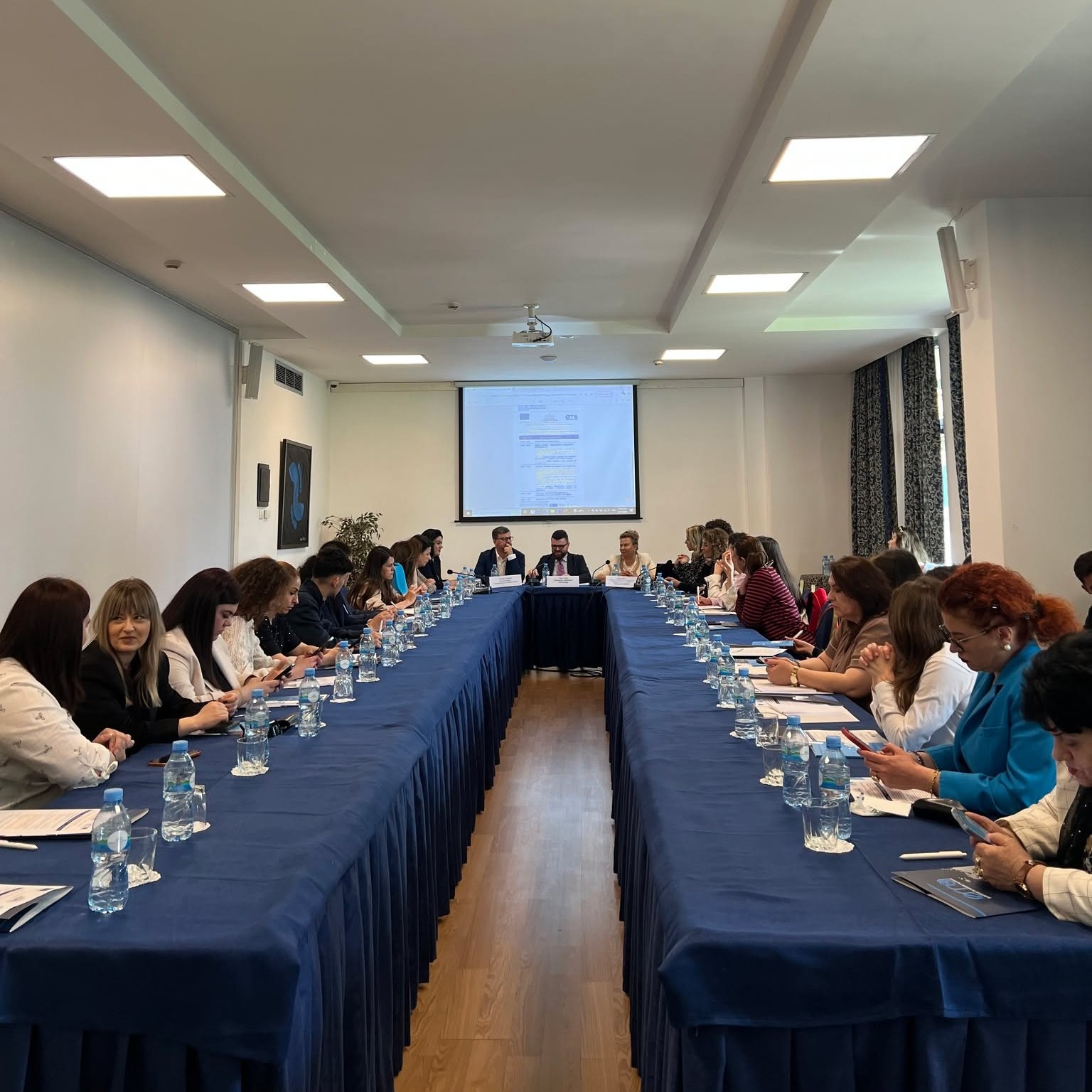 The European Movement in Albania (EMA), in cooperation with the Ministry of Justice of Albania, organized on 17 April 2026 a roundtable discussion and consultation within the framework of Chapter 23 “Judiciary and Fundamental Rights” of the Partnership Platform for European Integration and the National Convention for European Integration. The roundtable brought together representatives from public institutions and line agencies, civil society actors, academics, students and youth representatives, as well as field experts. The discussion focused on the steps undertaken in the context of fulfilling the interim benchmarks for Chapter 23, as well as on the latest legislative developments.
During his opening remarks, Gledis Gjipali, Executive Director of the European Movement in Albania (EMA), highlighted that this process is grounded in documents and work plans aligned with consultation processes. He underlined that Albania has concrete measures under Chapter 23 interim benchmarks, and stressed that the process requires intensive dialogue and cooperation with civil society organisations. He further noted that CSOs should engage in structured and continuous planning, identifying priority areas for consultation based on their expertise and fields of interest. Cooperation with the Ministry, he added, contributes to advancing and effectively implementing the process to achieve tangible results.
Tedi Dobi, Deputy Minister of Justice and Negotiator for Chapter 23 – Judiciary and Fundamental Rights, provided an overview of the negotiation process, describing it as a process that has progressed through the implementation of concrete steps, with significant involvement and expert contribution, particularly from civil society organisations. Comparing Albania’s negotiation process with that of Montenegro, which has been engaged in this process for the past ten years, Dobi emphasized that the European Commission has already prepared and submitted the Interim Benchmark Assessment Report (IBAR), which he described as highly positive. He also underlined that the process involves several actors, including EU Member States, candidate countries, and the European Commission in Brussels. He stressed that the process has intensified, requiring rapid assessments of highly complex issues. Dobi also addressed new legal measures and legislative amendments introduced within this framework, mentioning the new Juvenile Code, where civil society, together with donors and international organizations, plays an important role. He further focused on the legal aid component and the contribution required from all involved institutions. Among other issues discussed was the importance of interinstitutional cooperation, not only in monitoring implementation but also in service delivery for target groups. Furthermore, Dobi emphasized as a highly positive development the finalization of the Institute for the Education and Rehabilitation of Juveniles, which within two years has been transformed into a rehabilitation center.
Elona Bano, Director General of Policies and Projects in the Field of Justice, Integration and Negotiation, opened her presentation on the Intersectoral Strategy for Juvenile Justice 2027–2030 by referring to updates carried out within the framework of the negotiation process for Chapter 23 – Judiciary and Fundamental Rights, specifically in the sub-field of human rights. Bano provided a comprehensive overview of the Strategy, whose drafting covers the period April–December, with implementation foreseen for 2027–2030. The Ministry of Justice holds the leading institutional role, in cooperation with 22 central institutions and 13 constitutional and independent institutions, ensuring stronger protection, more efficient coordination, equal access, and sustainable results and services at both central and local levels.
Bano emphasized that the vision of this Strategy is to establish a child-friendly justice system through the revision of the main legal codes concerning juveniles and the protection of their rights, ensuring comprehensive institutional inclusion, implementing a rehabilitative approach, and promoting reintegration into society in line with EU standards. She further highlighted the strategic priorities of the plan, including proactive prevention and social inclusion, more accessible justice and procedural guarantees, consolidation of free legal aid, and the expansion of alternative measures as key instruments for sustainable rehabilitation and reintegration. Bano concluded her presentation by stressing that the new Strategy, following the completion of the previous one, marks a transformative shift in the treatment of juveniles in conflict with the law. It aims to transform the Institute for Education and Rehabilitation into a model national structure, not merely as a residential facility, but as a dynamic center for rehabilitation, personal transformation, and sustainable reintegration into society, operating according to contemporary standards, individualized treatment programmes, and an education-oriented regime, functioning as a multidisciplinary center.
Bano also presented the achievements and measures related to the Co-Creation Process for drafting the OGP National Action Plan 2026–2030, specifically for the “Access to Justice” component. She shared with participants the data and findings of a questionnaire prepared in line with the principles of the Open Government Partnership (OGP) and the responsibilities of the Ministry of Justice. The questionnaire constitutes a key instrument for the systematic collection of data, combining quantitative and qualitative approaches to provide a comprehensive overview of the current situation and priorities for improvement.
From the 98 respondents representing various target groups, the findings highlighted the need to improve the legal framework in the field of free legal aid and mediation. They also revealed an insufficient level of public information and awareness regarding free legal aid, mediation, and the European integration process; a lack of sustainable and targeted awareness campaigns, particularly in rural areas and small municipalities; and limited territorial coverage of services, creating inequalities in access. She further emphasized that other identified challenges relate to the need for strengthening institutional capacities, improving the quality and effectiveness of services, limited access to information, insufficient coordination in institutional communication, and the use of language that is not always understandable to the public. Finally, findings related to mediation demonstrated an insufficient level of awareness, lack of trust, and inadequate practical information regarding mediation as an alternative dispute resolution mechanism.
Following these findings, Bano explained that the drafting of the OGP Action Plan 2026–2030 includes several key steps: identifying the priority commitment in the field of access to justice; presenting this commitment to the OGP Multi-Stakeholder Forum and obtaining approval to initiate the drafting process; preparing the initial draft of the Action Plan with objectives, measures, activities, and implementation timelines; conducting a broad public consultation process with civil society organisations and interest groups; revising the draft by integrating contributions and agreeing on final measures; and finalizing the OGP Action Plan 2026–2030, including full documentation of the process (consultation reports, agendas, and meeting records). In conclusion, she informed participants that the plan is submitted to the Technical Secretariat, approved by the relevant structures, and officially published. She invited participants, especially organisations working directly in these fields, to contribute comments and suggestions, emphasizing that the involvement of civil society actors is highly welcome. She also stressed the need for increased communication and dialogue on these often technical and complex processes, using clear language and simplified terminology.
At the end of the meeting, an interactive discussion took place from different perspectives on the role of state institutions, civil society, and communities, as well as their partnership in improving the functioning of the Institute for the Education and Rehabilitation of Juveniles, as a centre requiring high expertise and adequate budget support. The discussion also addressed Cluster 1 – Fundamentals and the lessons learned from this challenging process, as an example to be considered in the integration and negotiation of other clusters, while emphasizing the need for continuous communication with the European Commission.
-
 Information and Discussion Roundtable “Combating corruption at the heart of the European Integration Journey: The Perspectives of Youth, Civil Society, and Academia”, 14 October 2026
The European Movement in Albania (EMA), in cooperation with “Aleksandër Moisiu” University of Durrës
Information and Discussion Roundtable “Combating corruption at the heart of the European Integration Journey: The Perspectives of Youth, Civil Society, and Academia”, 14 October 2026
The European Movement in Albania (EMA), in cooperation with “Aleksandër Moisiu” University of Durrës -
 Working Group on Chapter 23 – Digital Services in Albania within the framework of the accession negotiations – DSA Governance, Fundamental Rights, and Institutional Coordination, 30 June 2026
Gledis Gjipali, Executive Director of the European Movement in Albania (EMA), emphasised the importance
Working Group on Chapter 23 – Digital Services in Albania within the framework of the accession negotiations – DSA Governance, Fundamental Rights, and Institutional Coordination, 30 June 2026
Gledis Gjipali, Executive Director of the European Movement in Albania (EMA), emphasised the importance