


Working Group for Chapter 24 – Strengthening Law Enforcement Capacities through Police Education and International Cooperation: The Role of the Security Academy in the European Integration Process, 07 April 2026
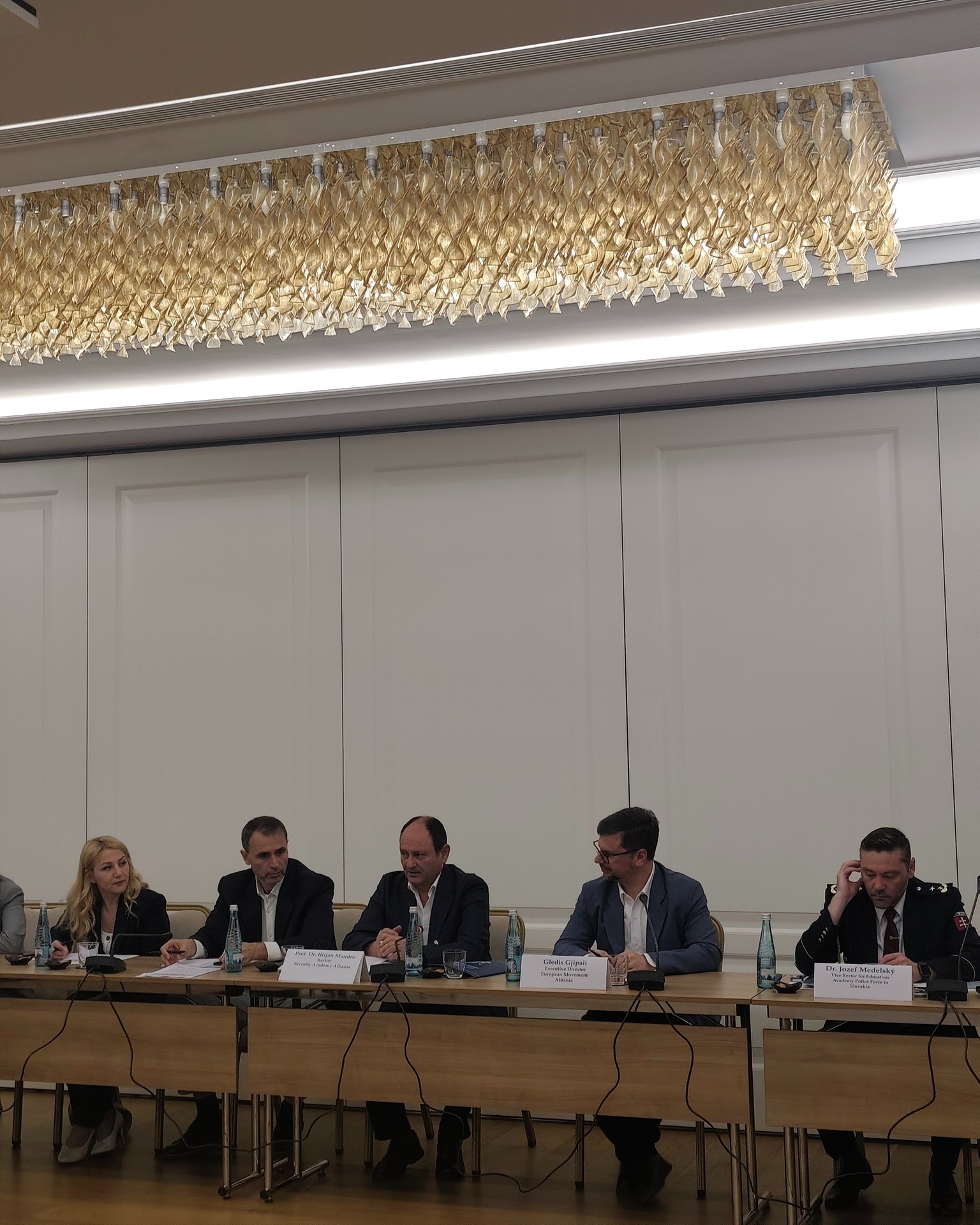 The European Movement in Albania (EMA), within the framework of the National Convention for European Integration, organized the next meeting of the Working Group on Chapter 24 – Justice, Freedom and Security, in cooperation with the Security Academy of Albania and with the participation of the Slovak Security Academy, thanks to the support of the European Union, on 7 April 2026. Representatives of civil society, academia, the State Police, public institutions, as well as various interest groups, took part in the meeting and contributed through discussions and comments with the experts.
In his opening remarks, Gledis Gjipali, Executive Director of the European Movement in Albania, praised the cooperation with the Security Academy of Albania as the only higher education institution dedicated to the academic training of future police officers. He stated that this cooperation is important for discussing and exchanging views on the need to increase institutional capacities and strengthen public security standards, in line with the requirements and themes of Chapter 24 within the integration process. Gjipali emphasized that, just as important as policy discussions and the technical aspects of legal approximation, is dialogue with the actors who directly implement this legislation, namely law enforcement bodies responsible for public order and security. In this regard, the Security Academy plays an important role in addressing security issues, providing relevant information, and building capacities. Such information contributes to strengthening security structures and helping them address specific challenges, including those linked to the European context, thereby enabling better coordination between national and European institutions.
Prof. Dr. Ilirjan Mandro, Rector of the Security Academy of Albania, first presented the development path of the Academy, which since 2023 has been accredited as a Higher Education Institution (HEI), and whose curricula and teaching techniques are being aligned with EU standards. Mandro presented developments undertaken within the framework of Albania’s European integration process and the objectives expected to be achieved in meeting European standards. He noted that the Faculty of Security and Investigation, as the main unit of the Security Academy responsible for implementing study programmes, seeks to coordinate teaching with scientific research. In the context of the requirements arising from Chapter 24, he underlined that training is conducted with the police to specialize future officers in cases involving drug trafficking and trafficking in human beings. Since October 2025, a cooperation agreement has been signed with several countries, including North Macedonia, Greece, and Montenegro, for regional training programmes. With the support of the Council of Europe, the Academy also signed a cooperation agreement with Moldova in 2024. The most recent development presented by the Rector concerned new curricula focused on the activities of journalists, with measures now being taken to ensure a high level of security for freedom of speech and the safe exercise of the journalistic profession. Mandro further explained that recent training programmes, given the priority placed on fulfilling reforms under Chapters 23 and 24, have also focused on respect for human rights. According to him, it is particularly important that student admissions at the Academy respect the principles of equality and non-discrimination, noting that students from the Roma community have currently been admitted into the study programmes offered. The Rector also added that the Security Academy, in addition to the State Police, under whose authority it operates, maintains close cooperation with other law enforcement institutions in the country, such as the Municipal Police, the Municipal Supervision Agency, the Military Police, and the Special Structure against Corruption and Organized Crime (SPAK), among others. The Rector stated that, in order to strengthen the internationalization of the Academy, several student exchange programmes have been undertaken with Police Academies in Italy, where 68 Albanian students have been accommodated. Other exchanges have taken place with the United States, Türkiye, and Germany, where three groups of German students have been hosted, while 10 Albanian students are expected to continue temporary studies in Germany in November 2026. In conclusion, he stated that although progress has been made, greater effort, support, and cooperation are required for the Security Academy to reach the level of counterpart academies in the EU and the region.
Dr. Jozef Medelsky, Vice-Rector for Teaching at the Slovak Security Academy, presented the structure of the Academy in his remarks, focusing on information processes, strategic documents, and the development of guidelines for the ethical use of Artificial Intelligence (AI), which are already being implemented in this institution in Slovakia. The Slovak Security Academy, as a higher education institution, has integrated 15 different departments and has operated in this form for 34 years, with a focus on public security. He emphasized that study programmes are offered at Bachelor’s, Master’s, and Doctoral levels, combining theoretical and practical knowledge as an ideal model that strengthens discipline and academic formation among students, enabling them to gain appropriate experience and solid knowledge. Medelsky stressed the continuing need to strengthen students’ foreign language skills as a valuable opportunity for Academy students to participate in various workshops organized by European agencies, gain international experience, and use these languages as essential communication tools in police practice and public administration. He further explained that the Academy offers specialized police courses and studies aimed at developing the skills required for the role of police investigator or law enforcement officer. Courses provided include police management training that combines theory and practice followed by an examination, specialized courses for members of the National Security Office, and courses for police attachés serving on missions outside Slovakia. A positive development achieved through European cooperation and EU community programmes, presented during the meeting, was the establishment of a special interview room for child and juvenile victims, enabling protection from further harm during criminal proceedings. To complement the full academic offer, the Erasmus+ programme was also presented and described as an important factor for students and academic staff in capacity building, exchange of experience, and promoting university cooperation at European level. Medelsky stated that students gain valuable experience, while academic staff participate in Erasmus exchanges in order to acquire and share new strategies and ideas with other European universities, with the aim of implementing them within Slovak higher education institutions. According to Medelsky, particularly valuable are also the opportunities created through the participation of the Security Academy in European agencies and mechanisms such as CEPOL, EMPACT, and SOCTA, whose developments and impact are directly reflected in the educational process through updated course content, the development of analytical thinking, and linking theory with practice. In this context, an important element is also the LEEd platform managed by CEPOL and the integration of e-learning in education, which provide opportunities for the use of modern teaching techniques, access to updated knowledge, and professional development in an international context for students and academic staff. In conclusion, attention was drawn to the use of Artificial Intelligence and to the Rector’s Guidelines on the ethical and transparent use of AI tools, which establish rules for both students and academic staff. These guidelines also foresee disciplinary measures in case of violations and aim to encourage the integration of AI into teaching while guiding students towards its responsible and ethical use. Medelsky also stated that additional methods of student assessment are now being considered, such as professional practice and practical verification of knowledge, in order to minimize the negative implications arising from the use of AI.
During the discussion, participants raised more concrete and technical questions regarding the involvement and capacities of students during and after their engagement at the Academy. Interest was also shown in the curriculum updating process, with the Slovak Academy emphasizing that updates are carried out once a year, taking into account European developments and standards. The discussion also focused on opportunities for cooperation and involvement in student exchange projects, noting that no such partnerships had previously existed between the Academies of Slovakia and Albania, while their future cooperation was considered important. Finally, the discussion concluded with the challenges that Artificial Intelligence is bringing to education, with the Slovak Security Academy noting that, through the issued guidelines, obligations and responsibilities have been defined for students and academic staff. A concrete example is that, from this year onwards, students are required to declare the use of AI in their academic work, whereas previously such use had not been disclosed.
This roundtable was held within the framework of the project “Building Partnership on Fundamental Issues: Empowering CSOs for the EU Accession Process”, with the financial support of the European Union – IPA Civil Society Facility 2021, implemented by the European Movement in Albania in cooperation with the Academy of European Integration and Negotiations (AIEN), the Slovak Foreign Policy Association (SFPA), and the Centre for Transparency and Free Information (CTFI).
-
 Information and Discussion Roundtable “Combating corruption at the heart of the European Integration Journey: The Perspectives of Youth, Civil Society, and Academia”, 14 October 2026
The European Movement in Albania (EMA), in cooperation with “Aleksandër Moisiu” University of Durrës
Information and Discussion Roundtable “Combating corruption at the heart of the European Integration Journey: The Perspectives of Youth, Civil Society, and Academia”, 14 October 2026
The European Movement in Albania (EMA), in cooperation with “Aleksandër Moisiu” University of Durrës -
 Working Group on Chapter 23 – Digital Services in Albania within the framework of the accession negotiations – DSA Governance, Fundamental Rights, and Institutional Coordination, 30 June 2026
Gledis Gjipali, Executive Director of the European Movement in Albania (EMA), emphasised the importance
Working Group on Chapter 23 – Digital Services in Albania within the framework of the accession negotiations – DSA Governance, Fundamental Rights, and Institutional Coordination, 30 June 2026
Gledis Gjipali, Executive Director of the European Movement in Albania (EMA), emphasised the importance