


NRC 3 Workshop: The European integration process in Albania – opportunities for the involvement of civil society and youth in the negotiations process for social policies, education, and youth, Bulqizë, 29 April 2026
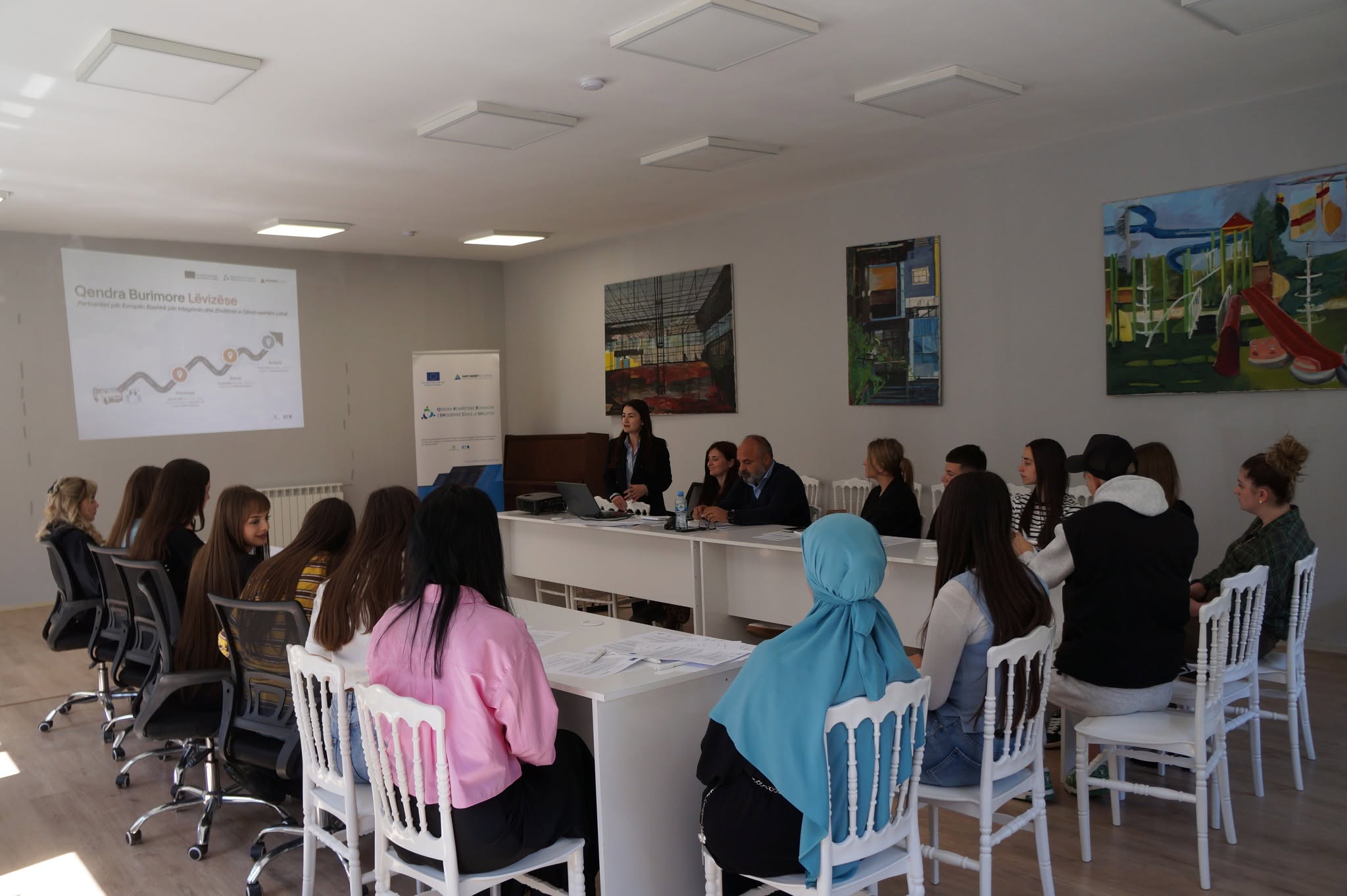 On 29 April 2026, the European Movement in Albania (EMA), in cooperation with Partners Albania, organised a workshop in Bulqizë within the framework of the National Resource Centre for Civil Society (NRC), an initiative of Partners Albania for Change and Development, supported by the European Union. The workshop focused on informing and encouraging the engagement of civil society organisations, activists and young people in Albania’s European integration process, with particular attention to agriculture, food safety and employment and social policies, as well as developments related to the respective chapters of the EU accession negotiations.
The activity opened with remarks by Xhoana Zeqo, Project Manager at Partners Albania for Change and Development, who introduced the objectives and activities of the National Resource Centre for Civil Society. She emphasised that the Centre aims to promote civic engagement and active participation in public life, with particular attention to civil society actors and interest groups beyond Tirana. Zeqo highlighted the importance of such initiatives in bringing civil society, public institutions and local communities closer to the European integration process by creating opportunities for information-sharing, discussion and participation in decision-making. She underlined that the workshop pursued two main objectives: first, to explain the technical aspects of the accession negotiations in accessible language and illustrate how they translate into concrete developments for local communities; and second, to create opportunities for engagement and dialogue among local institutions, civil society, young people and other relevant stakeholders.
Nirvana Deliu, Project Director at the European Movement in Albania, provided an overview of the European integration process, the EU’s revised Enlargement Methodology and the progress of Albania’s accession negotiations. She also introduced the structures and mechanisms through which civil society organisations and other interest groups can contribute to consultation and decision-making processes. Deliu stressed that, in order to become active stakeholders at this important stage for Albania, interest groups must first be informed and made aware of the opportunities and channels for participation, as well as the role they can play in the process. At the same time, the technical aspects of the accession negotiations need to be communicated in a clear and practical manner, enabling stakeholders to understand how developments in the European integration process affect their respective areas of activity and the everyday lives of their communities.
Florian Xhafa, Executive Director of the Institute for Policy and Law, then provided a more in-depth overview of several negotiation chapters of particular relevance to the participants. He addressed the thematic scope of these chapters, the relevant legal framework and the challenges Albania faces in aligning with EU standards, while also highlighting how different interest groups can engage and contribute to the process. Particular attention was given to Chapter 12 – Food Safety, Chapter 11 – Agriculture and Rural Development, and Chapter 19 – Social Policy and Employment. Xhafa emphasised that, at Albania’s current stage of the accession process, meeting EU standards in these areas will increasingly require investment in technical infrastructure, human resources and institutional capacities. He also highlighted the importance of raising awareness and encouraging discussion about the costs and potential adverse impacts that the reform and transformation process may have on certain sectors and interest groups.
Following the presentations, the workshop continued with an interactive discussion, during which participants shared some of the main challenges faced by non-state actors at the local level, particularly young people. Participants highlighted a widespread feeling of being left out of the process and having limited opportunities for meaningful engagement in European integration. Civil society organisations, meanwhile, pointed to their disconnection from developments and processes taking place at the central level, while also identifying limited capacities and expertise as significant obstacles to their active participation. The discussion highlighted the importance of bringing the European integration process closer to local communities through accessible information, spaces for dialogue and concrete opportunities for civil society organisations, young people and other stakeholders to participate.
***
National Resource Centre for Civil Society in Albania is a platform of information and service provision which contributes to the strengthening of civil society’s capacities to be more effective, transparent, accountable and independent actors and to the creation of an enabling environment for the civil society, participatory democracy and the integration process of Albania into the European Union. The initiative is financed by the European Union, and is implemented by Partners Albania in partnership with the Albanian Center for Population and Development (ACPD) and the European Movement in Albania (EMA).
Find more on: www.resourcecentre.al
-
 NRC 3 Workshop: The European integration process in Albania – opportunities for the involvement of civil society and youth in the negotiations process for social policies, tourism, education, and youth, Divjakë, 6 November 2026
On November 6, 2026, the European Movement in Albania and Partners Albania held the
-
 Information and Discussion Roundtable “Combating corruption at the heart of the European Integration Journey: The Perspectives of Youth, Civil Society, and Academia”, 28 October 2026, Elbasan
The European Movement in Albania (EMA), in cooperation with the Thu’Je Platform – a