


SANECA – Roundtable: Enterprises and Industrial Policies – Challenges Faced in Albania and Experiences from the Region, 1 June 2022
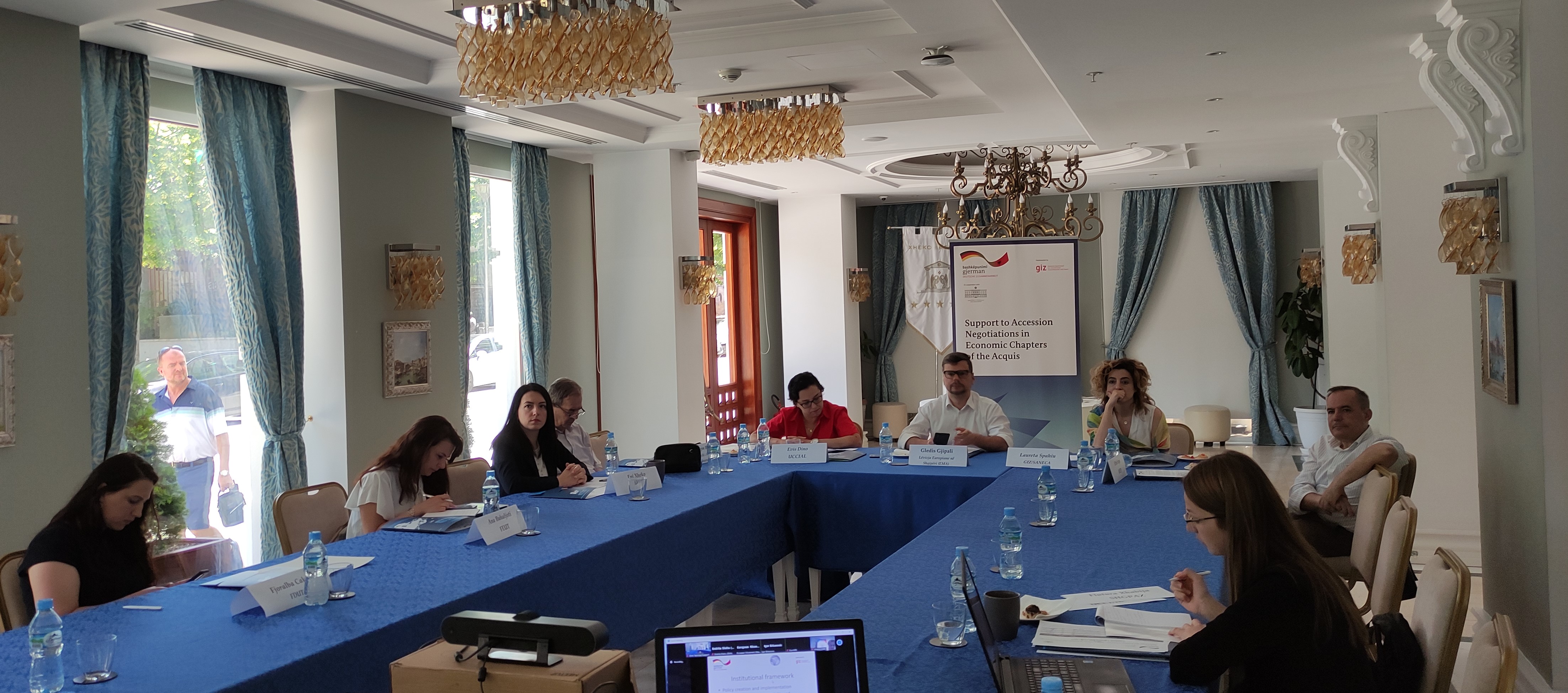 On June 1, 2022, the discussion table on Enterprises and Industrial policies was held, focused on the challenges faced in Albania and on the experience from the region. This activity took place within SANECA the project – Component of Civil Society Involvement, organised by GIZ and European Movement Albania (EMA). The meeting was attended by members of the PPEI rountables of Chapters 1, 3, 20 and 28, as well as representatives from institutions and responsible state authorities, chambers of commerce and industry, manufacturers, and business operators, as well as experts from civil society and universities. The activity took place in hybrid format, with physical participation at Xheko Imperial Hotel and online on the ZOOM platform.
The meeting was opened by Gledis Gjipali, Executive Director of European Movement Albania, who highlighted that this topic is of particular importance because it specifically addresses the negotiation process for this chapter and how the process impacts on identified target groups will be highlighted during the meeting.
Laureta Spahiu, advisor of the SANECA / GIZ project, said that these meetings will help the members of the platform with information and capacity building, and when the time to open the negotiations will come, it will be noticed even the relevance such tables have had.
Igor Brkanovic, expert for Chapter 20, started his presentation by answering questions such as: what the negotiation process is, which are the main challenges of membership and the features of the negotiations. He further spoke about the main challenges of the process of harmonisation of legislation, explaining that the framework of Chapter 20 is defined by the EU and the structure of negotiations is determined by the candidate country. He highlighted that the businesses participate in the first stages and during the presentation he did not hesitate to give recommendations for the negotiation process, such as: having a single voice during drafting and implementation of the policies. He also mentioned positive examples fromMontenegro, Serbia and Croatia. Brkanovic spoke about the principles of EU policies in Chapter 20, such as the institutional framework and plans for capacity building, etc., and paid special attention to the European Green Deal, focusing on its 3 priorities: global competitiveness; maintaining a neutral climate in Europe and the digital future of Europe, explaining each of them in more details. There was a special interest from the participants to know more about the case of Serbia/Montenegro and positive experiences from the past process in these countries.
Evis Dino, General Secretary of the Union of Chambers of Commerce and Industry in Albania (UCCIAL), addressed some issues of Chapter 20 raised by the business community. Dino said that the negotiation process will take time, but business involvement and their knowledge about the legislation is important, and this requires cooperation between state institutions and business community. Moreover, the involvement of business in the early stages is very important and the chambers should be as informed as possible to know how this information can be transferred to individual businesses.
Further, the meeting continued in the form of an open discussion with participants from this chapter. According to the participants, we are still in the stage where the business needs to be informed hence, it is essential the role of umbrella organisations in sharing, processing and clarifying the information needed. For the distribution of the information Dino suggested in finding a more efficient way (not only by emails), but perhaps it would be better to send representatives as well in face-to-face meetings. For this reason, the chambers of commerce should have its own strategy, so that businesses can have the most simplified and summarised information.
According to Rrapaj outside of Tirana city, as people are less involved and informed, they are also more interested in being informed. The agribusiness newspaper used as an informative tools has a lot of information and feedback from experts gained through these meetings, and this is one way to provide and exchange all the information. Given that we are in a time of crisis and people are focused on their daily problems and see the negotiations as a bit distant in time, according to him, this lack of attention or interest should be tackled in order to inform the interested groups in a proper time and with the proper know-hows. According to him, the closer we are to reality, the more efficient and effective the conclusions will be.
Furthermore, Spahiu highlighted the importance of the umbrella organisations and according to her it is very important that they to be part of these meetings in order to obtain information and to share it even with those businesses that are more difficult to be reached, for example: businesses in the rural or remote areas.
According to Gjipali, the importance of the information and its transferring is important and makes the reformation process easier. The participants were very interested to know which was the concrete contribution of the civil society in those tables and noted the importance for the increase of funds for scientific research and finding the right way for transmitting the information.
-
 Working Group on Chapter 23 – Digital Services in Albania within the framework of the accession negotiations – DSA Governance, Fundamental Rights, and Institutional Coordination, 30 June 2026
Gledis Gjipali, Executive Director of the European Movement in Albania (EMA), emphasised the importance
Working Group on Chapter 23 – Digital Services in Albania within the framework of the accession negotiations – DSA Governance, Fundamental Rights, and Institutional Coordination, 30 June 2026
Gledis Gjipali, Executive Director of the European Movement in Albania (EMA), emphasised the importance -
 Info Session – Access to Justice, Judicial Digitalisation, and Security Policies within Chapters 23 and 24, June 29, 2026
The European Movement in Albania (EMA) organised an info session as part of its
Info Session – Access to Justice, Judicial Digitalisation, and Security Policies within Chapters 23 and 24, June 29, 2026
The European Movement in Albania (EMA) organised an info session as part of its