


Working Group for Chapter 24 – Strengthening institutional capacities and best practices for the functioning of the Asset Recovery Office (ARO), 25 March 2026
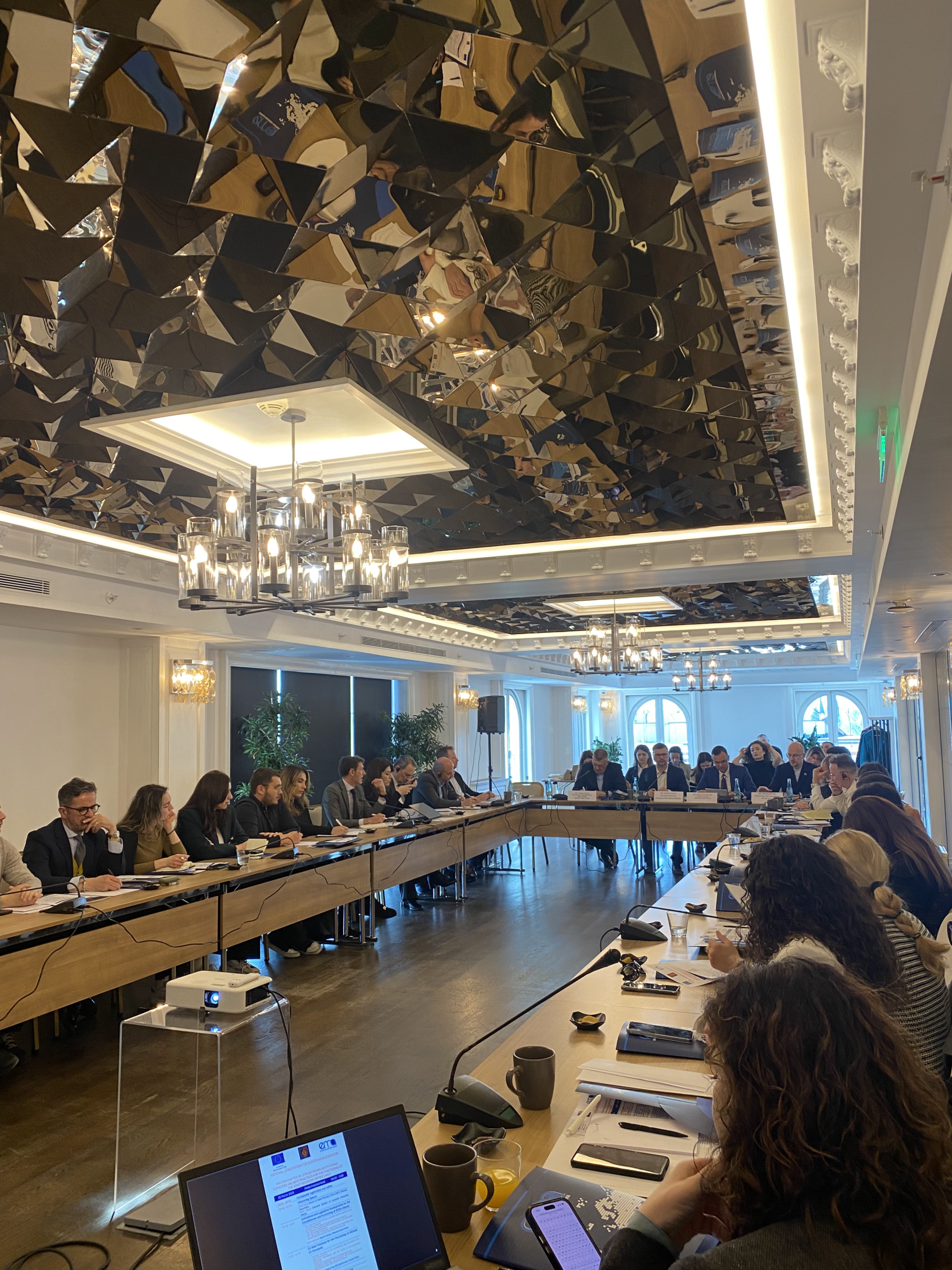 Strengthening institutional capacities and the exchange of European best practices for the functioning of the Asset Recovery Office (ARO) were at the center of the next meeting of the Working Group on Chapter 24 – Justice, Freedom, Security, held on 25 March 2026, within the framework of the National Convention for European Integration. The activity was organized by the European Movement in Albania (EMA), in cooperation with the Albanian State Police, with the support of the European Union.
This roundtable was held as a space for consultation and dialogue between state institutions, law enforcement agencies, CSOs, legal professionals, and international partners, with the aim of discussing the latest legal and institutional developments related to the establishment and operationalization of ARO in Albania. The focus of the discussions was the role that this new structure can play in strengthening the fight against organized crime and money laundering, as well as its importance in Albania’s alignment with the standards and benchmarks of the European Union under Chapter 24.
The meeting opened with welcoming remarks by Gledis Gjipali, Executive Director of the European Movement in Albania (EMA), and Arben Ujkaj, Director of the Asset Recovery Office (ARO) within the Albanian State Police. In his remarks, Gjipali emphasized the importance of the National Convention for European Integration as a model of cooperation between state institutions and non-state actors, creating opportunities for professional expertise, practical experience, and stakeholder recommendations to contribute to the improvement of the country’s legal and institutional framework. He underlined that issues related to Chapter 24 are particularly important, as they directly affect the rule of law, public security, justice, and the effectiveness of mechanisms against organized crime and money laundering.
For his part, Arben Ujkaj focused on the importance of establishing and consolidating the Asset Recovery Office as a key structure within the State Police. He emphasized that ARO represents an important instrument for identifying, tracing, and supporting processes for the recovery of assets deriving from criminal activity, thus making the fight against organized crime and money laundering more effective. At the same time, he pointed out that this structure is still in the phase of institutional consolidation and that its full functioning requires not only a solid legal basis but also close cooperation with justice institutions, law enforcement agencies, and international partners.
Rezar Velimishi, Sector Chief at the State Police, presented the institutional and legislative developments for the establishment and functioning of ARO in Albania. His presentation addressed several key issues, including the importance of asset recovery in the fight against organized crime and money laundering, the priorities and requirements of the EU under Chapter 24, the process of establishing ARO in Albania, and the next steps necessary for its full operationalization. He emphasized that ARO remains an important asset in the fight against organized crime and money laundering, which is also considered a priority by the EU. He also highlighted the role of inter-institutional coordination and close cooperation with justice institutions and other law enforcement agencies, as well as the need for rapid and effective exchange of information with international partners. In addition to the legal framework for the full functioning of ARO, Velimishi stated that secondary legislation and internal procedures are also required for its real and effective operation, as well as continuous investment in human resources, specialized training, technical capacities, and clear cooperation procedures.
Subsequently, Michal Pavlik, Head of the ARO Department at the Slovak Police, presented Slovakia’s experience and European Union best practices in the functioning of Asset Recovery Offices. He placed ARO functioning within the European framework, referring to the Council Decision (2007/845/JHA), which emphasizes the need for rapid information exchange between Member States for the identification and tracing of criminal assets. Regarding the organization in Slovakia, he explained that ARO operates as a unit within police structures, which has gone through several institutional phases and is currently part of specialized crime structures. The unit typically consists of 5–10 police officers, and currently operates with 7 officers and one head of unit. Regarding institutional cooperation, Pavlik emphasized that ARO in Slovakia has the right, based on police law, to request information from state institutions, legal entities, financial institutions, tax authorities, and social insurance schemes, even without the existence of a formal criminal proceeding, but within the framework of operational information. He also underlined the importance of capacity building, mentioning training in the use of systems and police databases, as well as participation in specialized CEPOL trainings in the field of anti-money laundering and asset recovery. In terms of international cooperation, he emphasized the use of channels such as SIENA, cooperation with National Europol Units, and direct operational communication. Cooperation with the private sector was also highlighted as an important element in the identification and tracing of assets. In conclusion, Pavlik referred to the latest developments in the EU, specifically Directive (EU) 2024/1260 on asset recovery and confiscation, which foresees an expansion of competences, new tasks, and a strengthening of the role of ARO, with a transposition deadline until November 2026.
The meeting continued with comments and discussions that once again emphasized the importance and purpose of the proper functioning of the Asset Recovery Office.
-
 Working Group for Chapter 5 – Status of Chapter 5 in the negotiation process: Fulfillment of closing benchmarks, 27 February 2026
The Public Procurement Agency and the European Movement in Albania (EMA) organised a roundtable
Working Group for Chapter 5 – Status of Chapter 5 in the negotiation process: Fulfillment of closing benchmarks, 27 February 2026
The Public Procurement Agency and the European Movement in Albania (EMA) organised a roundtable -
 Advocacy meetings in Brussels, 24-26 February 2026
The last week of February 2026 (23–26 February) marked the second advocacy meeting between
Advocacy meetings in Brussels, 24-26 February 2026
The last week of February 2026 (23–26 February) marked the second advocacy meeting between