


Working Group for Chapter 5 – Status of Chapter 5 in the negotiation process: Fulfillment of closing benchmarks, 27 February 2026
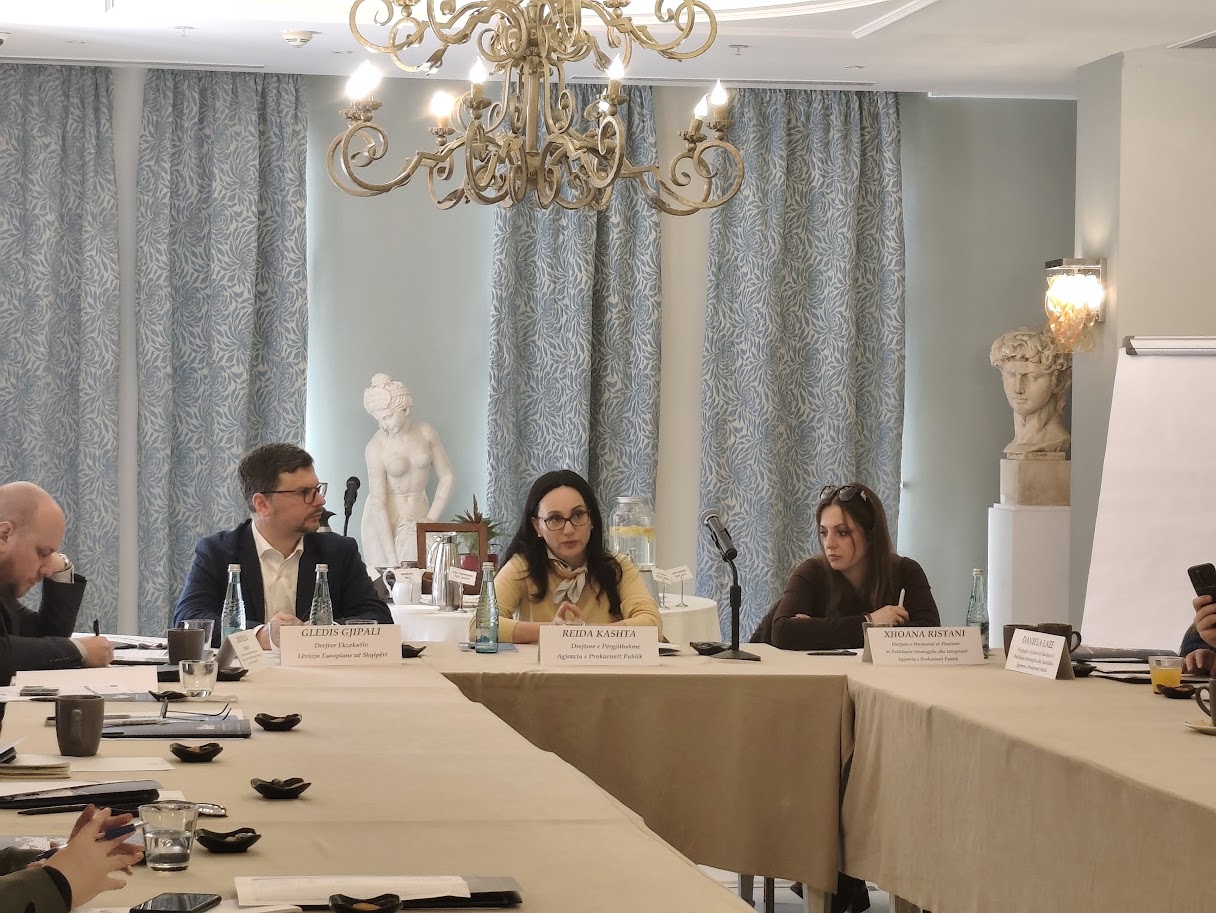 The Public Procurement Agency and the European Movement in Albania (EMA) organised a roundtable that focused mainly on the current state of progress under Chapter 5 – Public Procurement, the fulfillment of provisional closing benchmarks within the framework of Albania’s EU accession negotiations, and the drafting of the National Action Plan 2026–2030 for the Open Government Partnership (OGP). Representatives from civil society, public administration, and other stakeholders involved in the field of public procurement participated in the discussion.
In her remarks, Reida Kashta, Director General of the Public Procurement Agency, emphasized that the institution’s current work is focused on meeting the closing benchmarks of Chapter 5. These priorities relate to aligning legislation with the EU acquis, consolidating the institutional framework, and demonstrating a credible track record of a transparent and fair public procurement system. Regarding legislative alignment, she explained that improvements are being developed on several fronts in parallel, including the law on public procurement, the law on concessions and public-private partnerships, and the law on procurement in the fields of defence and security.
Concerning the law on concessions and PPPs, Ms. Kashta noted that the drafting and finalisation of by-laws is being carried out with the support of SIGMA, while amendments to the public procurement law are under continuous discussion with the European Commission services. She highlighted that a work plan for by-laws has been prepared, but further work is required, as the final deadline for this process is September 2026. It was also underlined that the European Union itself is in the process of amending its directives, which requires increased attention to ensure that current changes remain aligned with the existing framework while maintaining flexibility for future alignment. The current approach remains the closure of the first benchmark based on existing directives. Regarding the law on procurement in defence and security, it was emphasized that targeted amendments are being made, considering the current global context and recent European developments. In this regard, the Public Procurement Agency is closely cooperating with the Ministry of Defence to meet the relevant obligations, while inter-institutional coordination remains key, including with the Ministry of Economy on issues related to concessions and PPPs. According to Ms. Kashta, the expectation is that these benchmarks will be met within 3–4 months.
Regarding the second benchmark, which concerns improving the institutional framework, it was emphasized that at the macro level there is already a clear institutional structure, especially in the field of PPPs. The main challenge remains the establishment and operationalisation of a new institution dedicated to concessions and PPPs, which will be created through the reorganisation of ATRAKO, for which a draft has already been prepared with SIGMA’s support. Meanwhile, in the field of defence and security, there are no difficulties in establishing new institutions, as a consolidated legal and functional framework already exists. However, the main challenges relate to improving performance, particularly in increasing human capacities. In this context, Ms. Kashta stressed the importance of the professionalisation scheme in public procurement, which represents a new cornerstone of the system. She explained that following amendments made two years ago to the public procurement law, every institution must have trained, tested, and certified staff to perform functions in this field. After August, no individual will be able to work in public procurement without undergoing this process. So far, 499 individuals have been certified, while testing is conducted monthly in cooperation with the Department of Public Administration, with the aim that every institution has at least one qualified person; otherwise, the respective function will no longer be performed.
Regarding the third benchmark, it was emphasized that the Public Procurement Agency is preparing a detailed report based on data collected over the years, including a comparative analysis for the period 2022–2025. This report aims to identify whether there have been improvements or sustainable changes in the system, based on data from the Agency and other institutions involved in Chapter 5, as well as in cooperation with judicial institutions regarding indicators related to the criminal prosecution of irregularities in tenders. In this framework, the methodology for assessing corruption risk in public procurement was also presented, developed in partnership with the Italian Anti-Corruption Authority (ANAC), the Minister of State for Public Administration and Anti-Corruption, and with the support of the OSCE. This methodology is based on international experience and local context knowledge and aims to structure how risk signals are identified and analysed at both central and institutional levels. The Agency will conduct macro-level assessments to identify systemic weaknesses, while individual institutions will be encouraged to assess their own performance for each risk indicator. It was also noted that analysis of cancelled procedures during the past year showed a rate of around 25% of the total, a considerable figure, especially in the healthcare sector. However, it was emphasized that these cancellations are not necessarily related to issues with the public procurement law itself but often to sector-specific legislation, particularly in pharmaceuticals, requiring a more nuanced analysis of risk indicators.
Gledis Gjipali, Executive Director of the European Movement in Albania (EMA), positively assessed the pace of legal amendments and implementation measures in the field of public procurement, noting that this progress is clearly reflected in the European Commission’s periodic assessments. He emphasized that although the timeline for advancing and provisionally closing negotiation chapters is ambitious, it remains achievable as long as there are sustained commitment and close cooperation among all institutional and non-institutional actors involved in the process. Gjipali also highlighted the importance of continuous monitoring of the implementation of legislation and reforms in practice, recalling that until EU membership is achieved, negotiation chapters are considered only provisionally closed, and therefore the involvement of non-state actors facilitates the fulfillment of obligations.
Xhoana Ristani, Director of the Directorate for the Implementation of Strategic Policies and Integration at the Public Procurement Agency, explained that the methodology for assessing corruption risk in public procurement is built on a dual approach, combining macro and micro indicators while considering sectoral specifics. This methodology is based on practices applied by ANAC but adapted to the Albanian institutional and legal context. An important innovation is not only the identification of risk indicators but also the definition of concrete measurement methods and clear classification of risk levels (low, moderate, high), making it practical and applicable. The methodology is structured around three main pillars: systematic data collection, corruption risk analysis, and the definition of strategies and actions to reduce this risk. At the macro level, the analysis focuses on aggregated data reflecting the overall functioning of the procurement system, including indicators such as the use of the most economically advantageous tender (MEAT) based on cost, the share and value of negotiated procedures without prior publication, and the number and value of cancelled procedures. Standardised formulas and thresholds are defined for each indicator to signal risk levels and help identify systemic weaknesses and problematic trends. At the micro level, indicators enable deeper analysis of specific procurement stages and identification of issues at the institutional or procedural level, including delayed publication, re-announcement of cancelled procedures, duration of publication periods, single-bidder cases, and decision-making timelines. These indicators support early detection of irregularities or potential corruption risks and allow institutions to evaluate their own performance and take targeted corrective measures.
Geri Pilaca, Head of the Integration and External Relations Sector at the Directorate for the Implementation of Strategic Policies and Integration at the Public Procurement Agency, explained that within the Open Government Partnership (OGP), a platform aimed at increasing transparency, participation, and accountability through concrete commitments, the process of co-creating the National Action Plan 2026–2030 is being launched. A key innovation, beyond extending the plan’s duration to four years (from the previous two), is that for the first time, in addition to ministries, other institutions such as Parliament, the National Agency for Information Society (AKSHI), the Commissioner for Protection from Discrimination, and the Commissioner for the Right to Information and Personal Data Protection are included. The public procurement component is reflected in Commitment 15: “Increasing transparency of public contracts.” This commitment is closely linked to the use of technology, aiming to apply advanced solutions and automated processes to enhance transparency and efficiency. Key priorities include improving accessibility of electronic systems for civil society use, assessing corruption risks particularly in vulnerable sectors, and strengthening integrity in contract management. Another essential element is the joint implementation and monitoring of public contracts for 2026–2030 through close cooperation with civil society organizations. Pilaca emphasized that the new methodology involves not only public authorities but also consultation and integration of recommendations from civil society, experts, and the media, ensuring a more inclusive and transparent approach.
In conclusion, special attention was given to the content of certification tests for procurement specialists, emphasizing the need for these tests to better reflect the practical realities of procedures, particularly by including low-value procedures, which represent a significant portion of procurement activity and often carry specific risks. It was also discussed whether further harmonization of national practices with best practices from EU member states is needed, beyond formal alignment with EU directives. In this context, the role of the Public Procurement Agency in measuring and assessing risk was also discussed, especially in cases where indicators reveal not only administrative violations but also situations that may raise suspicions of criminal offenses. The need for further clarification of competencies, as well as the definition of appeal deadlines and procedures, was emphasized to ensure effective protection of the rights of economic operators without compromising the integrity and progress of the public procurement process.
*This roundtable took place within the framework of the “Building Partnership on Fundamentals: Empowered CSOs in the EU accession process” project, with the financial support of the European Union – IPA Civil Society Facility 2021, which is implemented by the European Movement in Albania and in cooperation with the Academy of European Integration and Negotiations (AIEN), Slovak Foreign Policy Association (SFPA) and the Center for Transparency and Freedom of Information (CTFI).
-
 Information and Discussion Roundtable “Combating corruption at the heart of the European Integration Journey: The Perspectives of Youth, Civil Society, and Academia”, 14 October 2026
The European Movement in Albania (EMA), in cooperation with “Aleksandër Moisiu” University of Durrës
Information and Discussion Roundtable “Combating corruption at the heart of the European Integration Journey: The Perspectives of Youth, Civil Society, and Academia”, 14 October 2026
The European Movement in Albania (EMA), in cooperation with “Aleksandër Moisiu” University of Durrës -
 Working Group on Chapter 23 – Digital Services in Albania within the framework of the accession negotiations – DSA Governance, Fundamental Rights, and Institutional Coordination, 30 June 2026
Gledis Gjipali, Executive Director of the European Movement in Albania (EMA), emphasised the importance
Working Group on Chapter 23 – Digital Services in Albania within the framework of the accession negotiations – DSA Governance, Fundamental Rights, and Institutional Coordination, 30 June 2026
Gledis Gjipali, Executive Director of the European Movement in Albania (EMA), emphasised the importance