


Information and Discussion Roundtable “Combating corruption at the heart of the European Integration Journey: The Perspectives of Youth, Civil Society, and Academia”, 28 October 2026, Elbasan
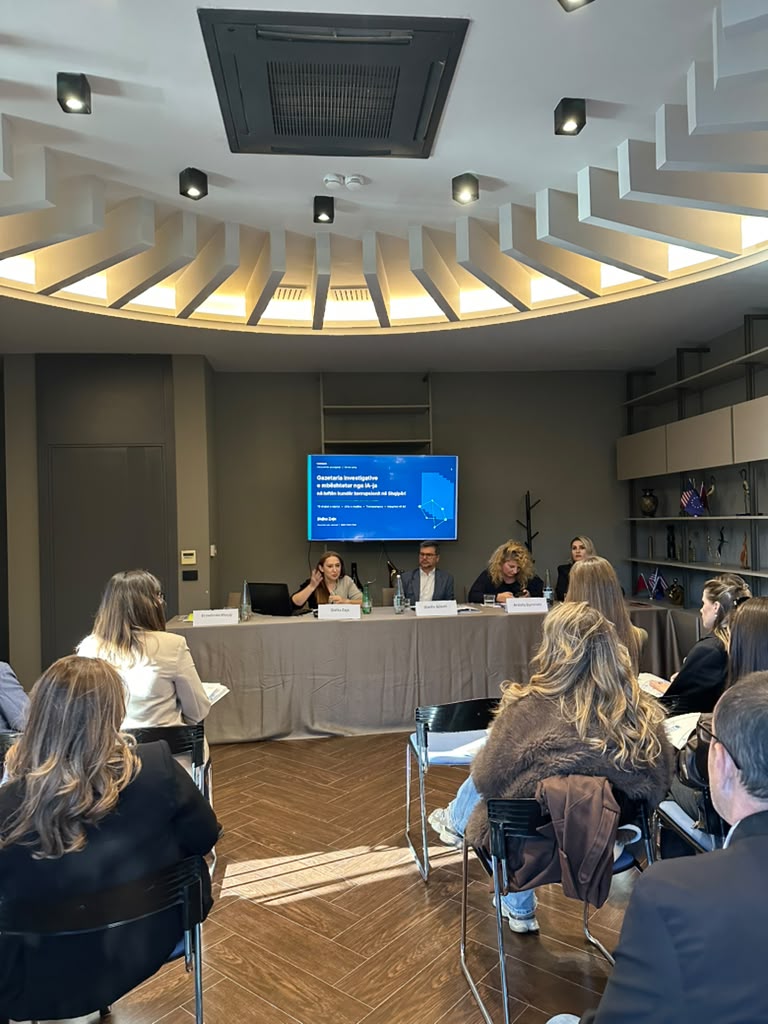 The European Movement in Albania (EMA), in cooperation with the Thu’Je Platform – a Platform for Democracy and Peace led by PVN Albania – organised an information and discussion roundtable in Elbasan on 28 October 2026.
Moderated by Lorena Haxhiymeri, Director of Performance at Elbasan Municipality, the event focused on the fight against corruption, EU mechanisms for protecting financial interests, and strengthening the rule of law. The discussion also featured two articles published in the Albanian Law Journal (ALJ), a journal established by the European Movement in Albania (EMA), as well as an explanatory manual on the European framework and mechanisms for combating corruption. These materials were prepared as part of EMA’s initiatives to raise awareness and strengthen capacity in the fight against corruption, with financial support from the Agency for the Support of Civil Society (AMSHC).
In his opening remarks, Gledis Gjipali, Executive Director of the European Movement in Albania (EMA), underlined the importance of such discussions for advancing Albania’s European integration process. He stressed that the fight against corruption remains a key element of reforms aimed at strengthening the rule of law and meeting EU membership criteria. He noted that European integration should not be confined to the central level, but should also involve cities and communities outside Tirana. In this regard, he emphasised the need to improve public awareness, build the capacity of local government institutions, and encourage citizens’ participation in processes related to integration. Given that a considerable part of EU legislation is implemented at local level, Gjipali highlighted the role of civil society organisations in supporting local institutions through information, education, and capacity-building for the implementation of European standards.
Dr Arsiola Dyrmishi then presented her article, “The Integrity of Albanian Businesses in the Face of the European Union’s New Anti-Corruption Standards: From Criminal Liability to a Culture of Legal Compliance,” focusing on the importance of preventing corruption in the private sector and strengthening integrity mechanisms within businesses. She explained that the fight against corruption cannot rely solely on punishment after violations occur; it also requires preventive measures, effective internal control systems, and an organisational culture based on respect for the law. The article analyses Albania’s legal framework on the criminal liability of legal persons in relation to Directive (EU) 2026/1021 on combating corruption and international standards issued by the OECD, UNODC, and ISO 37001. One of the main issues addressed is how the existence and actual implementation of anti-corruption programmes may be considered when assessing businesses’ liability and the legal consequences arising from violations. To complement the legal analysis, the study also includes empirical data from a survey of 31 businesses operating in Albania. The results show that internal anti-corruption mechanisms remain poorly formalised: only 6 businesses (19.4%) reported having a dedicated anti-corruption document that had been approved and implemented, while only 3 businesses (9.7%) reported conducting regular, documented corruption-risk assessments. The main obstacles to implementing these mechanisms included a lack of specialised staff, financial costs, and the limited capacities of small businesses. In conclusion, Dyrmishi stressed that aligning Albanian legislation with European standards should be accompanied by clear criteria for assessing the effectiveness of compliance programmes and requirements proportionate to each business’s size, activity, and level of risk.
Next, PhD(c) Sidita Zaja presented the article “Artificial Intelligence-Assisted Investigative Journalism in Albania’s Fight Against Corruption: Human Rights, Media Freedom and Transparency in the EU Integration Process.” The presentation explored the role artificial intelligence can play in strengthening investigative journalism, while also highlighting the importance of verifying information, maintaining source confidentiality, and respecting fundamental rights. Zaja explained that AI tools can help journalists analyse large numbers of documents, compare data, and identify discrepancies that may serve as starting points for further investigations into corruption, particularly in sectors such as public procurement, public-private partnerships, healthcare, education, and property administration. However, she emphasised that outputs generated by these tools cannot automatically be treated as evidence and that every claim must be supported by original documentation and independent verification. Another important issue concerned the risks arising from uncontrolled use of AI, including violations of privacy, exposure of confidential sources, the spread of inaccurate information, and the reproduction of bias. These challenges were considered in the context of journalism in Albania, where difficulties in accessing information, pressure on journalists, and the risk of abusive lawsuits may affect the independence and quality of reporting. The presentation also referred to European instruments concerning the regulation of artificial intelligence, media freedom, and the protection of journalists. In closing, Zaja stressed that the use of AI in newsrooms should be guided by human oversight, independent fact-checking, protection of data and sources, transparency, and editorial accountability. She noted that technology can enhance investigative journalism’s capabilities but cannot replace journalists’ professional judgement or their responsibility for the information made public.
Ermelinda Muçaj, Project Officer and author of the manual, then presented the EU’s institutional and legal framework for preventing, investigating, and sanctioning corruption offences. Starting from the different forms corruption can take, Muçaj stressed that the phenomenon is not limited to bribery, as young people often perceive it, but also includes practices such as conflicts of interest, fraud, embezzlement of funds, clientelism, and patronage. She explained that corruption’s cross-border nature and its impact on public finances have made stronger cooperation between states and the development of common European mechanisms essential, since national justice systems, organised primarily around territorial jurisdictions, cannot always address these issues in isolation. The presentation went on to examine developments in the EU legal framework, focusing on Directive (EU) 2026/1021 on combating corruption, which aims to harmonise the definitions of a range of criminal offences, strengthen penalties, and improve national prevention mechanisms. She also addressed the importance of national strategies, risk assessment, continuous training, and the establishment of specialised anti-corruption structures. Particular attention was given to the European Commission’s Rule of Law Report, a monitoring instrument that helps identify problems and encourage reforms, including in candidate countries such as Albania. A key part of the presentation explained the roles and powers of European institutions that contribute to protecting the EU’s financial interests and combating fraud and corruption. These included the European Public Prosecutor’s Office (EPPO), the European Anti-Fraud Office (OLAF), Eurojust, Europol, and the European Court of Auditors. Muçaj clarified that these institutions have different but complementary mandates in detecting irregularities, supporting investigations, facilitating judicial cooperation, and protecting the EU budget.
The concluding discussion focused on the practical challenges of applying these standards in Albania, emphasising the need to strengthen the capacity of local government institutions and raise awareness of the obligations arising from the European integration process. Participants also discussed the use of artificial intelligence to analyse and process information, as well as the importance of maintaining human oversight and judgement to ensure accuracy, sensitivity, and the responsible use of materials. In this regard, it was noted that the benefits of new technologies also depend on the capacity to use them ethically and in accordance with legal standards.
*This information and discussion roundtable was organised within the framework of the project “Justice NextGen: Empowering Young People in the Fight Against Corruption through Legal Education and Academic Debate,” funded by the Agency for the Support of Civil Society (AMSHC).
-
 Information and Discussion Roundtable “Combating corruption at the heart of the European Integration Journey: The Perspectives of Youth, Civil Society, and Academia”, 14 October 2026, Durrës
The European Movement in Albania (EMA), in cooperation with “Aleksandër Moisiu” University of Durrës
-
 Working Group on Chapter 23 – Digital Services in Albania within the framework of the accession negotiations – DSA Governance, Fundamental Rights, and Institutional Coordination, 30 June 2026
Gledis Gjipali, Executive Director of the European Movement in Albania (EMA), emphasised the importance