


Working Group for Chapter 12 – Strengthening the Regulatory Framework for Official Controls and the Categorisation of Entities in Albania within the Framework of the Negotiation Process, 28 April 2026
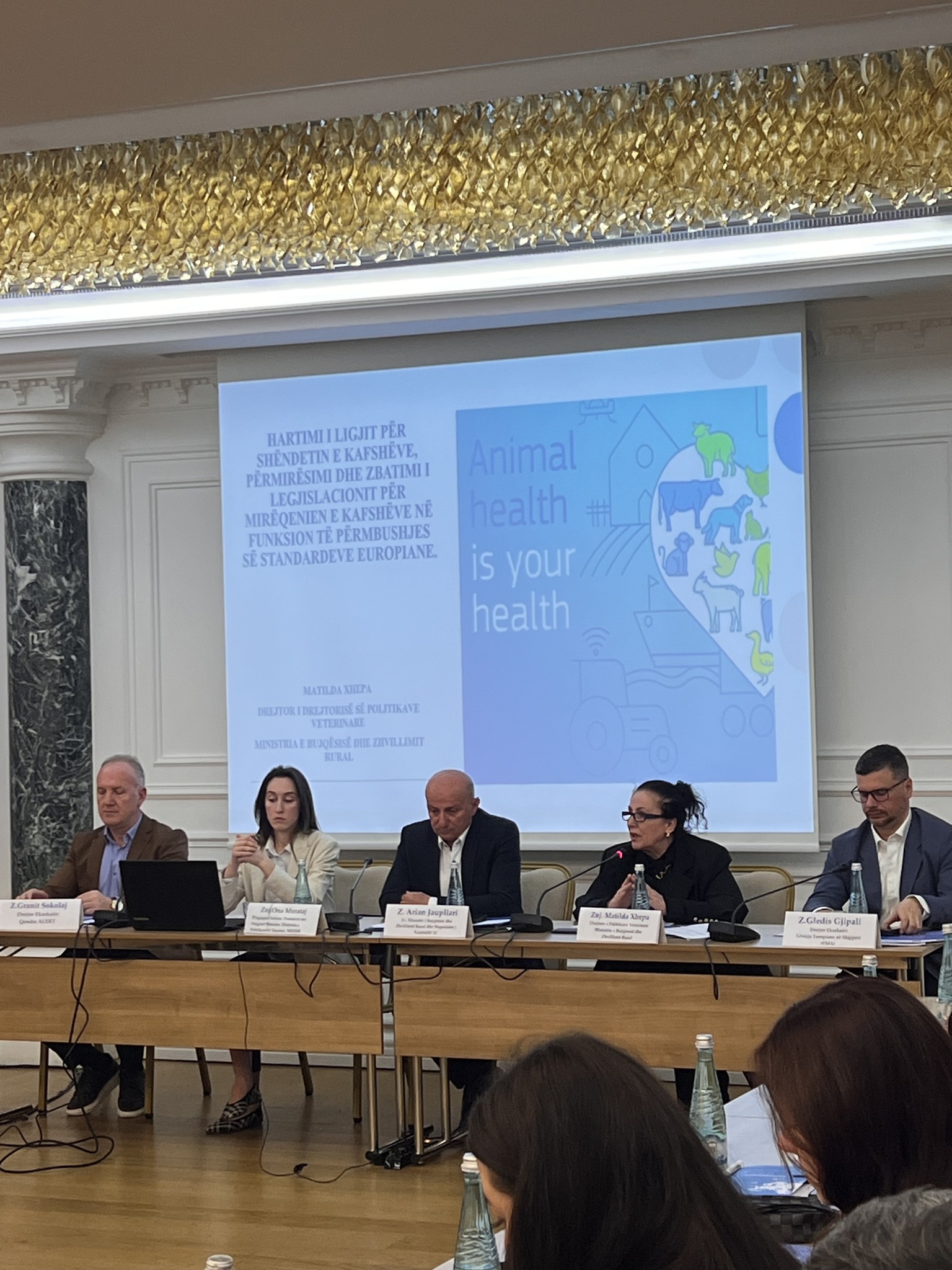 The roundtable for Chapter 12 – Food Safety, Veterinary and Phytosanitary Polices focused primarily on the discussion of the draft law on official controls, the categorisation of entities in meeting EU standards, and the law on animal health and welfare. This roundtable was organised within the framework of the Partnership Platform for European Integration (PPIE) and the National Convention for European Integration by the European Movement in Albania (EMA), in cooperation with the Ministry of Agriculture and Rural Development as the responsible institution for this chapter, and the ALERT Center as a project partner of the “Green Line for Consumer Protection – Food Safety and Strengthening Consumer Rights Protection in Albania through the Empowerment of Local CSOs,” funded by the European Union. The participants in the roundtable included representatives from various sectors, civil society, academia, public administration, business chambers, local government, etc.
Mr. Gledis Gjipali, Executive Director of the European Movement in Albania (EMA), in his opening remarks, emphasized that the approximation of legislation in this field is essential and that this process is intensive, requiring cooperation from all involved parties, including civil society. The latter plays an important role in informing citizens about the fulfilment of obligations arising from the negotiation process, but above all in raising their awareness as consumers. On the other hand, continuous information and the direct involvement of business operators in the negotiation process should be intensified, as they are affected in their activity operation, conduct of their activities; similar cases have occurred in other candidate countries that are now part of the Union, resulting in the bankruptcy of a large number of entities.
Mr. Arian Jaupllari, Deputy Minister of Agriculture and Rural Development and at the same time negotiator for Chapter 12, stressed that this chapter has particular importance, not only due to its high level of difficulty, but also in increasing citizens’ trust in Albanian product markets and domestic institutions. He explained that the work to meet EU standards has been based on three main pillars of the Chapter. The first pillar relates to food safety, covering the entire “farm to fork table” chain, while recently work has focused on the draft law on official controls, for which final comments from the European Commission are expected, with the approval deadline set for June 2026. In this area, improvements in traceability, and the strengthening of laboratory capacities and inspection processes need to be intensified. The second pillar focuses on animal health and welfare, where the relevant law was adopted in June 2025 and is aligned with Regulation (EU) 2016/429, providing an integrated risk management approach. The third pillar relates to plant protection, a field in which continuous audits have been carried out by the EU, and where further progress is required by 2027. He also highlighted that laboratory capacities have been increased through cooperation with the World Bank and the EU4FoodSafety project, from which €13.5 million in investments for phytosanitary measures are expected. Regarding the categorisation process of entities, he noted that, as of April 14 this year, out of 70 entities evaluated so far, 6 have been classified in the fourth category, which implies a risk of closure if they do not meet the required standards. The main sectors involved in this categorisation process include milk and its by-products, meat, fisheries, eggs, animal feed, and other products (such as mollusks and honey), etc. Most of the entities assessed so far fall under the third category, and concrete action plans are needed to raise their standards and move them to higher categories. In conclusion, the Minister stated that Albania is taking concrete steps toward food safety, which are first and foremost an obligation to its citizens, and then to the EU accession process, regardless of the level of difficulty; however, cooperation with various stakeholders provides assurance.
Mr. Granit Sokolaj, Executive Director of the ALERT Center, emphasized that the approximation process is irreversible and that the focus is not only on the final product, but on the entire production and distribution chain. He pointed out the large volume of work required for the transposition of directives and the importance of accrediting new laboratories, including those of the Institute of Food Safety and Veterinary (ISUV). Mr. Sokolaj stated that this process is not only technical but also strategic and negotiation-related, and that on August 10, 2026, the final assessment report on the categorisation of entities is expected as the final deadline for its preparation.
Ms. Ona Murataj, Head of Sector for Products of Animal Origin, Directorate of Food Safety Policies, Ministry of Agriculture and Rural Development, presented the process of categorising entities according to EU standards, as it is directly linked to the advancement of our country in fulfilling the obligations of Chapter 12. Order No. 329 of the Minister of Agriculture and Rural Development, dated March 26, 2026, has standardised the evaluation methodology to ensure the uniform implementation of categorisation and institutional roles, launching this process with on-site assessments starting from April 14, 2026, and expected to conclude on July 31, 2026. The main institution responsible for field implementation of the categorisation assessment is the National Food Authority (AKU). Murataj further explained that the key instrument for this process is the drafting of the National Program for the Improvement of Establishments, which will be submitted to the European Commission and is a direct condition both for the acceptance of Albania’s request for a transitional period for establishments operating in the meat, milk, eggs, and fish sectors, and for the completion of the first negotiation benchmark. She clarified that, according to the evaluation methodology, establishments will be divided into four categories: Category 1 includes establishments fully compliant with EU standards; Category 2 includes those with minor non-compliances expected to be resolved in the short term; Category 3 includes those with significant non-compliances requiring improvement plans; and Category 4 includes those posing a high risk to consumer health and which should not operate on the market. Murataj specified that this entire process is not punitive for operators, but purely evaluative, and that they have been informed in advance about its implementation and the main assessment elements, which include checklists for each activity, evaluation under real operating conditions, and an information document for each establishment. She added that the final report on evaluation and categorization is expected to be completed by August 10, 2026, and will include the list of establishments by category, analysis of non-compliances, the basis for financial and legal interventions, and elements of flexibility.
Regarding the draft law “On official controls and other official activities carried out to ensure the enforcement of legislation on food and feed, rules on animal health and welfare, as well as plant health and plant protection products in the Republic of Albania,” Ms. Murataj further explained that it has been drafted in accordance with Regulation (EU) 2017/625 and provides for the division of competent authorities into three main categories: for official controls, for other official activities, and for uniform controls at border inspection posts. The draft law is currently under review by the European Commission, is expected to be adopted in June 2026, and to enter into application on August 1, 2027. Its approach is risk-based, stipulating that controls be carried out regularly, transparently, and with an appropriate frequency depending on the level of risk, initially taking into account self-controls within private quality schemes, then risks related to animals or goods, and finally the operator’s history, with the objectives of protecting consumer life and health, safeguarding animal health and welfare, protecting plant health, ensuring safe food on the market, preventing health risks, and ultimately strengthening trust in trade with the EU and beyond.
Ms. Murataj emphasized that the obligations of the authorities include ensuring the effectiveness, impartiality, and quality of official controls and other official activities, as well as carrying out these controls in accordance with documented procedures while maintaining written records for each control. On the other hand, operators are required to provide information on their name, legal form, and specific activities, to grant access to computers and premises as necessary, and to assist and cooperate with the staff of the competent authorities. Ensuring sufficient resources for all types of controls is accompanied by the introduction of a mandatory fee applied to sectors such as slaughterhouses, meat cutting establishments, dairy products, fishery products, and border inspection posts, including controls on animals, products of animal origin, germinal products and animal by-products (ABP), as well as plant products and plant protection products, operators’ requests, and the follow-up of non-compliances with protective measures, which is then formalized through a Council of Ministers decision. The cost includes elements such as staff salaries, facilities and equipment, consumables, services of delegated bodies, continuous training, travel, as well as sampling and testing. To ensure transparency, the methods and data used to determine the fees, the amounts charged for each category of operators, and consultations with stakeholders on the general calculation methods must be made public, Murataj stressed.
Ms. Matilda Xhepa, Director of Veterinary Policies at the Ministry of Agriculture and Rural Development, emphasized that the law on animal health was adopted on June 26, 2025 (No. 41/2025) and consists of 9 parts, 273 articles, and 4 annexes. It will enter into force in 2027 and is aligned with Regulation (EU) 2016/429, reflecting the most advanced European standards and establishing the foundations for a system harmonized with EU requirements. She further added that the country is in an acceleration phase and necessarily requires the approximation of 400 articles in line with EU standards. She highlighted the new elements of the law, including the responsibilities of animal keepers, operators, veterinarians, and competent authorities, as well as the strengthening of biosecurity and surveillance. The law is based on a risk-oriented approach, with a particular focus on preventing animal diseases by category, as well as on the importance of their notification and reporting to protect the entire chain, with the aim of enabling live animals to access the European market. Ms. Xhepa also stressed that veterinary services play a very important role in this process, and that through various training and audits, accurate information regarding animal safety and biosecurity has been ensured.
In conclusion, participants discussed the criteria for evaluating entities based on risk, especially in cases where they are classified in the third category, and the timeframes needed to develop work plans aimed at meeting standards and moving to higher categories. The importance of raising awareness and sensitizing business operators about these processes was also emphasized, as they are directly affected by them.
*This roundtable took place within the project “Green line for consumer protection – Food safety and strengthening the protection of consumer rights in Albania through the empowerment of local CSOs”, financed by the European Union (IPA III/2024), which is being implemented by the Alert Center in cooperation with the European Movement in Albania (EMA).
-
 Information and Discussion Roundtable “Combating corruption at the heart of the European Integration Journey: The Perspectives of Youth, Civil Society, and Academia”, 14 October 2026
The European Movement in Albania (EMA), in cooperation with “Aleksandër Moisiu” University of Durrës
Information and Discussion Roundtable “Combating corruption at the heart of the European Integration Journey: The Perspectives of Youth, Civil Society, and Academia”, 14 October 2026
The European Movement in Albania (EMA), in cooperation with “Aleksandër Moisiu” University of Durrës -
 Working Group on Chapter 23 – Digital Services in Albania within the framework of the accession negotiations – DSA Governance, Fundamental Rights, and Institutional Coordination, 30 June 2026
Gledis Gjipali, Executive Director of the European Movement in Albania (EMA), emphasised the importance
Working Group on Chapter 23 – Digital Services in Albania within the framework of the accession negotiations – DSA Governance, Fundamental Rights, and Institutional Coordination, 30 June 2026
Gledis Gjipali, Executive Director of the European Movement in Albania (EMA), emphasised the importance