


Info Session – Next steps towards the EU: Closing negotiation Chapters, meeting EU Standards, and delivering reforms, 13 June 2026, Durrës
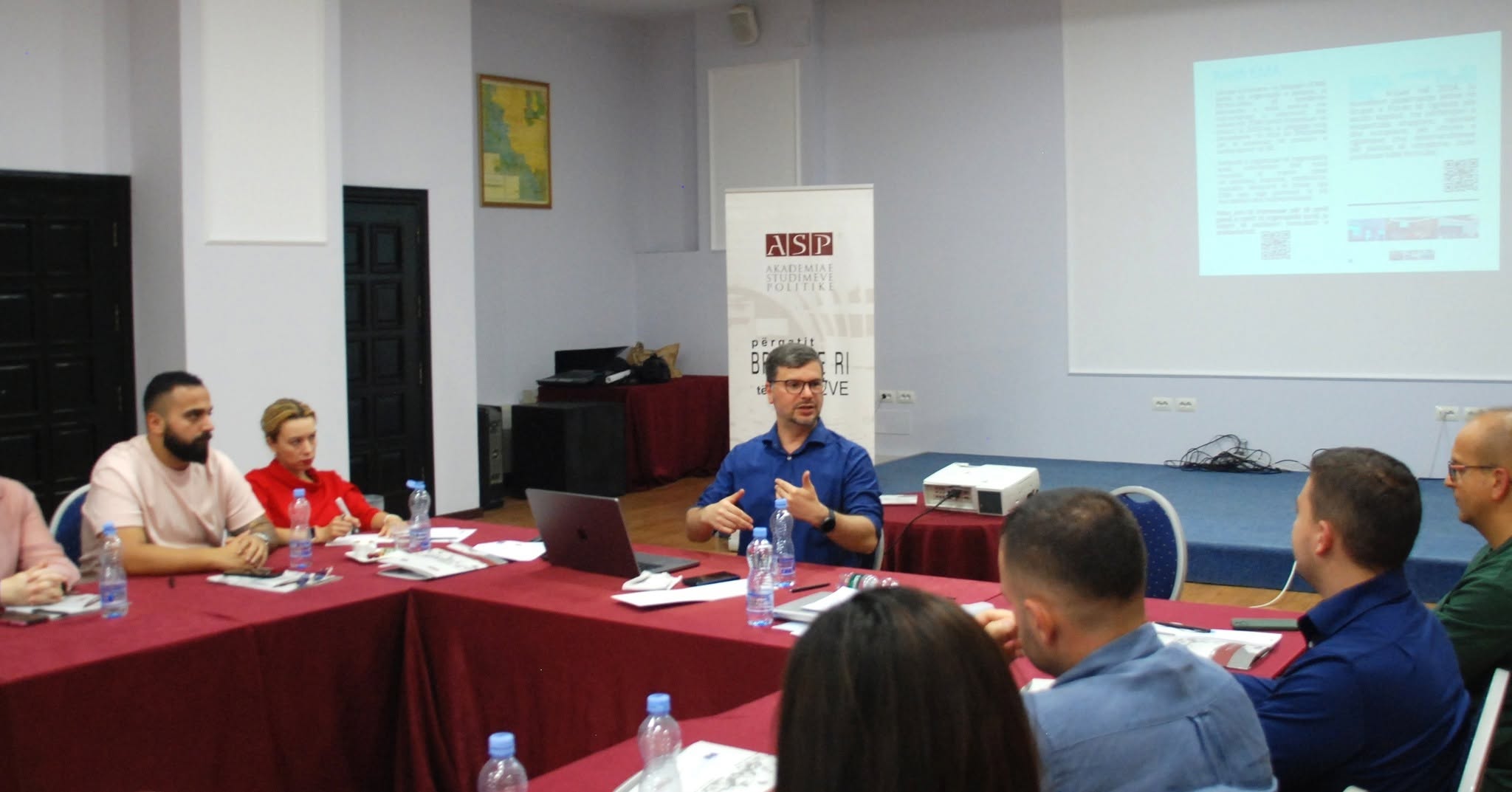 The European Movement in Albania (EMA), in cooperation with the Academy of Political Studies (ASP), organized an information session in Durrës with the aim of informing participants about the current stage of Albania’s EU accession negotiations, the latest developments under Cluster 1 – Fundamentals, as well as the institutional mechanisms and new EU instruments that support the accession process and the implementation of reforms.
During the first session, Erjon Tase, Executive Director of the Academy of Political Studies (ASP), presented an overview of the current state of Albania’s European integration process, focusing on the importance of Cluster 1 – Fundamentals, which is the first cluster to be opened and the last to be closed in the accession negotiations. He explained that meeting the closing benchmarks for this cluster is crucial to the overall pace of the negotiation process, as progress in the areas of the rule of law, the functioning of democratic institutions, public administration reform, and the protection of fundamental rights is continuously assessed by the European Commission. He also outlined the next steps in the negotiation process, explaining the procedures following the opening of negotiation clusters, the preparation of negotiating positions, compliance with the requirements of the EU acquis, and the process leading to the provisional closure of negotiation chapters. It was emphasized that the closure of negotiation chapters depends on the alignment of national legislation with EU law, also on the effective implementation of reforms and the demonstration of tangible results in practice.
During the second session, Gledis Gjipali, Executive Director of the European Movement in Albania (EMA), presented the EU–Albania joint institutions established under the Stabilisation and Association Agreement (SAA) and their role in monitoring the accession process. He explained the functions of the Stabilisation and Association Council, the Stabilisation and Association Committee, the seven sectoral subcommittees, and the EU–Albania Stabilisation and Association Parliamentary Committee, which serve as mechanisms for political and technical dialogue between Albania and the European Union in assessing the country’s reform progress. Particular attention was also given to the EU–Albania Joint Consultative Committee (JCC), which ensures the participation of civil society organisations in the accession process, as well as to the Enlargement Candidate Members (ECMs) initiative, which enables representatives from candidate countries to contribute to the work of the European Economic and Social Committee (EESC).
The presentation further focused on the Growth Plan for the Western Balkans, explaining its main objectives: the gradual integration of the region into the EU Single Market, the strengthening of the Regional Common Market, the acceleration of fundamental reforms, and increased financial support from the European Union. In this context, the Reform and Growth Facility, with a budget of €6 billion for the region, was presented, along with the mechanism through which financial support is directly linked to the implementation of agreed reforms. A significant part of the presentation was dedicated to Albania’s National Reform Agenda 2024–2027, which identifies 143 reform measures across five priority areas: private sector development and the business environment, human capital development, digital transformation, the green transition, and strengthening the rule of law. Participants were also informed about the disbursement of Growth Plan funds to Albania, highlighting that the country has already received its initial financial disbursements as a result of fulfilling the conditions set out in the National Reform Agenda, while future financial support will continue to depend on further progress in implementing these reforms.
The event concluded with an interactive discussion, during which participants exchanged views on the challenges related to meeting the closing benchmarks of Cluster 1 – Fundamentals, institutional coordination throughout the negotiation process, the role of civil society in monitoring reforms, and the opportunities created by the Growth Plan for the Western Balkans to accelerate Albania’s European integration. The discussion highlighted that the pace of Albania’s accession negotiations in the coming years will largely depend on the consistent implementation of reforms and the successful fulfilment of the benchmarks required for the provisional closure of the negotiation chapters.
*This info session took place within the framework of the “Building Partnership on Fundamentals: Empowered CSOs in the EU accession process” project, with the financial support of the European Union – IPA Civil Society Facility 2021, which is implemented by the European Movement in Albania and in cooperation with the Academy of European Integration and Negotiations (AIEN), Slovak Foreign Policy Association (SFPA) and the Center for Transparency and Freedom of Information (CTFI).
-
 Working Group on Chapter 23 – Digital Services in Albania within the framework of the accession negotiations – DSA Governance, Fundamental Rights, and Institutional Coordination, 30 June 2026
Gledis Gjipali, Executive Director of the European Movement in Albania (EMA), emphasised the importance
Working Group on Chapter 23 – Digital Services in Albania within the framework of the accession negotiations – DSA Governance, Fundamental Rights, and Institutional Coordination, 30 June 2026
Gledis Gjipali, Executive Director of the European Movement in Albania (EMA), emphasised the importance -
 Info Session – Access to Justice, Judicial Digitalisation, and Security Policies within Chapters 23 and 24, June 29, 2026
The European Movement in Albania (EMA) organised an info session as part of its
Info Session – Access to Justice, Judicial Digitalisation, and Security Policies within Chapters 23 and 24, June 29, 2026
The European Movement in Albania (EMA) organised an info session as part of its