


Working Group for Chapter 23 – Improving the Business Climate: Legal Certainty, Property Rights, and the Perspective of the Business Community in the Framework of Chapter 23, June 15, 2026
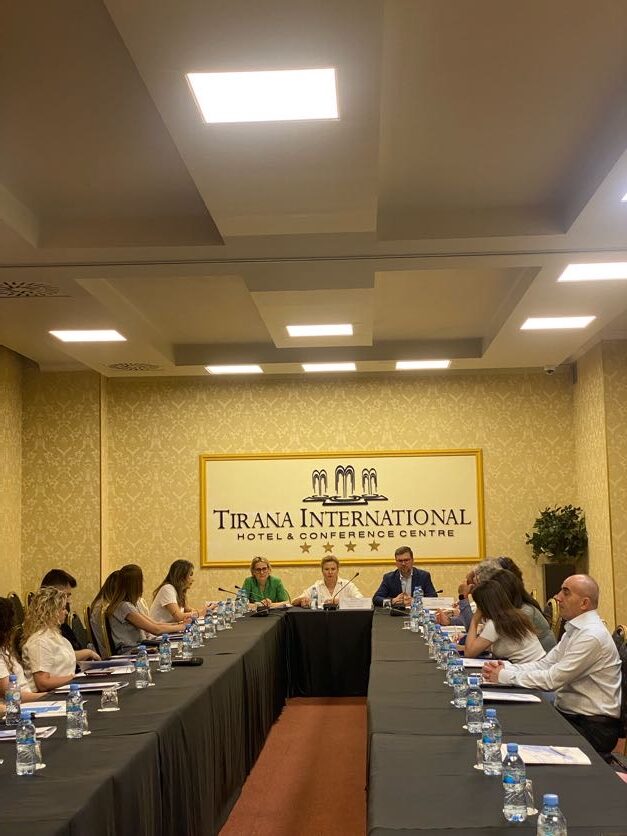 Following the endorsement of the IBAR for Chapters 23 and 24, work continues steadily and intensively towards fulfilling the Closing Benchmarks under Chapter 23 – Judiciary and Fundamental Rights, while maintaining a strong focus on those issues that remain most challenging and require broader stakeholder engagement. In this context, the latest meeting between the European Movement Albania and the Ministry of Justice, organised within the framework of the National Convention on European Integration and the Partnership Platform for European Integration for Chapter 23, brought together representatives of the Ministry of Justice, the business community, civil society organisations, and other relevant stakeholders. The discussion focused in particular on property rights, judicial effectiveness, the fight against corruption, and their impact on Albania’s business climate.
In his opening remarks, Gledis Gjipali, Executive Director of the European Movement Albania (EMA), underlined the importance of ensuring the involvement of various stakeholder groups in the EU integration process, not only civil society organisations but also actors such as the business community. He stressed that these meetings serve, first and foremost, to inform and raise awareness about opportunities for participation and contribution, as well as about the effects and costs associated with the accession process. Participation and dialogue, he noted, make it possible to identify needs in advance and facilitate the fulfilment of requirements affecting this sector. According to Gjipali, discussions have increasingly reached a more technical level, with meetings organised under the Partnership Platform and the National Convention aiming to foster high-quality debate and generate concrete recommendations through the direct contribution of non-state actors. He also emphasised that this dialogue process does not remain confined to these discussions, as the outcomes and recommendations are published and shared with public institutions, Parliament, the EU Delegation, and the European Commission.
Elona Bano, Director General of Policies and Projects in the Field of Justice, Integration and Negotiations at the Ministry of Justice, provided an overview of the key developments under Chapter 23, emphasising that the approval of the IBAR should be understood as the achievement of the minimum standards required, while the most challenging phase now begins: delivering concrete and sustainable results. Bano presented several achievements under Chapter 23, including the strengthening of judicial independence and impartiality through the successful completion of the vetting process, highlighting that Albania’s justice reform is increasingly serving as a model for other candidate countries such as Ukraine and Moldova. At the same time, she identified a number of remaining challenges, which should be viewed as priorities requiring greater attention and capacity rather than as obstacles. These include the judicial case backlog, the need to strengthen institutional capacities, increase financial resources, and address issues related to property rights. Regarding the business environment, Bano stressed the direct link between the rule of law, judicial efficiency, and economic development. She highlighted the need for greater efforts to reduce the time required for court proceedings, particularly at the appeal level, where it has been estimated that a case may take up to seven years before being reviewed. She also underlined the need for further alignment with European practices. Referring to findings from a World Bank survey, Bano noted that only two out of five cases provide satisfactory solutions for citizens, while approximately 60% of citizens would consider making informal payments, illustrating that public trust in the impartiality of the justice system remains limited. Concerning fundamental rights, Bano informed participants about ongoing work on the Criminal Code, noting that 37 additional EU directives still need to be transposed, while only seven have been aligned so far. She also highlighted developments and challenges related to freedom of expression and media, personal data protection, the rights of communities and national minorities, and gender equality.
Property rights were analysed in detail by Najada Shundi, Director, Directorate of Integration and Negotiations, Ministry of Justice, who emphasised that ensuring their protection requires continuous institutional efforts, the development of digital infrastructure, and improved management and coordination, particularly regarding property restitution and compensation. Shundi presented data on the process of first registration and digitalisation of property records, noting that 45 cadastral zones were covered during the period 2024–2025, while an additional 82 zones are expected to be completed by 2027. According to her, the main objectives relate both to the completion of registration and digitalisation processes and to increasing the level of compensation and reimbursement, which requires more effective management of the process. Shundi stressed that property rights and their effective implementation have been a priority throughout Albania’s EU integration process, beginning with the Rule of Law Roadmap as an opening benchmark for Chapter 23, continuing through the interim benchmarks and now forming part of the closing benchmarks. At the same time, this issue is also included in the Growth Plan and the National Reform Agenda.
The discussion with representatives of the business community, civil society organisations, and legal professionals focused on the need for greater stakeholder involvement and information-sharing in consultation processes from the earliest stages of legislative drafting, the strengthening of institutional coordination, and the identification of common solutions to challenges that continue to have a negative impact on these sectors and on various stakeholder groups.
*This roundtable took place within the framework of the “Building Partnership on Fundamentals: Empowered CSOs in the EU accession process” project, with the financial support of the European Union – IPA Civil Society Facility 2021, which is implemented by the European Movement in Albania and in cooperation with the Academy of European Integration and Negotiations (AIEN), Slovak Foreign Policy Association (SFPA) and the Center for Transparency and Freedom of Information (CTFI).
-
 Working Group on Chapter 23 – Digital Services in Albania within the framework of the accession negotiations – DSA Governance, Fundamental Rights, and Institutional Coordination, 30 June 2026
Gledis Gjipali, Executive Director of the European Movement in Albania (EMA), emphasised the importance
Working Group on Chapter 23 – Digital Services in Albania within the framework of the accession negotiations – DSA Governance, Fundamental Rights, and Institutional Coordination, 30 June 2026
Gledis Gjipali, Executive Director of the European Movement in Albania (EMA), emphasised the importance -
 Info Session – Access to Justice, Judicial Digitalisation, and Security Policies within Chapters 23 and 24, June 29, 2026
The European Movement in Albania (EMA) organised an info session as part of its
Info Session – Access to Justice, Judicial Digitalisation, and Security Policies within Chapters 23 and 24, June 29, 2026
The European Movement in Albania (EMA) organised an info session as part of its