


Info Session – Assessment of Fundamental Legislative Updates in the Context of European Integration: Perspectives of Researchers and Civil Society, 4 June 2026
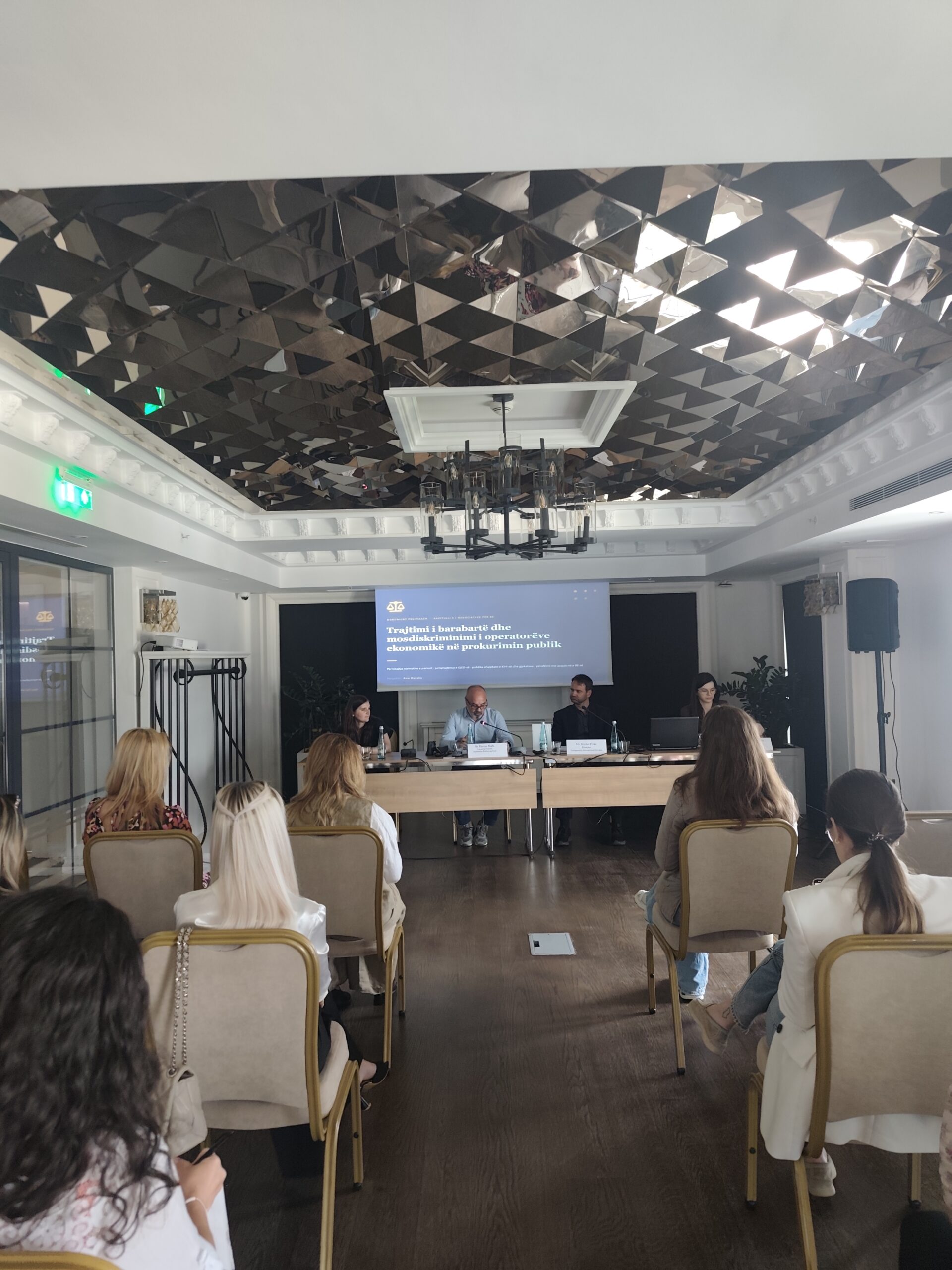 The European Movement in Albania (EMA) organized its latest information session, dedicated to presenting policy research developed in support of reforms related to the fundamental chapters of Albania’s EU accession negotiations. This session focused primarily on Chapter 5 – Public Procurement, one of the negotiation chapters currently at a decisive stage, where efforts are underway to meet the closing benchmarks through legislative amendments and the strengthening of the institutional framework.
Opening the event, Ms. Nirvana Deliu, Project Director at the European Movement in Albania (EMA), emphasized that Albania’s European integration process has entered a more intensive phase, particularly following the European Commission’s approval of the IBAR report confirming the fulfilment of the interim benchmarks for Chapters 23 and 24, as well as the adoption of the common negotiating position during the Eighth EU–Albania Intergovernmental Conference on 22 May 2026. During this conference, 14 closing benchmarks were established for each of Chapters 23 and 24, marking a significant milestone in the negotiation process. In this context, Ms. Deliu underlined the importance of information sessions such as this in raising awareness and strengthening the engagement of civil society, public institutions, and other stakeholders in the European integration process. She also stressed that discussions grounded in comprehensive policy research and accompanied by concrete recommendations contribute to improving the quality of public dialogue while creating opportunities for various stakeholders to participate in strengthening the legal and institutional framework in priority reform areas.
Moderated by Mr. Florian Xhafa, Executive Director of the Institute for Policy and Law (IPL), the session continued with the presentation of a policy paper on the principle of equal treatment and non-discrimination of economic operators in public procurement, prepared and presented by Ms. Ana Duraku, lawyer and legal expert. The policy paper examines the legal content of these principles, their evolution within Albanian legislation, their relationship with the EU acquis, the case law of the Court of Justice of the European Union (CJEU), and the practice of Albania’s Public Procurement Commission and administrative courts. At the outset of the presentation, it was emphasized that equal treatment and non-discrimination constitute fundamental procedural principles of public procurement while also deriving from the constitutional principles of the rule of law and equality before the law. Compliance with these principles ensures the efficient and transparent use of public funds, promotes fair competition among economic operators, and represents one of the core requirements of Chapter 5 of Albania’s EU accession negotiations. The presentation then introduced the analytical methodology employed in the policy paper, which is based on a legal, analytical, and comparative approach. This methodology seeks to assess the degree of alignment between Albania’s legal framework and European standards while identifying potential gaps between legislative provisions and their practical implementation. The presentation also reviewed the evolution of Albania’s legal framework on public procurement, highlighting the transition from Law No. 7971 of 1995, based on the UNCITRAL Model Law and primarily focused on prohibiting discrimination based on nationality, to Law No. 9643 of 2006, which broadened protection against discriminatory criteria, and finally to Law No. 162/2020 “On Public Procurement”, which aligns Albanian legislation more comprehensively with the 2014 EU Public Procurement Directives. It was noted that this legislative development has established a more modern, transparent, and competition-oriented procurement system.
A significant part of the presentation focused on distinguishing between the principles of equal treatment and non-discrimination. Ms. Duraku explained that equal treatment requires all economic operators to be assessed according to the same criteria and standards, without arbitrary advantages or disadvantages, whereas non-discrimination aims to eliminate any barriers or requirements that directly or indirectly restrict access to the market. She emphasized that while every act of discrimination results in unequal treatment, not every instance of unequal treatment necessarily constitutes discrimination in the legal sense. Furthermore, she explained that the legality of qualification criteria should be assessed through the principles of proportionality and their functional connection to the subject matter of the contract. A qualification criterion is considered acceptable only if it is objectively necessary for the performance of the contract and proportionate to its nature, whereas criteria that create unnecessary barriers or unjustifiably restrict competition should be regarded as discriminatory. Ms. Duraku also presented several practical tests that contracting authorities can use to identify potential violations of these principles during procurement procedures. She emphasized the importance of applying the same qualification criteria to all economic operators, providing clarifications simultaneously and equally to all participants, avoiding double standards during bid evaluation, and ensuring that qualification requirements do not restrict market participation beyond what is strictly necessary for contract implementation.
Particular attention was devoted to the European dimension of these principles and the process of aligning Albanian legislation with the EU acquis. Ms. Duraku noted that, within the context of the European internal market, the principle of non-discrimination serves as the key mechanism guaranteeing equal access for economic operators from all Member States to public procurement markets. As an illustrative example, she discussed the Storebælt case (Commission v Denmark), in which the Court of Justice held that preferences for domestic materials and local labour violated the principle of non-discrimination and the fundamental freedoms underpinning the internal market. She further observed that although Law No. 162/2020 has significantly aligned Albania’s public procurement legislation with the 2014 EU Directives, additional approximation remains necessary in areas such as concessions, defence and security procurement, electronic invoicing, clean vehicles, and several other components of the EU acquis. The presentation also reviewed the case law of the Court of Justice of the European Union, which has further clarified the principles of equal treatment and non-discrimination. Among the most significant judgments discussed were Telaustria, emphasizing transparency as a prerequisite for non-discrimination; EVN/Wienstrom, requiring award criteria to be clearly defined and objectively verifiable; SAG ELV and Manova, which define the permissible scope of clarifications during bid evaluation; and CAS Succhi di Frutta, which prohibits altering procurement rules after the procedure has commenced. Other judgments concerning the separation between qualification and evaluation stages and the management of conflicts of interest were also examined.
The presentation concluded with an analysis of the practice of Albania’s Public Procurement Commission and administrative courts, highlighting the most common violations of these principles. Cases were presented in which allowing only one economic operator to supplement documentation was found to undermine competition and equal treatment, while other decisions annulled unclear, disproportionate, or unjustified qualification criteria that unnecessarily restricted competition. Finally, it was emphasized that the principal challenges facing Albania’s procurement system stem not from overt discrimination but rather from indirect restrictions on competition, including vague qualification criteria, excessive requirements, substantial amendments to tender documents, and selective clarifications provided during procurement procedures. The policy paper concludes with several key recommendations, including the standardization of tender documentation, the use of measurable and objective qualification criteria, the consistent application of the proportionality test, enhanced transparency in decision-making, stronger mechanisms for preventing conflicts of interest, and the continued development of harmonized administrative practice and professional training programmes, all with the objective of ensuring a fair, transparent, and EU-compliant public procurement system.
*This info session took place within the framework of the “Building Partnership on Fundamentals: Empowered CSOs in the EU accession process” project, with the financial support of the European Union – IPA Civil Society Facility 2021, which is implemented by the European Movement in Albania and in cooperation with the Academy of European Integration and Negotiations (AIEN), Slovak Foreign Policy Association (SFPA) and the Center for Transparency and Freedom of Information (CTFI).
-
 Working Group on Chapter 23 – Digital Services in Albania within the framework of the accession negotiations – DSA Governance, Fundamental Rights, and Institutional Coordination, 30 June 2026
Gledis Gjipali, Executive Director of the European Movement in Albania (EMA), emphasised the importance
Working Group on Chapter 23 – Digital Services in Albania within the framework of the accession negotiations – DSA Governance, Fundamental Rights, and Institutional Coordination, 30 June 2026
Gledis Gjipali, Executive Director of the European Movement in Albania (EMA), emphasised the importance -
 Info Session – Access to Justice, Judicial Digitalisation, and Security Policies within Chapters 23 and 24, June 29, 2026
The European Movement in Albania (EMA) organised an info session as part of its
Info Session – Access to Justice, Judicial Digitalisation, and Security Policies within Chapters 23 and 24, June 29, 2026
The European Movement in Albania (EMA) organised an info session as part of its