


SANECA – Discussion Roundtable: The strategies for development of business and industrial policies- the latest updates concerning innovation, entrepreneurship and financial support, 21 June 2022
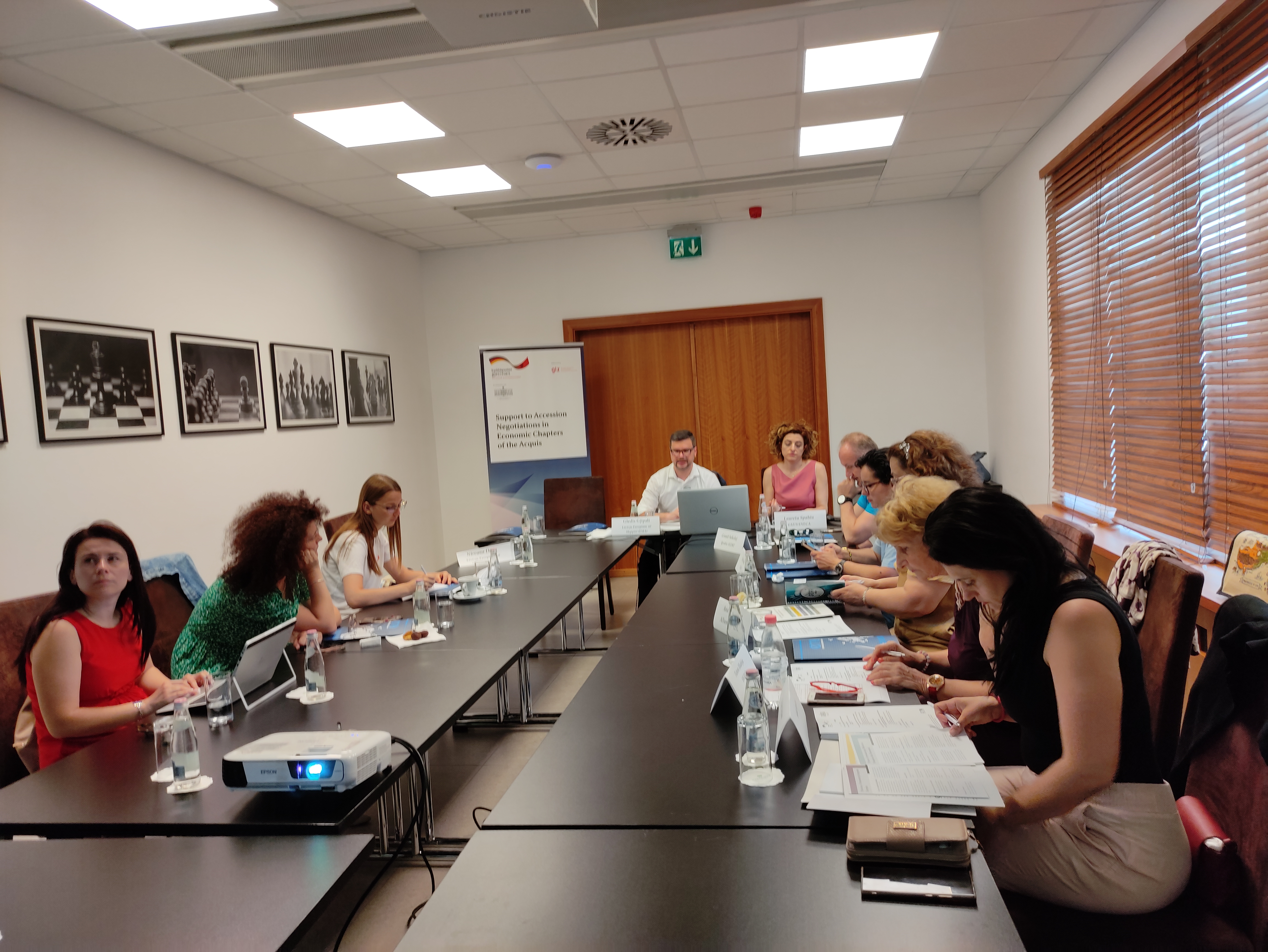 On 21 June 2022 was held the discussion table The strategies for development of business and industrial policies- the latest updates concerning innovation, entrepreneurship and financial support. This activity was held in the framework of the SANECA project – Component for involvement of civil society, organised by GIZ and European Movement Albania (EMA). In the meeting participated members of tables of Partnership Platform on European Integration for chapters 1, 3, 20 and 28, as well as representatives from responsible state authorities, chambers of commerce and industry, producers and business operators, as well as experts from civil society and universities. The activity was held in a hybrid format, with physical participation at Rogner Hotel and online on the ZOOM platform.
The meeting was opened by Gledis Gjipali, Executive Director of European Movement Albania, who said that in this project 4 chapters of negociations are treated and a number of recommendations were discussed and extracted during the discussions. The first part of this meeting was devoted to Chapter 20 and further the recommendations that are extracted from those tables were to be discussed, to clarify also what steps to be followed in future activities and meetings.
Igor Brkanovic, expert for Chapter 20, during his presentation covered several topics related with this chapter such as: business, innovation, financial support, soft skills and green agenda and education etc. Brkanovic in the first part of his presentation talked about the SMEs and introduced the participants to the business environment in Serbia and Montenegro while underlined as a positive step the establishment of an Innovation Fund in both countries. Serbia established the Innovation Fund in 2012, while Montenegro approved this fund in 2021. Furthermore, he stopped to talk about the promotion of innovation policies based on European standards. He introduced to the participants the main priorities of the European Union supporting Funds in framework of the budget for the period 2021-2027. Thus, he highlighted that the EU has raffinated programmes that support the implementation of various policies. The budget of a total 9.5 billion Euros of IPA III and other programmees like Horizon Europe program, will be implemented in three directions: science; global challenges and European industrial competition and innovation. Further, Branovic presented the programs like: Creative Europe, Digital Europe and Erasmus+, and also talked about ‘Green transition’, posing questions such as: how much is included the ‘Green transition’ in the development of strategies in Albania, are the strategies in education addressing this transition etc. The participants had interest in knowing more about the experience of other countries, in terms of the inclusion of women in business, how they have been part of these tables in the countries of the region etc.
Gledis Gjipali, said that this presentation was very interesting because we saw many innovations in education, business, economy etc., based in the ‘Green deal’, which is very important for us because we are still in the negotiations process, due the flexibility of this document is to taken into account during the approximation of our legislation with EU legislation. The meeting was followed by the presentation of the recommendations made during the roundtables held during the period June 2021- July 2022 in the framework of SANECA project, in order to have a work plan for other activities in the future.
Laureta Spahiu, adviser of project SANECA/GIZ, brought into attention that such roundtables were held in the framework of the third component that focuses on the involvement of civil society in the European Integration process. According to Spahiu, alongside these meetings learning about the experiences of other countries of the region has been of much interest. Over 100 recommendations were issued, which were classified in 3 categories: on the process of consultation, on the process of Albania’s integration in the European Union and the recommendations for the members of the mentioned roundtables. Also, Spahiu highlighted that those recommendations were issued along all the tables. In the first category, she listed among the main recommendations: increasing the transparency of public institutions, increasing information and cooperation between actors, etc. Spahiu highlighted that the monitoring and the valuation of the received recommendations, will be useful to the interest groups, as well as the ministries. The development of informative meetings is important, not only inside Tirana, but outside it. Further, she stopped at recommending the creation of an online platform, by bringing as an example the Ministry of Finance and Economy, which has already set up such a page. In the recommendations of the second category, Spahiu said that it is necessary to have communication bridges in order for the negotiation process to be as effective as possible. An other recommendation concerns the structures and institutions that are involved in the process of integration; flexible decision making.
Gjipali highlighted that it is very important that the members of those tables to be involved, so that these tables are transformed into working tables with concrete results, in the function of the negotiation process. The umbrella organisations have responsibilities not only to engage in these tables, but also to convey the information. Another important point is the predictability of the acts that will be harmonised. A very important planning document is the National Plan for European Integration.
Furthermore, the meeting continued in a discussion form with the participants. Agim Rrapaj, said that this activity has been with much value, the recommendations are important to treat the problems and now is to see how those recommendations will be implemented. For the participants, it has been with much importance the participation of the foreign experts in the meetings, in order to have the opportunity to learn from those experience.
-
 Working Group on Chapter 23 – Digital Services in Albania within the framework of the accession negotiations – DSA Governance, Fundamental Rights, and Institutional Coordination, 30 June 2026
Gledis Gjipali, Executive Director of the European Movement in Albania (EMA), emphasised the importance
Working Group on Chapter 23 – Digital Services in Albania within the framework of the accession negotiations – DSA Governance, Fundamental Rights, and Institutional Coordination, 30 June 2026
Gledis Gjipali, Executive Director of the European Movement in Albania (EMA), emphasised the importance -
 Info Session – Access to Justice, Judicial Digitalisation, and Security Policies within Chapters 23 and 24, June 29, 2026
The European Movement in Albania (EMA) organised an info session as part of its
Info Session – Access to Justice, Judicial Digitalisation, and Security Policies within Chapters 23 and 24, June 29, 2026
The European Movement in Albania (EMA) organised an info session as part of its